


The largest tablets available in 2026
Last updated on October 10, 2026.
The following article lists all large tablets (≥ 12.7 inches) with optional / detachable keyboards. However, it does not contain devices whose keyboard is permanently attached to the screen, even with a 360-degree hinge (convertibles).
Use the filters below to show older models and tablets that are only sold in China.
I am registered with the Amazon Associates Program. This website contains Amazon affiliate links (marked with a star). If you click on one of these links and make a purchase, I may receive a commission from Amazon.
Clicking on an affiliate link does not change the price you pay. As an Amazon Associate I earn from qualifying purchases.
 I am a classical musician (violist) with 20 years of professional experience in orchestra and chamber music. For many years, I have been advising colleagues, students, and fellow musicians in the choice of their tablet.
Along with the many positives of using tablets, I’ve also seen the negatives: tablets crashing just before going on stage, batteries that don’t hold up during long rehearsal days, and missing page turner pedals in concert.
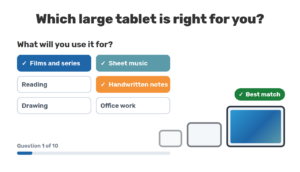
Not sure which tablet to choose? Answer 10 short questions in our Tablet Chooser: it compares your needs with every tablet of this list and explains its suggestions.
Generation
Available in
System
1. List of the largest tablets
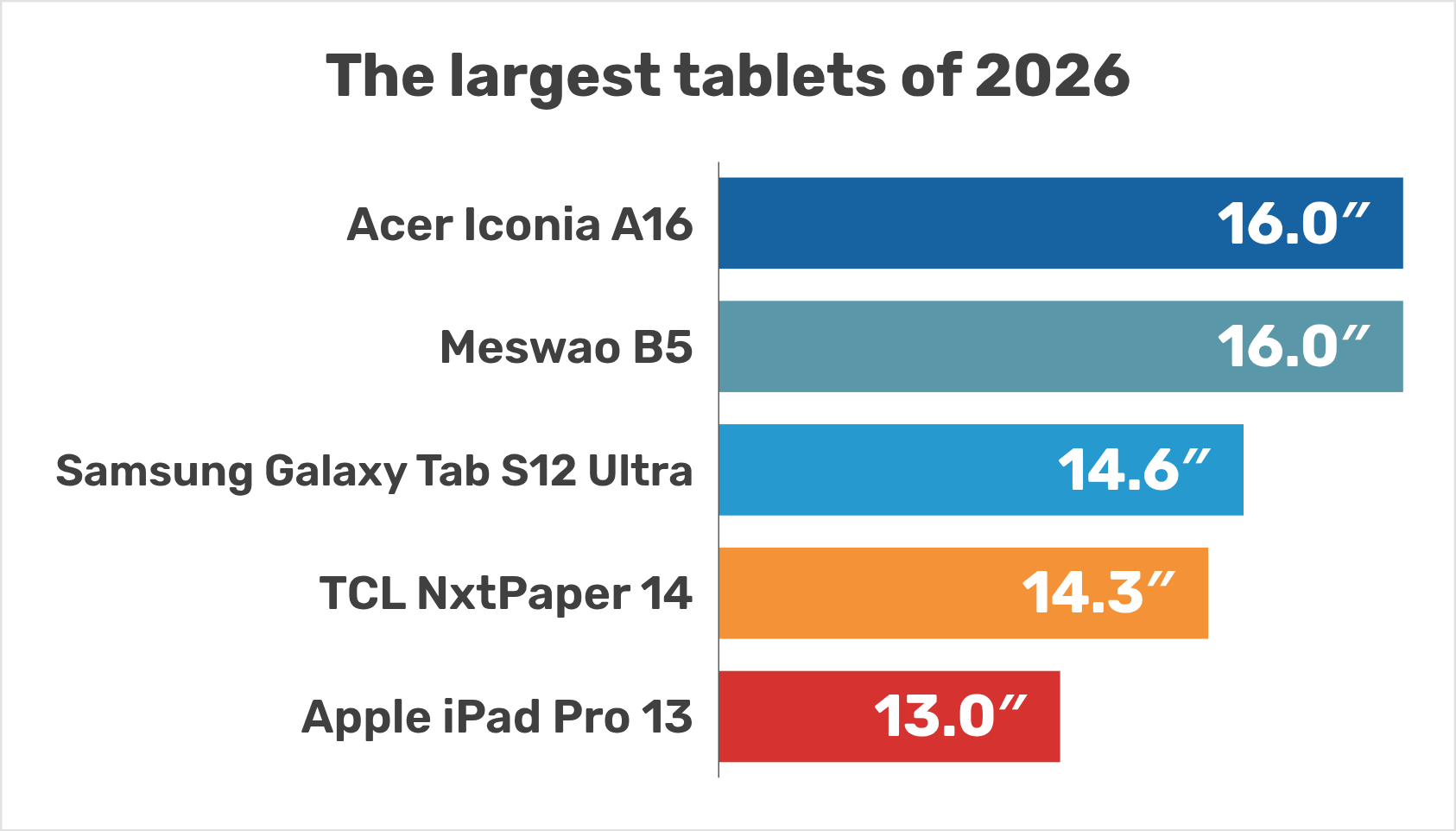
The tablets in the diagram below are sorted by screen size, which typically refers to the diagonal measurement of the screen, excluding rounded corners.
Screen area: a better measure than the diagonal
Display area, sometimes inaccurately referred to as “surface area”, is another metric that I personally find more useful than (diagonal) display size: it is simply a better indicator of how much content you can fit on the screen.
For example, the 13-inch iPad Pro only has a 13-inch diagonal, but its 4:3 aspect ratio results in a relatively large screen area.
The diagrams follow the filters above.



2. Table of the largest tablets
The tablets in the following table are sorted by display size (diagonal, in inches). The screen area is calculated from the diagonal and the aspect ratio.
| Rank | Tablet | Screen size | Screen area | System | Aspect ratio | Sponsored links |
|---|---|---|---|---|---|---|
| 1. Largest tablet (tie) |
Acer Iconia A16 | 16.0″ | 115.1 in² 742 cm² |
Android | 16:10 | |
| 1. | Acer Iconia X16 | 16.0″ | 115.1 in² 742 cm² |
Android | 16:10 | |
| 1. Largest tablet (tie) |
Meswao B5 / B5 Basic | 16.0″ | 115.1 in² 742 cm² |
Android | 16:10 | |
| 4. | Huion Kamvas Studio 16 | 15.8″ | 106.7 in² 688 cm² |
Windows | 16:9 | |
| 5. | Iris Ohyama LUCA Tablet 15.6 | 15.6″ | 104.0 in² 671 cm² |
Android | 16:9 | |
| 5. | Meswao / Azamp MES-B3 (Pro) | 15.6″ | 104.0 in² 671 cm² |
Android | 16:9 | |
| 7. | Meswao B4 | 15.4″ | 101.3 in² 654 cm² |
Android | 16:9 | |
| 8. | Jumper Z1 (EZpad Max15) | 15.0″ | 103.8 in² 670 cm² |
Android | 3:2 | |
| 8. | Microsoft Surface Book 3 15-inch | 15.0″ | 103.8 in² 670 cm² |
Windows | 3:2 | |
| 10. | Samsung Galaxy Tab S11 Ultra | 14.6″ | 95.8 in² 618 cm² |
Android | 16:10 | |
| 10. | Samsung Galaxy Tab S8 / S9 / S10 Ultra | 14.6″ | 95.8 in² 618 cm² |
Android | 16:10 | |
| 10. Largest premium Android tablet |
Samsung Galaxy Tab S12 Ultra | 14.6″ | 95.8 in² 618 cm² |
Android | 16:10 | |
| 13. | Lenovo Tab Extreme | 14.5″ | 94.5 in² 610 cm² |
Android | 16:10 | |
| 13. | Lenovo Yoga Pad Pro 14.5 AI | 14.5″ | 94.5 in² 610 cm² |
Android | 16:10 | |
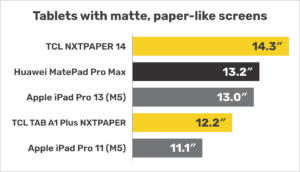
| 15. Largest matte (paper-like) display |
TCL NxtPaper 14 | 14.3″ | 94.4 in² 609 cm² |
Android | 3:2 | |
| 16. | Ugee Trio Pad UT3 | 14.2″ | 93.7 in² 605 cm² |
Android | 3:2 | |
| 17. | Acer Iconia Duo S14 | 14.2″ | 91.5 in² 590 cm² |
Android | 1.57:1 | |
| 17. Largest HarmonyOS tablet |
Huawei MatePad Edge | 14.2″ | 93.1 in² 600 cm² |
HarmonyOS | 3:2 | |
| 19. | Callsky Ctab 14 | 14.1″ | 89.4 in² 576 cm² |
Android | 16:10 | |
| 19. | Meswao B1 (MES-B1) | 14.1″ | 85.0 in² 548 cm² |
Android | 16:9 | |
| 21. | Acer Iconia X14 / A14 | 14.0″ | 88.1 in² 568 cm² |
Android | 16:10 | |
| 21. Largest Windows tablet |
Asus ProArt PZ14 | 14.0″ | 88.1 in² 568 cm² |
Windows | 16:10 | |
| 21. | Doogee Tab E3 Max | 14.0″ | 90.5 in² 584 cm² |
Android | 3:2 | |
| 21. | Doogee U14 | 14.0″ | 88.1 in² 568 cm² |
Android | 16:10 | |
| 21. | Lenovo ThinkBook Plus G5 Hybrid | 14.0″ | 88.1 in² 568 cm² |
Windows + Android | 16:10 | |
| 21. | Meswao MES-B2 | 14.0″ | 83.8 in² 540 cm² |
Android | 16:9 | |
| 21. | Minisforum V3 3-in-1 | 14.0″ | 88.1 in² 568 cm² |
Windows | 16:10 | |
| 21. | Ninkear T40 | 14.0″ | 88.1 in² 568 cm² |
Windows | 16:10 | |
| 21. | OneXPlayer Super X | 14.0″ | 88.1 in² 568 cm² |
Windows | 16:10 | |
| 21. | Teclast T70 | 14.0″ | 88.1 in² 568 cm² |
Android | 16:10 | |
| 21. | Teclast T70 Pro | 14.0″ | 88.1 in² 568 cm² |
Android | 16:10 | |
| 21. | Wacom MovinkPad Pro 14 | 14.0″ | 88.1 in² 568 cm² |
Android | 16:10 | |
| 21. | Xiaomi Pad 7 Ultra | 14.0″ | 90.5 in² 584 cm² |
Android | 3:2 | |
| 21. | Xiaomi Pad 6 Max 14 | 14.0″ | 88.1 in² 568 cm² |
Android | 16:10 | |
| 35. | Asus ROG Flow Z13 (2025) | 13.4″ | 80.7 in² 521 cm² |
Windows | 16:10 | |
| 35. | Asus ROG Flow Z13 (2023) | 13.4″ | 80.7 in² 521 cm² |
Windows | 16:10 | |
| 35. | Doogee Tab G6 Max | 13.4″ | 80.7 in² 521 cm² |
Android | 16:10 | |
| 35. | Teclast T65 / T65 Plus | 13.4″ | 80.7 in² 521 cm² |
Android | 16:10 | |
| 39. | Asus ProArt PZ13 | 13.3″ | 79.5 in² 513 cm² |
Windows | 16:10 | |
| 39. | Asus Vivobook 13 Slate OLED (T3300) | 13.3″ | 75.6 in² 488 cm² |
Windows | 16:9 | |
| 39. Largest E-Reader |
Boox Tab X C / Note Max | 13.3″ | 84.9 in² 548 cm² |
Android | 4:3 | |
| 39. | Fujitsu (FCCL) FMV LOOX | 13.3″ | 75.6 in² 488 cm² |
Windows | 16:9 | |
| 39. | Honor MagicPad3 / MagicPad3 Pro | 13.3″ | 81.6 in² 527 cm² |
Android | 3:2 | |
| 39. | Lenovo Duet 5 Chromebook | 13.3″ | 75.6 in² 488 cm² |
ChromeOS | 16:9 | |
| 39. | Xiaomi Pad 9 Pro Max | 13.3″ | 81.6 in² 527 cm² |
Android | 3:2 | |
| 46. | Huawei MatePad Pro 13.2 (2025) | 13.2″ | 80.4 in² 519 cm² |
Android | 3:2 | |
| 46. | Huawei MatePad Pro Max | 13.2″ | 80.4 in² 519 cm² |
Android | 3:2 | |
| 46. | OnePlus Pad 3 | 13.2″ | 82.4 in² 532 cm² |
Android | 7:5 | |
| 46. | OnePlus Pad 4 | 13.2″ | 82.4 in² 532 cm² |
Android | 7:5 | |
| 46. | Oppo Pad 4 Pro | 13.2″ | 82.4 in² 532 cm² |
Android | 7:5 | |
| 46. | Teclast ArtPad | 13.2″ | 82.4 in² 532 cm² |
Android | 7:5 | |
| 46. | vivo Pad6 Pro | 13.2″ | 79.8 in² 515 cm² |
Android | 1.53:1 | |
| 53. | Samsung Galaxy Tab S10 FE+ | 13.1″ | 77.1 in² 498 cm² |
Android | 16:10 | |
| 54. | Alldocube iPlay 70 Max Pro / Ultra Pad | 13.0″ | 76.0 in² 490 cm² |
Android | 16:10 | |
| 54. Largest iPad |
Apple iPad Pro 13″ | 13.0″ | 81.1 in² 523 cm² |
iPadOS | 4:3 | |
| 54. | Blackview Mega 8 | 13.0″ | 76.0 in² 490 cm² |
Android | 16:10 | |
| 54. | Dell Latitude 7350 Detachable | 13.0″ | 78.0 in² 503 cm² |
Windows | 3:2 | |
| 54. | Dell Latitude 7320 Detachable | 13.0″ | 78.0 in² 503 cm² |
Windows | 3:2 | |
| 54. | Dell XPS 13 2-in-1 (9315) | 13.0″ | 78.0 in² 503 cm² |
Windows | 3:2 | |
| 54. | Doogee Tab E3 Pro / U13 | 13.0″ | 76.0 in² 490 cm² |
Android | 16:10 | |
| 54. | HP Elite x2 G8 | 13.0″ | 78.0 in² 503 cm² |
Windows | 3:2 | |
| 54. | Honor Pad X9 Max | 13.0″ | 76.0 in² 490 cm² |
Android | 16:10 | |
| 54. | Honor MagicPad 13 | 13.0″ | 76.7 in² 495 cm² |
Android | 1.57:1 | |
| 54. | Juno Tab 4 | 13.0″ | 76.0 in² 490 cm² |
Linux | 16:10 | |
| 54. | Lenovo Yoga Tab Plus Gen 2 | 13.0″ | 78.0 in² 503 cm² |
Android | 3:2 | |
| 54. | Lenovo Legion Y900 13 | 13.0″ | 78.0 in² 503 cm² |
Android | 3:2 | |
| 54. | Lenovo Idea Tab Pro Gen 2 | 13.0″ | 76.0 in² 490 cm² |
Android | 16:10 | |
| 54. | Lenovo Xiaoxin Pad Pro GT 13 (2026) | 13.0″ | 76.0 in² 490 cm² |
Android | 16:10 | |
| 54. | Lenovo Yoga Tab 13 | 13.0″ | 76.0 in² 490 cm² |
Android | 16:10 | |
| 54. | Microsoft Surface Pro 13-inch | 13.0″ | 78.0 in² 503 cm² |
Windows | 3:2 | |
| 54. | Ninkear S13 Neo | 13.0″ | 78.0 in² 503 cm² |
Windows | 3:2 | |
| 54. | vivo Pad3 Pro | 13.0″ | 78.0 in² 503 cm² |
Android | 3:2 | |
| 54. | vivo Pad5 Pro | 13.0″ | 78.0 in² 503 cm² |
Android | 3:2 | |
| 74. | Chuwi Hi10 Max | 13.0″ | 77.5 in² 500 cm² |
Windows | 3:2 | |
| 75. | Teclast T65 Max | 12.9″ | 75.4 in² 486 cm² |
Android | 16:10 | |
| 76. | Apple iPad Air 13″ | 12.9″ | 79.9 in² 515 cm² |
iPadOS | 4:3 | |
| 76. | Apple iPad Pro 12.9″ (2015–2022) | 12.9″ | 79.9 in² 515 cm² |
iPadOS | 4:3 | |
| 78. | Huion Kamvas Slate 13 | 12.7″ | 77.4 in² 499 cm² |
Android | 4:3 | |
| 78. | Lenovo Idea Tab Pro / Tab P12 | 12.7″ | 72.5 in² 468 cm² |
Android | 16:10 | |
| 78. | Lenovo Yoga Tab Plus | 12.7″ | 72.5 in² 468 cm² |
Android | 16:10 | |
| 78. | Teclast ArtPad Pro | 12.7″ | 77.4 in² 499 cm² |
Android | 4:3 |
3. The largest tablets in detail
For each extra-large tablet, I listed not only the most well-known specs, but also some hard-to-find details such as the minimum brightness, or the weight with and without keyboard (when available).
Note: since 2026, two tablets with 16-inch screens are available: the Acer Iconia A16 and the Meswao B5. There are still no tablets with 17-inch displays.
The best 16-inch tablets
Acer Iconia A16
A 16-inch Android tablet with a built-in kickstand at an entry-level price
Acer Iconia A16 tech specs: OS: Android 15 / Processor: Allwinner A733 (12 nm) / RAM: 6 GB or 8 GB / Storage: 128 GB or 256 GB (UFS 3.1) / microSD slot: yes (up to 1 TB) / Pen: no official one / Keyboard: no official one / Battery: 8000 mAh / Connections: 1 × USB-C (USB 2.0) / Released: January 2026
Screen specs: IPS LCD, glossy, 60 Hz / Size: 16.0 inches / Resolution: 1920 × 1200 pixels, 142 ppi / Aspect ratio: 16:10 (1.60)
Weight: without keyboard: 34.6 ounces – 2.16 pounds – 980 g
One of the two 16-inch tablets, not reviewed yet
The Acer Iconia A16 is a 16-inch Android 15 tablet with a built-in kickstand, intended for videos, reading and web browsing on a large, cheap screen. With the Meswao B5, it is one of only two 16-inch tablets on sale in 2026. It went on sale in early 2026, but no independent review has been published yet (October 2026), so its brightness and battery life have not been measured.
Screen: very large, but not sharp
The 16:10 screen, a wide format made for videos, is about 42 % larger than that of the 13-inch iPad Pro. With 1920 × 1200 pixels (142 ppi), it is not sharp at this size. Acer gives no brightness figure for the IPS LCD panel (Acer).
Performance: an unusual entry-level chip
The Allwinner A733 is a low-cost chip more often used in TV products; 9to5Google called it a “bizarre” choice. Acer announced up to 8 GB of RAM and 256 GB of storage, but shops sell a 6 GB / 128 GB version. A microSD slot takes cards up to 1 TB (Notebookcheck). Acer has published no update policy and has not said whether Netflix plays in HD (Widevine L1).
No pen or keyboard support
There is no stylus support and no keyboard connector, but any Bluetooth keyboard works (Liliputing). Acer promises up to 10 hours from the 8,000 mAh battery. The A16 weighs 980 g; it has four speakers, a headphone jack and one USB-C port (USB 2.0) (GSMArena).
Availability and the 2026 successor
It is one of the cheapest large tablets and is sold in North America, Canada included, and in Europe. A new A16, announced for late 2026, adds an optional keyboard, a stylus and a USB-C video input, but uses an older MediaTek Helio G80 chip with 6 GB of RAM (Notebookcheck).
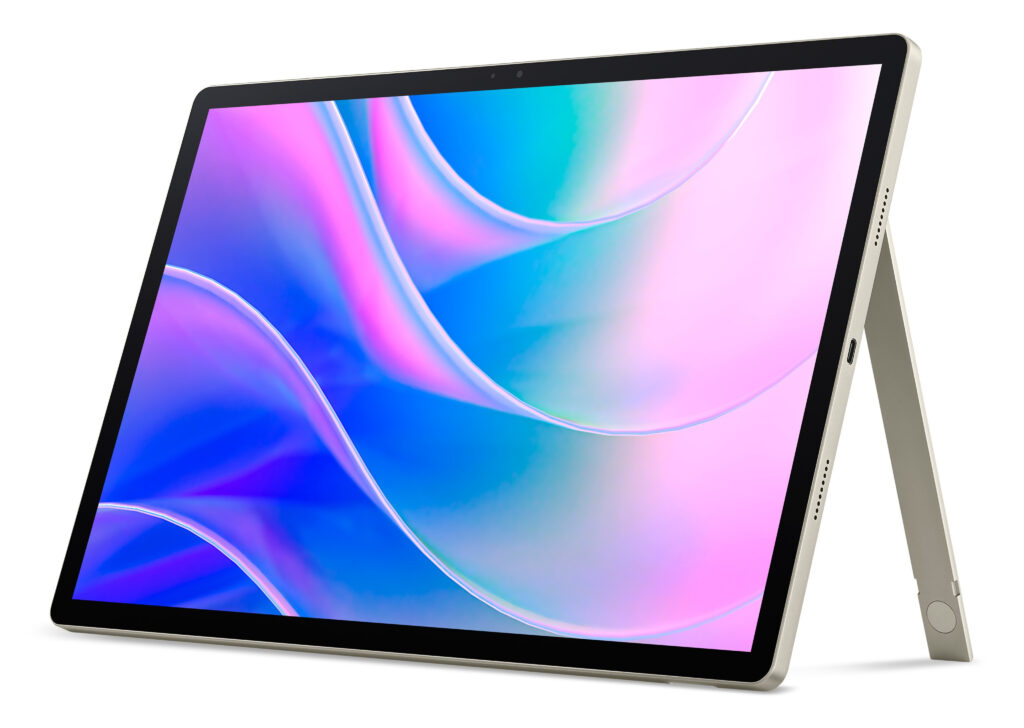
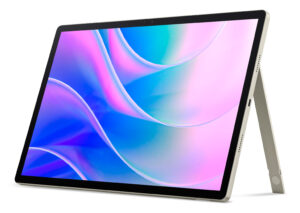
The Acer Iconia A16 and its built-in kickstand. Image: Acer
Performance
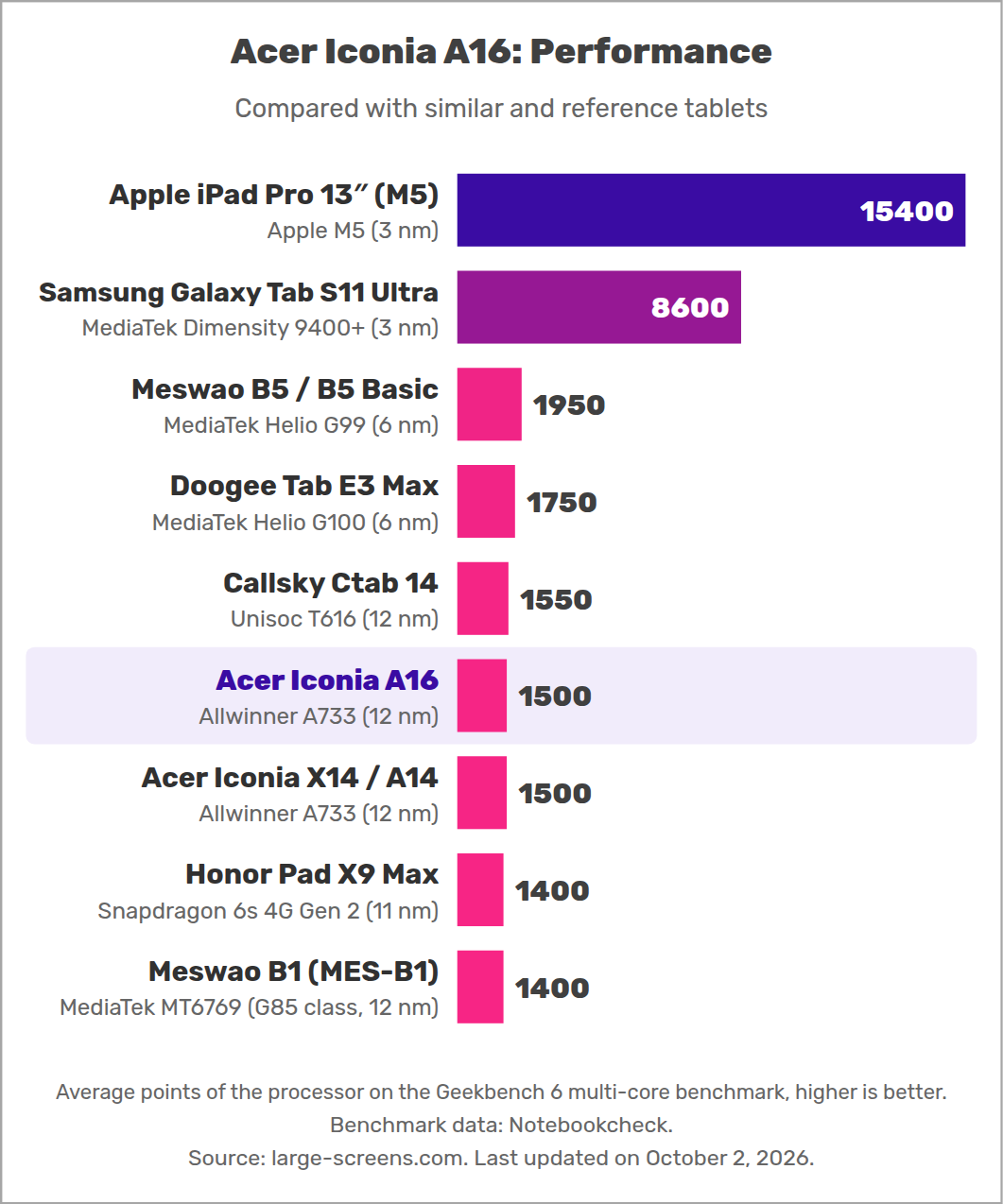
The Acer Iconia A16 is powered by the Allwinner A733 processor, released in 2024 and built on a 12 nm process. It is an entry-level chip: fine for videos, web browsing, reading and taking notes, but apps open slowly and games have to run at low settings. The same chip is used in the Acer Iconia X14 / A14. Compared with other large tablets:
- The Apple M5 in the Apple iPad Pro 13″ (M5) is about 10 times faster.
- The MediaTek Helio G99 in the Meswao B5 / B5 Basic is about 30 % faster.
- The MediaTek Helio G99 in the Meswao MES-B3 (Pro) is about 30 % faster.
Pros
- One of the two largest tablets (16 inches, 16:10)
- Low price for a 16-inch tablet
- Built-in kickstand
- microSD slot (up to 1 TB)
- Four speakers and a headphone jack
Cons
- Low sharpness for 16 inches (142 ppi)
- Entry-level Allwinner A733 chip (old 12 nm process)
- No stylus support and no keyboard connector
- Shops sell only 6 GB of RAM and 128 GB of storage
- No update policy published
Sponsored
Meswao B5 / B5 Basic
One of the two largest tablets: 16 inches, 16 GB of RAM and Widevine L1
Meswao B5 / B5 Basic tech specs: OS: Android 16 / Processor: MediaTek Helio G99 (6 nm, 2022) / RAM: 16 GB or 12 GB / Storage: 256 GB or 128 GB / microSD slot: yes (up to 2 TB [Meswao]) / Pen: Meswao Stylus Pen (active capacitive) (optional) / Keyboard: Meswao Foldable Bluetooth Keyboard with Touchpad (optional, with touchpad) / Battery: 12,000 mAh, 30 W charging / Connections: 1 × USB-C / HD streaming: yes (Widevine L1) / Released: 2026
Screen specs: IPS LCD, glossy / Size: 16.0 inches / Max brightness: 350 nits (Meswao) / Resolution: 1920 × 1200 pixels, 142 ppi / Aspect ratio: 16:10 (1.60)
Weight: without keyboard: 39.5 ounces – 2.47 pounds – 1,120 g
One of the two largest tablets: B5 or B5 Basic
The Meswao B5 is a 16-inch Android tablet for videos, reading and sheet music at home. Together with the Acer Iconia A16, it has the largest screen of any tablet on sale in 2026. The B5 has 16 GB of RAM, 256 GB of storage and a microSD slot; the cheaper B5 Basic (silver) has 12 GB and 128 GB. No independent review has been published yet (October 2026), so the figures below are Meswao’s.
Screen: 42 % larger than the iPad Pro, but not sharp
The screen is about 42 % larger than that of the 13-inch iPad Pro and about 11 % larger than that of Meswao’s 15.6-inch MES-B3. Its 16:10 format is a wide format made for videos. With 1920 × 1200 pixels (142 ppi), the IPS panel is not very sharp at this size. Meswao gives 350 nits, the same rating as the MES-B3, whose screen the MES-B3 review on this site found bright enough indoors but too dim in the sun. Meswao gives neither the refresh rate nor the finish.
Speed: Helio G99, fine for sheet music; Widevine L1
The MediaTek Helio G99 is an entry-level chip from 2022, the same as in the MES-B3: fine for videos, web browsing and sheet-music apps, but too slow for demanding games. The B5 runs Android 16 with Google Play, and Meswao says it is Widevine L1 certified, which allows HD on Netflix and Prime Video. Meswao publishes no update policy.
Pen and keyboard extra; heavy at 1,120 g
Meswao sells an active stylus (MPP 2.0, according to its blog) and a separate folding Bluetooth keyboard with touchpad, not a keyboard cover. The 12,000 mAh battery charges at 30 W (full in 3.5 hours); Meswao promises 10.5 hours of video. At 1,120 g, the B5 is heavy: 140 g more than the Acer Iconia A16. It has four speakers, one USB-C port, Wi-Fi 5 and Bluetooth 5.2, but no headphone jack (an adapter is included) and no 4G.
B5 and B5 Basic: sold in the US and Europe
Meswao sells the B5 and the slightly cheaper B5 Basic in the US and in Europe, at low prices for their size (Meswao).
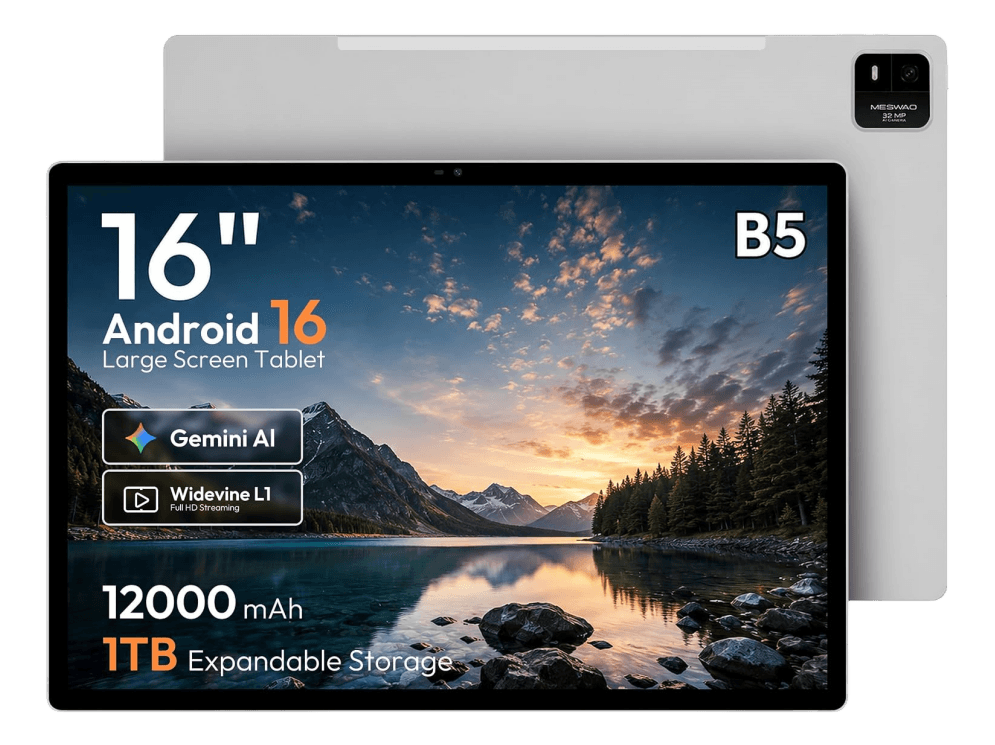
The Meswao B5, a 16-inch Android tablet. Image: Meswao
Performance
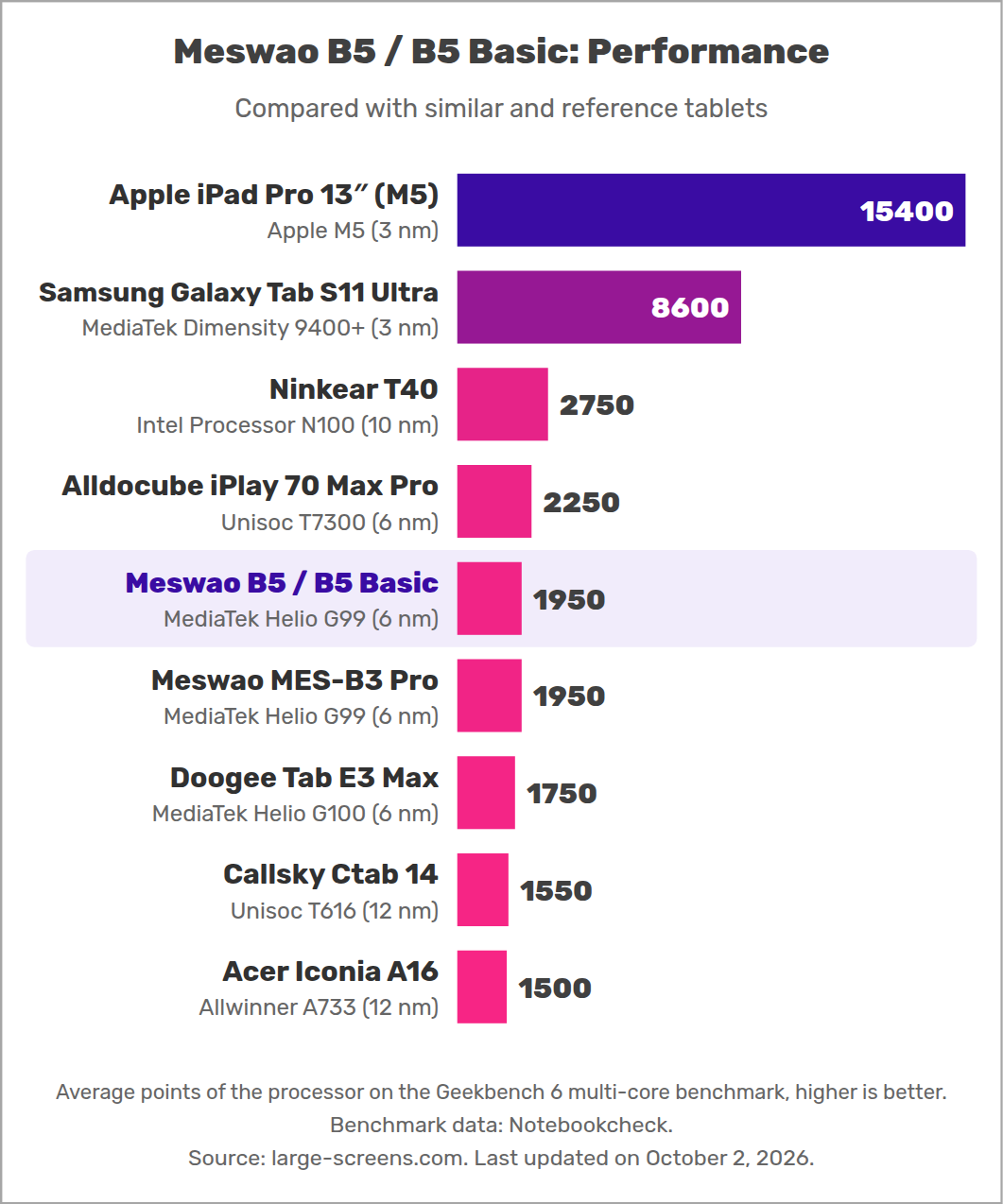
The Meswao B5 / B5 Basic is powered by the relatively old MediaTek Helio G99 processor, released in 2022 and built on a 6 nm process. It is fine for streaming, web browsing, documents and casual games, but it is not made for demanding games, video editing or heavy multitasking. The same chip is used in 8 other tablets of our database, including the Meswao MES-B3 (Pro) and the Meswao B4. Compared with other large tablets:
- The Apple M5 in the Apple iPad Pro 13″ (M5) is about 8 times faster.
- The Meswao B5 / B5 Basic is about 30 % faster than the Acer Iconia A16 and its Allwinner A733.
- The Meswao B5 / B5 Basic is about 40 % faster than the Acer Iconia X16 and its MediaTek Helio G80.
Pros
- Largest screen on sale (16 inches, 16:10)
- 16 GB RAM, 256 GB storage and microSD (B5)
- Widevine L1 and Google Play (Meswao)
- Optional keyboard with touchpad and stylus
- 12,000 mAh battery with 30 W charging
Cons
- Heavy (1,120 g)
- Entry-level Helio G99 chip from 2022
- Not very sharp for 16 inches (142 ppi)
- Modest brightness (350 nits, Meswao)
- No update policy, no independent test yet
- No headphone jack, no 4G
Sponsored
Meswao B5 or B5 Basic?
Both versions have the same 16-inch screen, MediaTek Helio G99 processor, 12,000 mAh battery and Android 16. The B5 has 16 GB of RAM and 256 GB of storage (black); the B5 Basic has 12 GB and 128 GB (silver) and is slightly cheaper. For videos, the web and documents, the Basic is enough; the B5 is worth it if you keep many apps open or store films for offline viewing (both have a microSD slot).
Acer Iconia A16 or Meswao B5: which 16-inch tablet?
They are the only two 16-inch tablets on sale, and their screens are alike (16:10, 1920 × 1200 pixels, not very sharp at this size). The rest is quite different:
- Choose the Acer Iconia A16 if you mainly watch videos at a table or in bed: it has a built-in kickstand, it is lighter (980 g instead of 1,120 g) and it is the cheapest of the two. But its Allwinner A733 is about 30 % slower, it has less memory (6 or 8 GB) and no keyboard or stylus.
- Choose the Meswao B5 if you also want to write or work: it offers an optional keyboard with touchpad and an active stylus, more memory (12 or 16 GB), a bigger battery (12,000 mAh instead of 8,000) and Widevine L1 for HD streaming on Netflix and Prime Video (Acer does not say whether the A16 has it). It needs a case or a stand.
Acer Iconia X16
16.0″ 16:10 · 1920 × 1200 · MediaTek Helio G80
Acer Iconia X16
16.0″ 16:10 · 1920 × 1200 · MediaTek Helio G80
A 16-inch OLED Android tablet with a kickstand, but an old chip (coming late 2026)
Acer's 16-inch OLED Android tablet with a built-in kickstand and a USB-C video input, due in late 2026; its 2020 Helio G80 chip is slow, and no review exists yet.
Acer Iconia X16 tech specs: OS: Android 16 / Processor: MediaTek Helio G80 (12 nm, 2020) / RAM: 6 GB / Storage: 128 GB (eMMC) / microSD slot: yes (up to 2 TB) / Pen: Acer active stylus (optional) / Keyboard: Acer detachable keyboard (optional) / Battery: 8000 mAh / Connections: 2 × USB-C (the second one accepts a video signal, to use the tablet as a portable monitor) / Released: September 2026
Screen specs: OLED, 60 Hz / Size: 16.0 inches / Max brightness: 300 nits (Acer) / Resolution: 1920 × 1200 pixels, 142 ppi / Aspect ratio: 16:10 (1.60)
Not available yet. Official website ›
The best 15-inch tablets

Huion Kamvas Studio 16
15.8″ 16:9 · 2560 × 1440 · Intel Core i7-1355U · 1,700 g
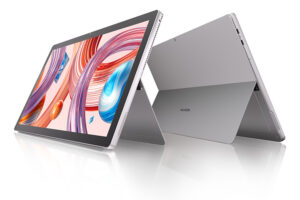
Huion Kamvas Studio 16
15.8″ 16:9 · 2560 × 1440 · Intel Core i7-1355U · 1,700 g
A 15.8-inch Windows 11 pen computer for artists, with a matte screen and an EMR pen
A 15.8-inch Windows 11 pen computer for artists: reviewers praise its accurate pen and matte 2560 × 1440 screen, but it weighs 1.7 kg and lasts only 4 to 5 hours.
Huion Kamvas Studio 16 tech specs: OS: Windows 11 Pro / Processor: Intel Core i7-1355U (10 nm, 2023) / RAM: 16 GB / Storage: 512 GB (NVMe SSD) / microSD slot: no / Pen: Huion PW550S (slim, battery-free EMR pen) (included) / Keyboard: no official one / Battery: 58 Wh, 65 W charging — 4.5 hours (Parka Blogs) / Connections: 2 × USB-C (USB 3.2 up to 20 Gbps, DisplayPort 1.4 video output, PD charging), 1 × 3.5 mm headphone jack; no video input (cannot be used as a monitor for another computer) / Released: February 2023
Screen specs: IPS LCD, matte (Anti-glare etched glass), 60 Hz / Size: 15.8 inches / Max brightness: 400 nits (Huion), 262 cd/m² (Parka Blogs) / Resolution: 2560 × 1440 pixels, 186 ppi / Aspect ratio: 16:9 (1.78)
Weight: without keyboard: 60.0 ounces – 3.75 pounds – 1,700 g
Sponsored

Iris Ohyama LUCA Tablet 15.6
15.6″ 16:9 · 1920 × 1080 · Unisoc T620 · 1,083 g
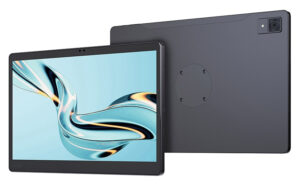
Iris Ohyama LUCA Tablet 15.6
15.6″ 16:9 · 1920 × 1080 · Unisoc T620 · 1,083 g
A 15.6-inch Android tablet for the home with a magnetic back, sold only in Japan
A 15.6-inch Android 16 tablet for the home with a magnetic back for an optional wireless charging stand, but a 141 ppi screen, 4 GB of RAM and sales in Japan only.
Iris Ohyama LUCA Tablet 15.6 tech specs: OS: Android 16 / Processor: Unisoc T620 / RAM: 4 GB / Storage: 128 GB / microSD slot: yes (up to 512 GB) / Pen: no official one / Keyboard: no official one / Battery: 8000 mAh, 18 W charging / Connections: 1 × USB-C (USB 2.0), 3.5 mm headphone jack, microSD slot / HD streaming: yes (Widevine L1) / Released: September 2026
Screen specs: LCD, glossy / Size: 15.6 inches / Resolution: 1920 × 1080 pixels, 141 ppi / Aspect ratio: 16:9 (1.78)
Weight: without keyboard: 38.2 ounces – 2.39 pounds – 1,083 g
Meswao (aka Azamp) MES-B3 / MES-B3 Pro
A huge 15.6-inch screen in a heavy tablet with low-range hardware
Update October 2026: the MES-B3 is no longer the largest tablet. Two 16-inch tablets are now available: the Acer Iconia A16 and Meswao’s own B5. With their 16:10 screens, they offer 10.7 % more screen area than the 15.6-inch 16:9 MES-B3. Meswao also announced a 15.4-inch B4.
Meswao B3: OS: Android 14 / Processor: MediaTek Helio G99 (aka MT6789, 6 nm, 2022) / Graphics: ARM Mali-G57 (7 nm, 2020) / RAM: 6GB / Storage: 128GB / microSD slot: yes (microSDXC, up to 1TB) / Colors: Midnight black, Starlight silver / Connections: USB Type-C / Battery life: up to 12 hours (12,000 mAh / 30W charging) / Released: April 2024 / “Pro” refresh in August 2025
Screen specs: IPS, glossy, 60 Hz / Size: 15.6 inches / Max brightness: 350 nits (Meswao), 270 nits (Notebookcheck) / Min brightness: 15.0 cd/m² / Resolution: 1920 × 1080 pixels, 141 ppi / Aspect ratio: 16:9 (1.78)
Weight without keyboard: 38.8 ounces – 2.43 pounds – 1.1 kg
One tablet, three brands: Meswao, azamp and FollowM
The Meswao MES-B3 (also sold under the “azamp” and “FollowM” brands) is a large tablet manufactured by Bezeworld Technology in Shenzhen, China. It was the largest non-foldable tablet until 2026, when the 16-inch Acer Iconia A16 and Meswao B5 arrived.
Large IPS screen, but low-resolution
Its 15.6-inch screen with a 16:9 ratio is perfect for watching movies or videos. However, it’s not as useful for office work or multitasking, as the screen resolution is only 1920 x 1080, resulting in a low pixel density of 141 ppi. The maximum brightness is specified at 350 nits (which is sufficient for indoor use), but has been tested at 270 nits on average by Notebookcheck.
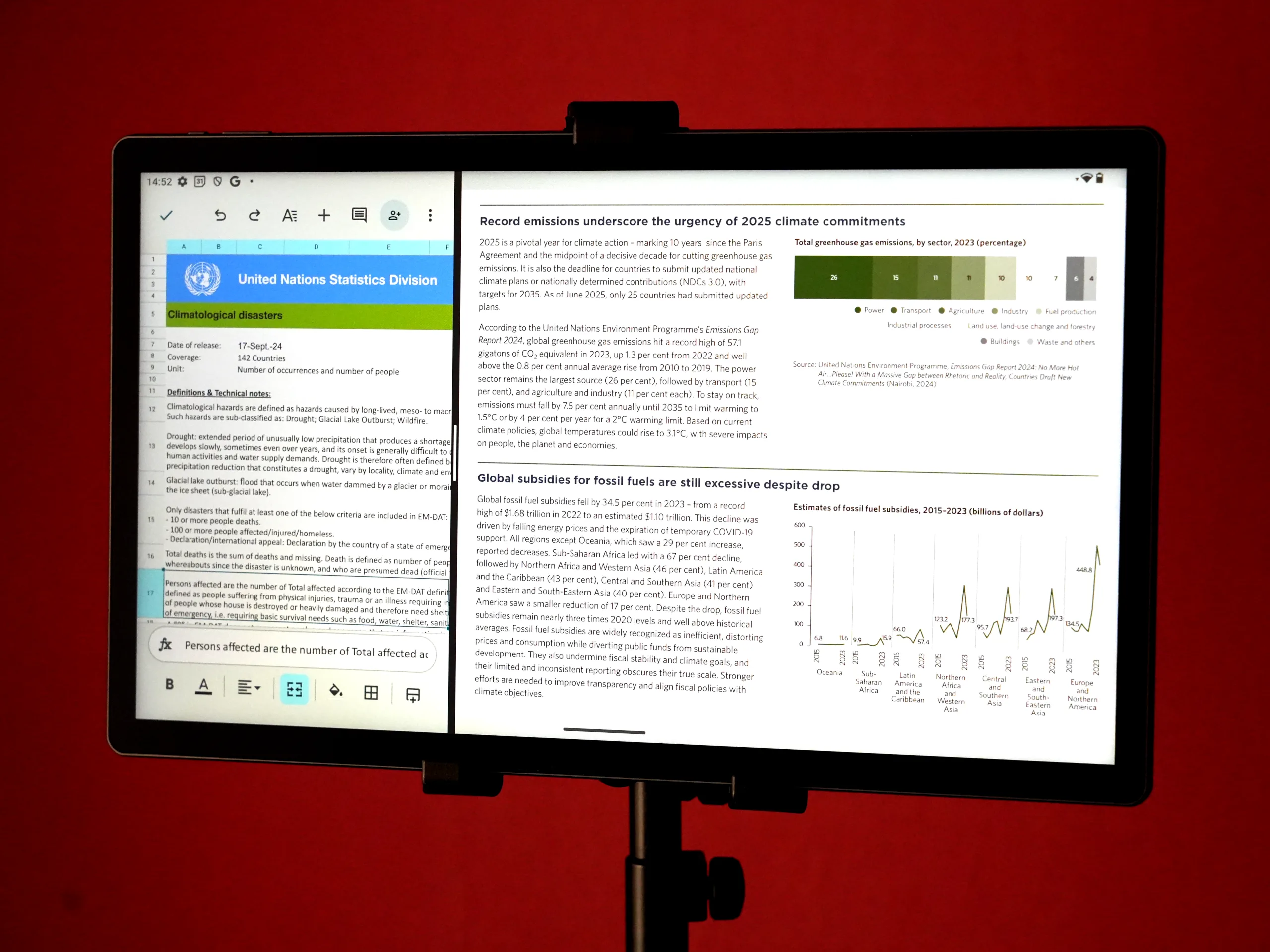
The Meswao MES-B3 Pro is also sold under the brands Hoogee and Azamp. It has a 15.6-inch full HD IPS screen with a 16:9 aspect ratio. Image credit: large-screens.com
Performance: sub-par, but acceptable
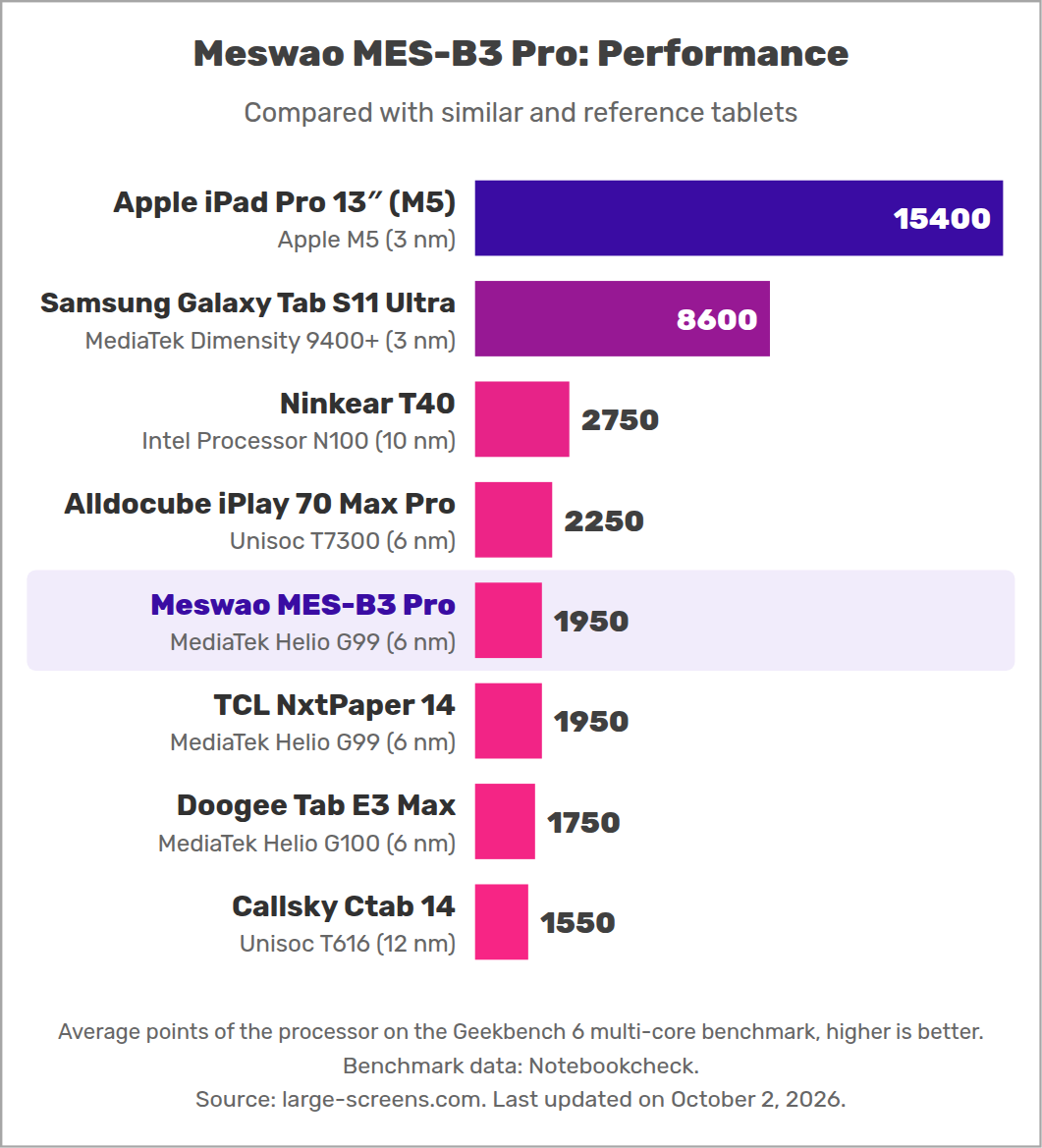
The Meswao MES-B3 “Pro” uses the same System-on-a-Chip (SoC) as the older, non-Pro model: the MediaTek Helio G99. This three-year-old entry-level processor is used in countless entry-level tablets, including models released in 2025.
Don’t expect to use performance-demanding apps, such as video editing or intensive gaming, on its huge screen. However, it is perfectly fine for normal use like web browsing, document editing, photo editing, and watching videos.
Video streaming limitations
The Meswao B3’s huge display and 16:9 aspect ratio make it ideal for watching videos. YouTube works well at 1080p, which is the native screen resolution.
However, when it comes to other streaming services such as Netflix, Disney+, Amazon Prime Video, Hulu, and HBO, as well as paid content on YouTube, only SD resolution (up to 480p) is supported. The Meswao B3 does not support HD (720p or higher) resolution for copyrighted content, as it does not have Widevine L1 support.
Weight and battery life
Weighing in at 2.43 lbs (1.1 kg), the 15.6-inch Meswao giant is almost twice as heavy as the 13-inch iPad Pro. It comes with a substantial 12,000 mAh battery, similar to the Samsung Galaxy Tab S10 Ultra (11,200 mAh) and S11 Ultra (11,600 mAh). However, with its larger display, battery life may not stretch too far. Meswao claims up to 15 hours of video playback and 12 hours of web browsing, though these estimates seem a bit optimistic.
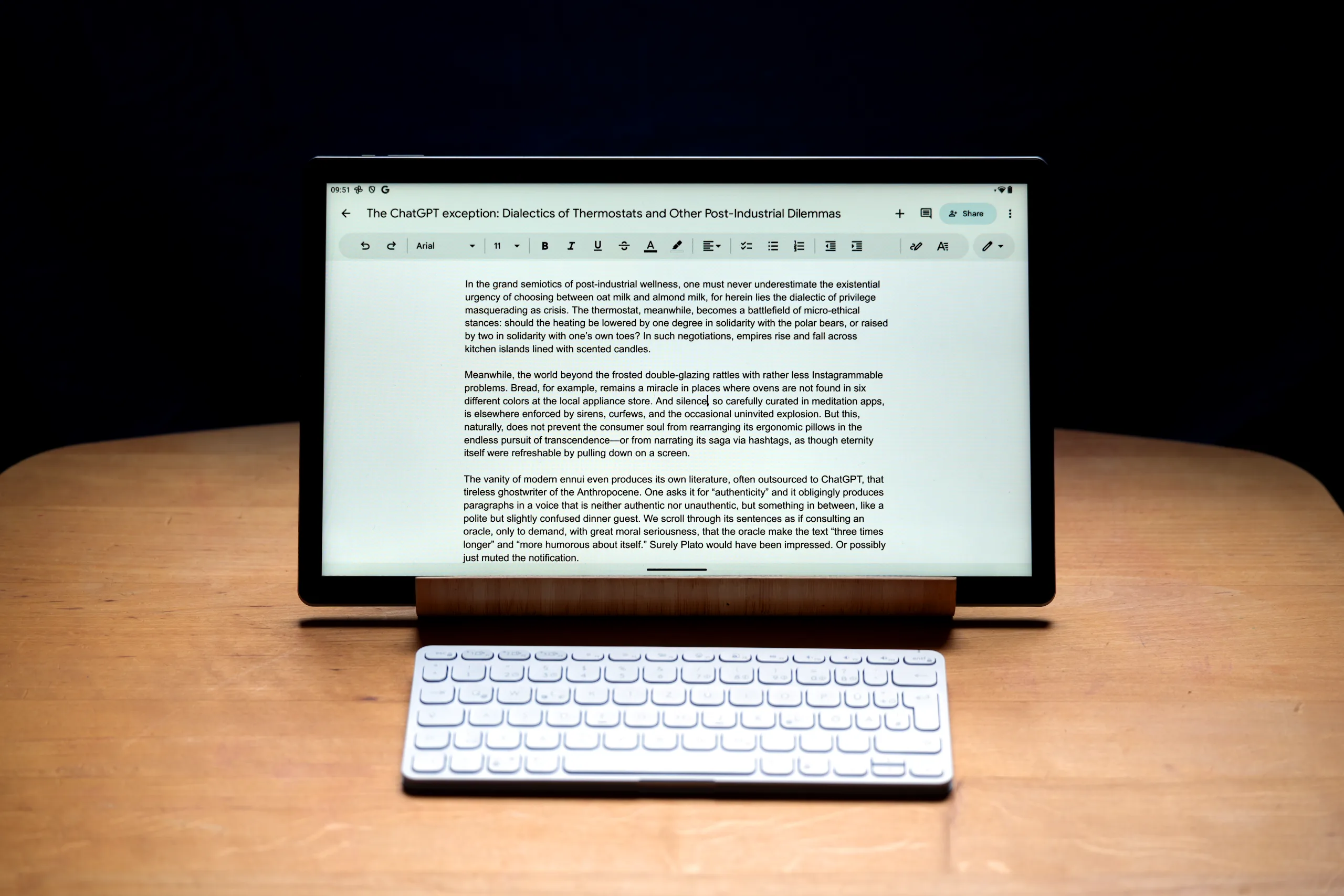
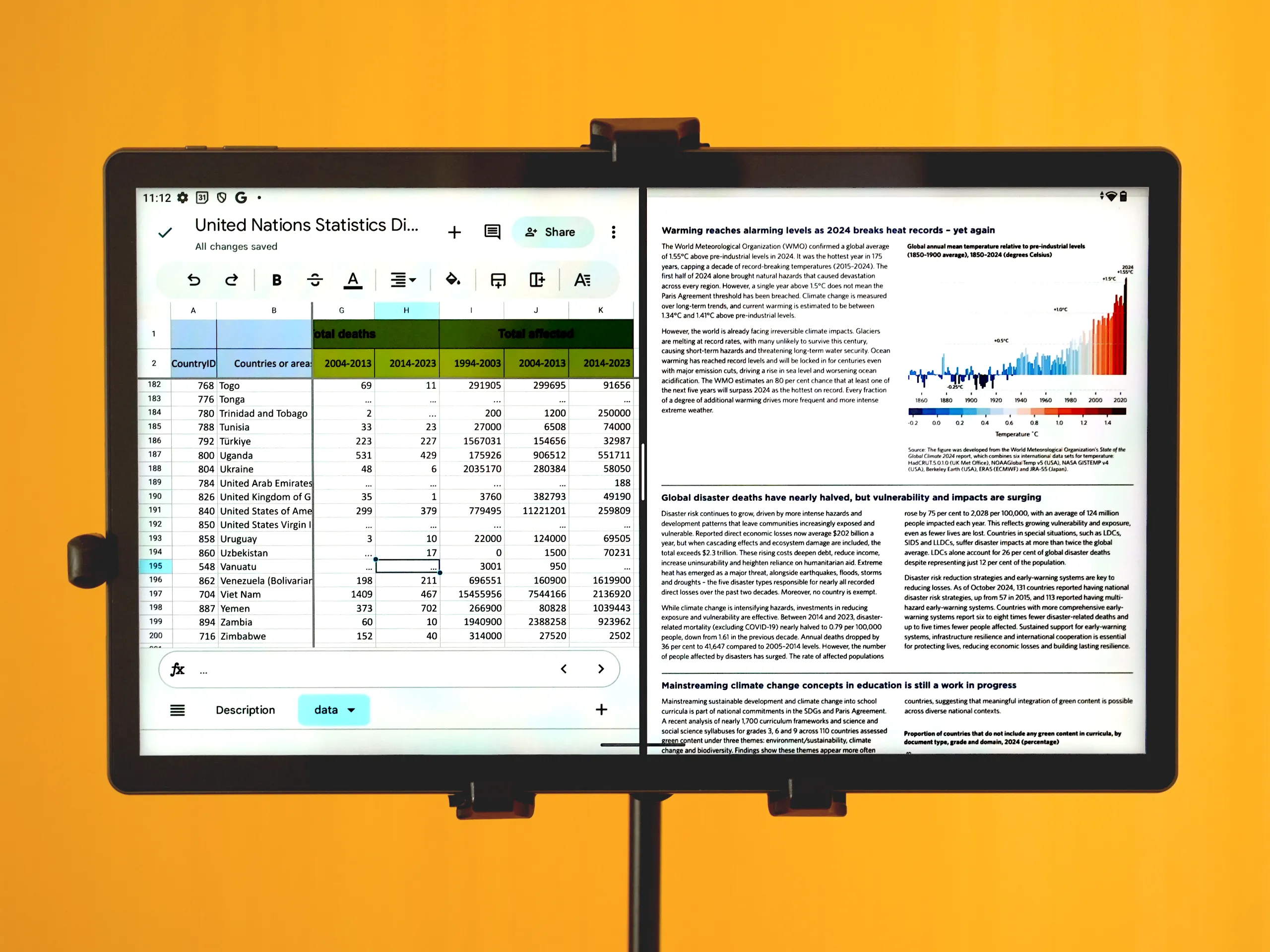
Thanks to its huge 15.6-inch screen, the Meswao MES-B3 Pro can be used as a laptop replacement. Image credit: large-screens.com
Meswao MES-B3 Pro refresh in August 2025
In Summer 2025, Meswao quietly upgraded its 15.6-inch tablet. Unfortunately, the only notable difference (except the “Pro” suffix) is a faster charging battery. It now fully charges at 30 Watts under 3 hours instead of 15 Watts under 6 hours.
The non-Pro version was sold under the “Azamp” brand, but that does not seem to be the case anymore since the upgrade. Instead, there is a model that is completely identical (except for the branding) sold as the Hoogee MES-B10, which also dropped the “more than bigger” motto and is sold more or less as a no-name tablet.
Pros
- Huge 15.6-inch screen (28 % larger than the 13-inch iPad Pro)
- MicroSD card slot
- Stylus support (sold separately)
- Great price for its size
- Supports Google Mobile Services
Cons
- Low-resolution display and low brightness
- Slow processor
- No Widevine L1 on early units (HD streaming)
- Stylus not included
- No information on security updates and software support duration
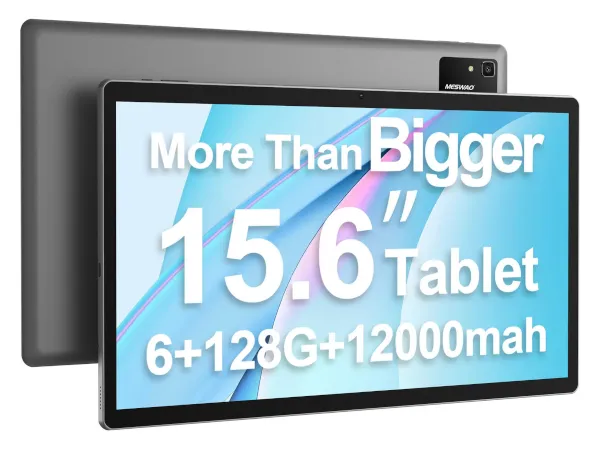
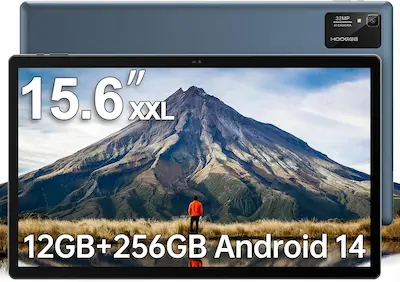
Meswao MES-B3 Pro or a 16-inch tablet (Meswao B5, Acer Iconia A16)?
These three large, low-cost Android tablets have screens of 1920 × 1080 or 1920 × 1200 pixels, not very sharp at this size (about 140 ppi), and none has a published update policy. The 16-inch 16:10 screens are about as wide as the 15.6-inch 16:9 screen of the MES-B3 Pro, but about 11 % taller in landscape, with about 11 % more area.
- Choose the Meswao MES-B3 Pro if you want a tablet that has been reviewed: it is the only one of the three with a hands-on review on this site and an independent test (Notebookcheck, original MES-B3). It is the thickest (about 1 cm) and weighs 1,085 g.
- Choose the Meswao B5 for the largest screen with a keyboard and a pen: the same Helio G99 chip and the same optional keyboard with touchpad as the MES-B3 Pro, but 16 inches, 12 or 16 GB of RAM and Widevine L1 (according to Meswao); it is the heaviest (1,120 g), and no independent review exists yet.
- Choose the Acer Iconia A16 for videos: it is the lightest (980 g), has a built-in kickstand and a headphone jack, and is the cheapest; but its chip is slower, and it supports neither a pen nor a keyboard.

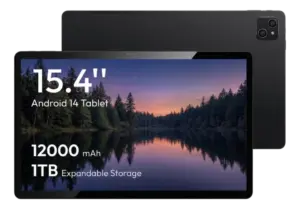
Meswao B4
15.4″ 16:9 · 1920 × 1080 · MediaTek Helio G99 · 1,035 g
Meswao B4
15.4″ 16:9 · 1920 × 1080 · MediaTek Helio G99 · 1,035 g
An announced 15.4-inch Meswao tablet, a little smaller and lighter than the B3 Pro
An announced 15.4-inch Android 14 tablet from Meswao with a Helio G99, 8 GB of RAM and an optional keyboard, at a low announced price but not on sale yet (October 2026).
Meswao B4 tech specs: OS: Android 14 / Processor: MediaTek Helio G99 (6 nm, 2022) / RAM: 8 GB / Storage: 256 GB / microSD slot: yes (up to 2 TB [Meswao]) / Pen: Meswao Stylus Pen (Microsoft MPP 2.0) (optional) / Keyboard: Meswao Foldable Bluetooth Keyboard with Touchpad (optional, with touchpad) / Battery: 12,000 mAh, 30 W charging / Connections: 1 × USB-C / Released: March 2026
Screen specs: IPS LCD, glossy / Size: 15.4 inches / Max brightness: 350 nits (Meswao) / Resolution: 1920 × 1080 pixels, 143 ppi / Aspect ratio: 16:9 (1.78)
Weight: without keyboard: 36.5 ounces – 2.28 pounds – 1,035 g
Not available yet. Official website ›
Jumper Z1 (aka EZpad Max15)
The second-largest tablet: minimally smaller, but with a better resolution
Jumper Z1 tech specs: OS: Android 14 / Processor: MediaTek Helio G99 aka MT8781 (8 nm), released in May 2022 / RAM: 8 GB / Storage: 256GB / microSD slot: yes, max 512 GB / Connections: 1 × USB Type-C / Released: September 2024
Screen specs: IPS / Size: 15.0 inches / Max brightness: 300 nits (Jumper) Resolution: 2496 × 1664 pixels, 2.5 K, 200 ppi / Aspect ratio: 3:2 (1.50)
Weight: 35.2 ounces – 2.2 pounds – 1.0 kg
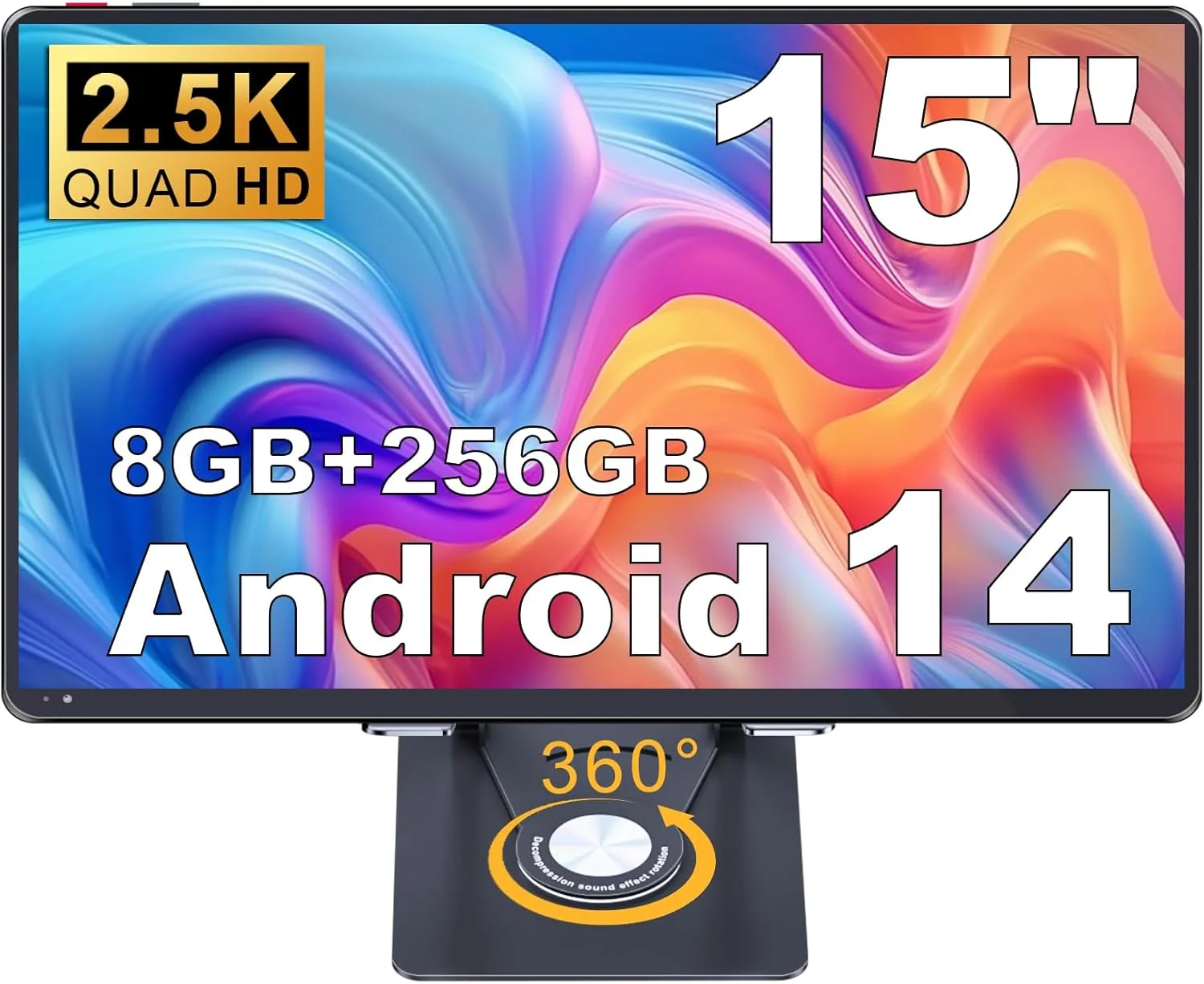
The Jumper Z1 has a large 2.5K 15-inch display. Due to its 3:2 aspect ratio, the display area is almost identical to that of the 15.6-inch Meswao MES-B3. Image credit: Jumper
Performance
The Jumper Z1 (EZpad Max15) is powered by the relatively old MediaTek Helio G99 processor, released in 2022 and built on a 6 nm process. It is fine for streaming, web browsing, documents and casual games, but it is not made for demanding games, video editing or heavy multitasking. The same chip is used in 9 other tablets of our database, including the Meswao MES-B3 (Pro) and the TCL NxtPaper 14. Compared with other large tablets:
- The Apple M5 in the Apple iPad Pro 13″ (M5) is about 8 times faster.
- The Unisoc T7300 in the Alldocube iPlay 70 Max Pro is about 20 % faster.
- The Jumper Z1 (EZpad Max15) is about 30 % faster than the Callsky Ctab 14 and its Unisoc T616.
Pros
- Second-largest display on the market!
- 2.5K (2496 × 1664) screen resolution
- 3:2 aspect ratio
- microSD card slot
- Great price for its size
Cons
- Low maximum brightness
- Slow processor
- No stylus support
- No warranty
- No information on security updates and software support duration
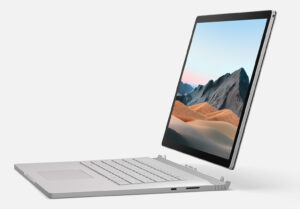
Microsoft Surface Book 3 15-inch
15.0″ 3:2 · 3240 × 2160 · Intel Core i7-1065G7 + NVIDIA GeForce GTX 1660 Ti Max-Q (in the keyboard base) · 815 g
Microsoft Surface Book 3 15-inch
15.0″ 3:2 · 3240 × 2160 · Intel Core i7-1065G7 + NVIDIA GeForce GTX 1660 Ti Max-Q (in the keyboard base) · 815 g
A 2020 Windows laptop whose 15-inch 3:2 screen detaches as a tablet
Microsoft’s 2020 15-inch Windows laptop whose sharp 3:2 screen detaches as a tablet; strong with its GPU base, but the screen alone lasts only about 3.5 hours.
Microsoft Surface Book 3 15-inch tech specs: OS: Windows 11 (shipped with Windows 10) / Processor: Intel Core i7-1065G7 + NVIDIA GeForce GTX 1660 Ti Max-Q (in the keyboard base) (10 nm, 2019) / RAM: 16 GB or 32 GB / Storage: 256 GB or 512 GB or 1 TB or 2 TB (PCIe SSD) / microSD slot: yes (full-size SDXC card reader [in the keyboard base]) / Pen: Surface Pen (optional) / Keyboard: Surface Book 3 keyboard base (with the NVIDIA GPU) (included, with touchpad) / Connections: Base: 2 × USB-A (3.1 Gen 2), 1 × USB-C (3.1 Gen 2, USB PD 3.0), full-size SDXC card reader, Surface Connect; tablet: Surface Connect; 3.5 mm headphone jack / Released: May 2020
Screen specs: IPS LCD (PixelSense), glossy / Size: 15.0 inches / Max brightness: 428 cd/m² (Notebookcheck (center)) / Min brightness: 3.8 cd/m² (Notebookcheck) / Resolution: 3240 × 2160 pixels, 260 ppi / Aspect ratio: 3:2 (1.50)
Weight: without keyboard: 28.7 ounces – 1.80 pounds – 815 g / with keyboard: 67.2 ounces – 4.20 pounds – 1,905 g
The best 14-inch tablets
Samsung Galaxy Tab S12 Ultra
Samsung’s 14.6-inch 2026 flagship: faster chip, longer battery life and a higher price
Samsung Galaxy Tab S12 Ultra tech specs: OS: Android 17 (One UI 9) / Processor: MediaTek Dimensity 9500 (3 nm, 2025) / RAM: 12 GB or 16 GB / Storage: 256 GB or 512 GB or 1 TB (UFS 4.0) / microSD slot: yes (up to 2 TB) / Pen: S Pen (no Bluetooth) (included) / Keyboard: Pro Keyboard, Book Cover Keyboard Slim (optional, with touchpad) / Battery: 11,600 mAh, 45 W charging — 19.7 hours (Expert Reviews) / Connections: 1 × USB-C (USB 3.2 Gen 1) / HD streaming: yes (Widevine L1) / Updates: 7 years of security updates / Released: October 2026
Screen specs: Dynamic AMOLED 2X, anti-reflective, 120 Hz / Size: 14.6 inches / Max brightness: 1000 nits (Samsung) / Resolution: 2960 × 1848 pixels, 239 ppi / Aspect ratio: 16:10 (1.60)
Weight: without keyboard: 24.4 ounces – 1.53 pounds – 692 g / with keyboard: 48.0 ounces – 3.00 pounds – 1,360 g
Verdict: excellent, but little change from the S11 Ultra
The Galaxy Tab S12 Ultra, Samsung’s 2026 flagship, is a very large Android tablet for films, drawing, notes and office work. Reviewers praise its screen, speed and battery life: Engadget gave it 9 out of 10, Stuff 5 out of 5, and Expert Reviews its “Recommended” badge. Stuff notes that it changes little from the S11 Ultra, yet costs more.
Screen: 14.6-inch AMOLED, up to 1,700 nits in HDR
The 14.6-inch screen has 18% more area than the 13-inch iPad Pro. Its 16:10 format is a wide format made for videos. The AMOLED panel is sharp (239 ppi) and runs at 120 Hz. Expert Reviews measured up to 1,700 nits with HDR content. The anti-reflective glass (Stuff) is still glossy and catches the light in bright rooms (Expert Reviews).
Speed: faster than the S11 Ultra; updates until 2033
The MediaTek Dimensity 9500 is clearly faster than the S11 Ultra’s chip, but slower than the iPad Pro with M5 (Expert Reviews). It has 12 or 16 GB of RAM, 256 GB to 1 TB of storage and a microSD slot. It runs Android 17 with One UI 9, Google Play and the DeX desktop mode, and gets updates until September 2033. Like earlier Galaxy Tab S models, it should support Widevine L1 (HD on Netflix and Prime Video). Reviewers find fewer tablet-optimized and creative apps than on the iPad (Expert Reviews, Stuff).
Battery: nearly 20 hours of video; S Pen in the box
The S Pen (no Bluetooth) is in the box; the Pro Keyboard with touchpad costs extra. Engadget measured 19 h 39 min of video, Expert Reviews 19 h 44 min, about 2.5 hours more than the S11 Ultra. A 45 W charge takes about 95 minutes (no charger in the box). It is 5.1 mm thin, weighs 692 g and is IP68 rated. Its four speakers are loud but light on bass. There is only one USB-C port (Engadget, Tech Advisor) and no headphone jack.
Release: in shops from October 7, 2026
Sales start on October 7, 2026, at a higher price than the S11 Ultra at its launch (Notebookcheck).
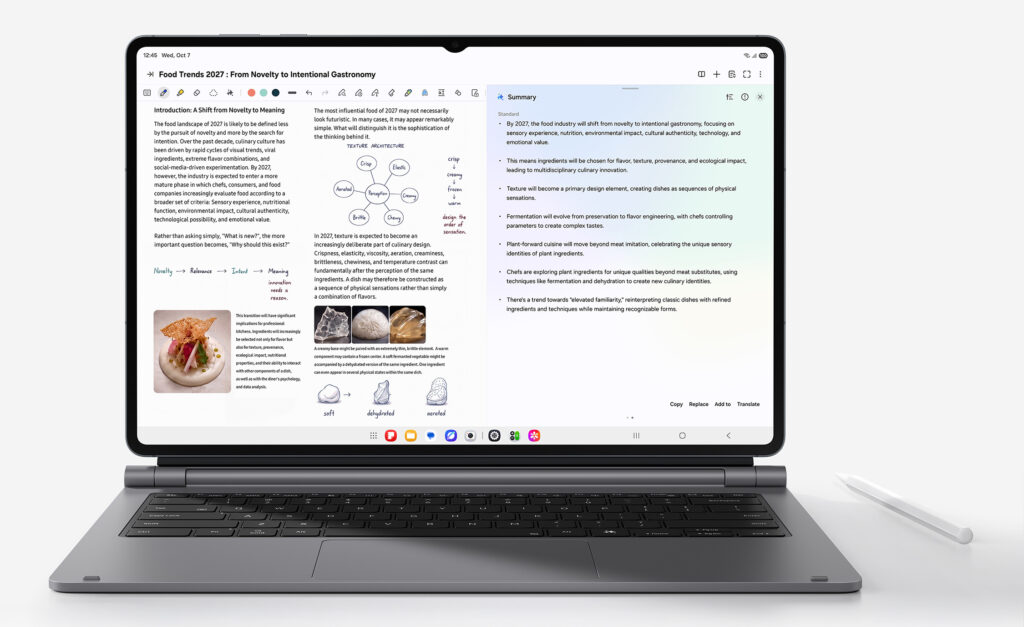
The Samsung Galaxy Tab S12 Ultra. Image: Samsung
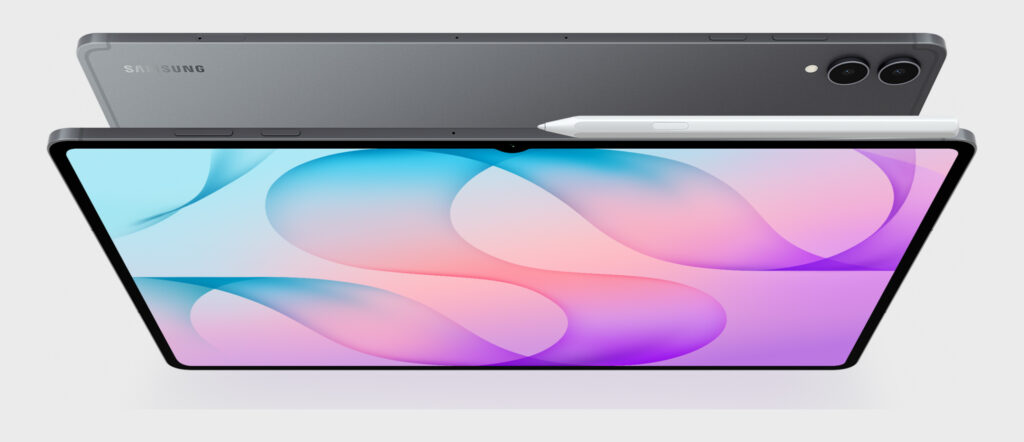
The Galaxy Tab S12 Ultra, front and back: 5.1 mm thin. Image: Samsung
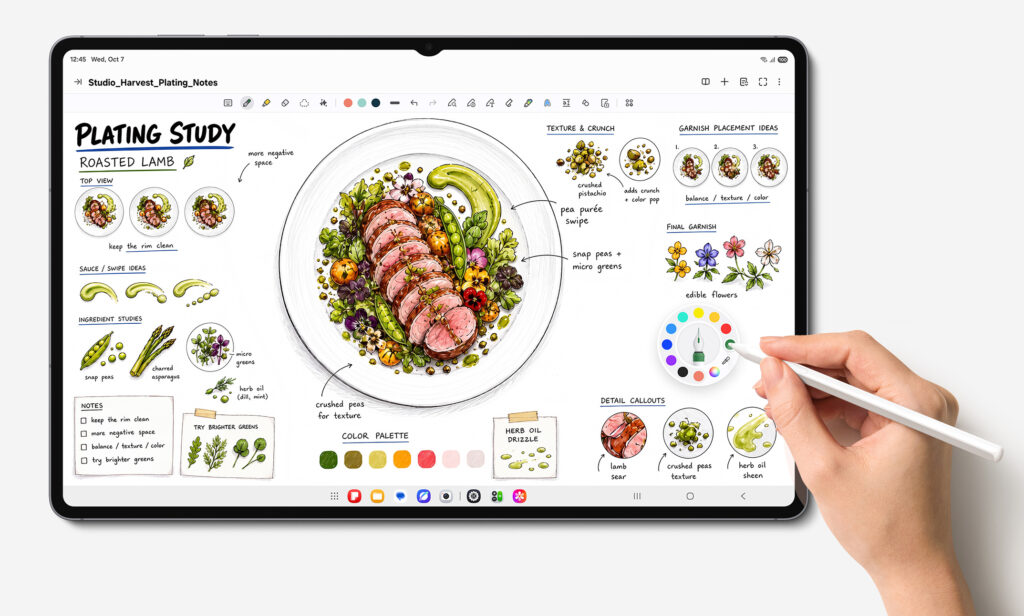
Drawing and taking notes with the included S Pen. Image: Samsung
Performance
The Samsung Galaxy Tab S12 Ultra is powered by the MediaTek Dimensity 9500 processor, released in 2025 and built on a 3 nm process. It is one of the fastest chips in any tablet: it handles everything, including heavy video editing, 3D work and the most demanding games. Compared with other large tablets:
- The Apple M5 in the Apple iPad Pro 13″ (M5) is about 50 % faster.
- The Samsung Galaxy Tab S12 Ultra is about 20 % faster than the Samsung Galaxy Tab S11 Ultra and its MediaTek Dimensity 9400+.
- The Samsung Galaxy Tab S12 Ultra is about 40 % faster than the Samsung Galaxy Tab S10 Ultra and its MediaTek Dimensity 9300+.
Pros
- Large, sharp 14.6-inch AMOLED screen (1,700 nits HDR measured)
- Long battery life (over 19 h of video measured)
- Fast MediaTek Dimensity 9500
- S Pen included
- Very thin (5.1 mm), light for its size (692 g), IP68
- Seven years of updates, microSD slot
Cons
- Very expensive, more than the S11 Ultra at launch
- Small upgrade over the S11 Ultra
- Keyboard extra (Pro Keyboard)
- Fewer tablet-optimized and creative apps than the iPad
- Only one USB-C port; no charger in the box
Sponsored
Samsung Galaxy Tab S11 Ultra
The largest and best Android tablet from a major brand
Update October 2026: Samsung announced the Galaxy Tab S12 Ultra on September 30, 2026; it has been on sale since October 7. It keeps the 14.6-inch size (Dynamic AMOLED 2X, 2960 × 1848 pixels, 120 Hz, up to 1,600 nits) with a MediaTek Dimensity 9500, an 11,600 mAh battery and 692 g (Samsung, Notebookcheck). The Tab S12+ is too small for this list (12.6 inches).
Samsung Galaxy Tab S11 Ultra tech specs: OS: Android 16, seven years of security updates / Processor: Mediatek Dimensity 9400+ (3 nm) / RAM: 12GB or 16GB / Storage: 128GB, 256GB, 512GB or 1TB / microSD slot: yes (microSDXC) / Colors: Moonstone Gray, Platinum Silver / Connections: USB 3.2 Type-C (Gen. 1) / Released: September 2025
Screen specs: Dynamic AMOLED 2X, 120Hz, HDR10+ / Size: 14.6 inches / Max brightness: Samsung announces a peak brightness of 1600 nits (small areas) or 1000 nits (whole screen). Notebookcheck has measured an average maximum of 965 nits (whole screen) / Min brightness: 1.54 cd/m² Resolution: 2960 × 1848 pixels, 240 ppi / Aspect ratio: 16:10 (1.60)
Weight: without keyboard: 24.5 ounces – 1.53 pounds – 695 grams / with “Book Cover Keyboard Slim”: 40.2 ounces – 2.56 pounds – 1.16 kg
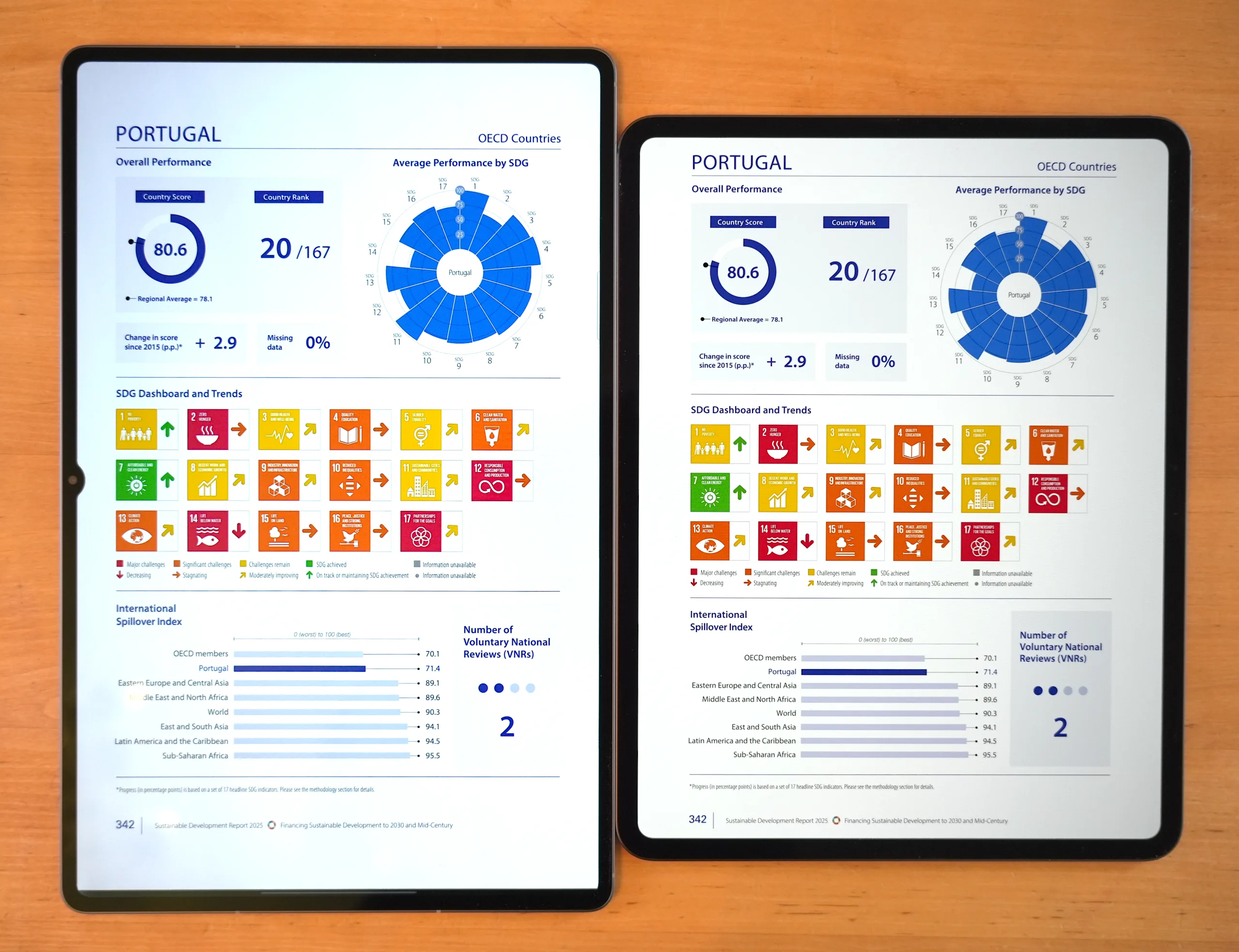
Here is a comparison of the Samsung Galaxy Tab S11 Ultra (left) and the Apple iPad Pro 13 (right). When viewed vertically, they are equally wide, but the S11 Ultra is much taller. Image credit: large-screens.com
The largest tablet from a major brand (foldables aside)
The Samsung Galaxy Tab S11 Ultra, released in September 2025, simply is the largest (non-foldable) tablet from a major brand available on the market – together with its predecessor, the S10 Ultra.
Foldable tablets such as the LG Gram Fold or the HP Spectre Foldable 17 do have bigger displays, but they run Windows and are way heavier, thicker when folded, and twice as expensive. See at the bottom of the page for more details on foldable tablets.
Performance
The Samsung Galaxy Tab S11 Ultra is powered by the MediaTek Dimensity 9400+ processor, released in 2025 and built on a 3 nm process. It is a fast chip: demanding games, large drawings and video editing run smoothly. Compared with other large tablets:
- The Apple M5 in the Apple iPad Pro 13″ (M5) is about 80 % faster.
- The MediaTek Dimensity 9500 in the Samsung Galaxy Tab S12 Ultra is about 20 % faster.
- The Samsung Galaxy Tab S11 Ultra is about 20 % faster than the Samsung Galaxy Tab S10 Ultra and its MediaTek Dimensity 9300+.
Pros
- Largest tablet from a major brand
- Bright screen (up to 965 nits)
- Excellent battery life
- MicroSD card slot
- Bundled stylus (S Pen)
- 7 years of security updates!
- Fast charging (up to 45W)
Cons
- Glossy display (prone to reflections)
- 16:10 aspect ratio is great for movies, not for work
- Very expensive
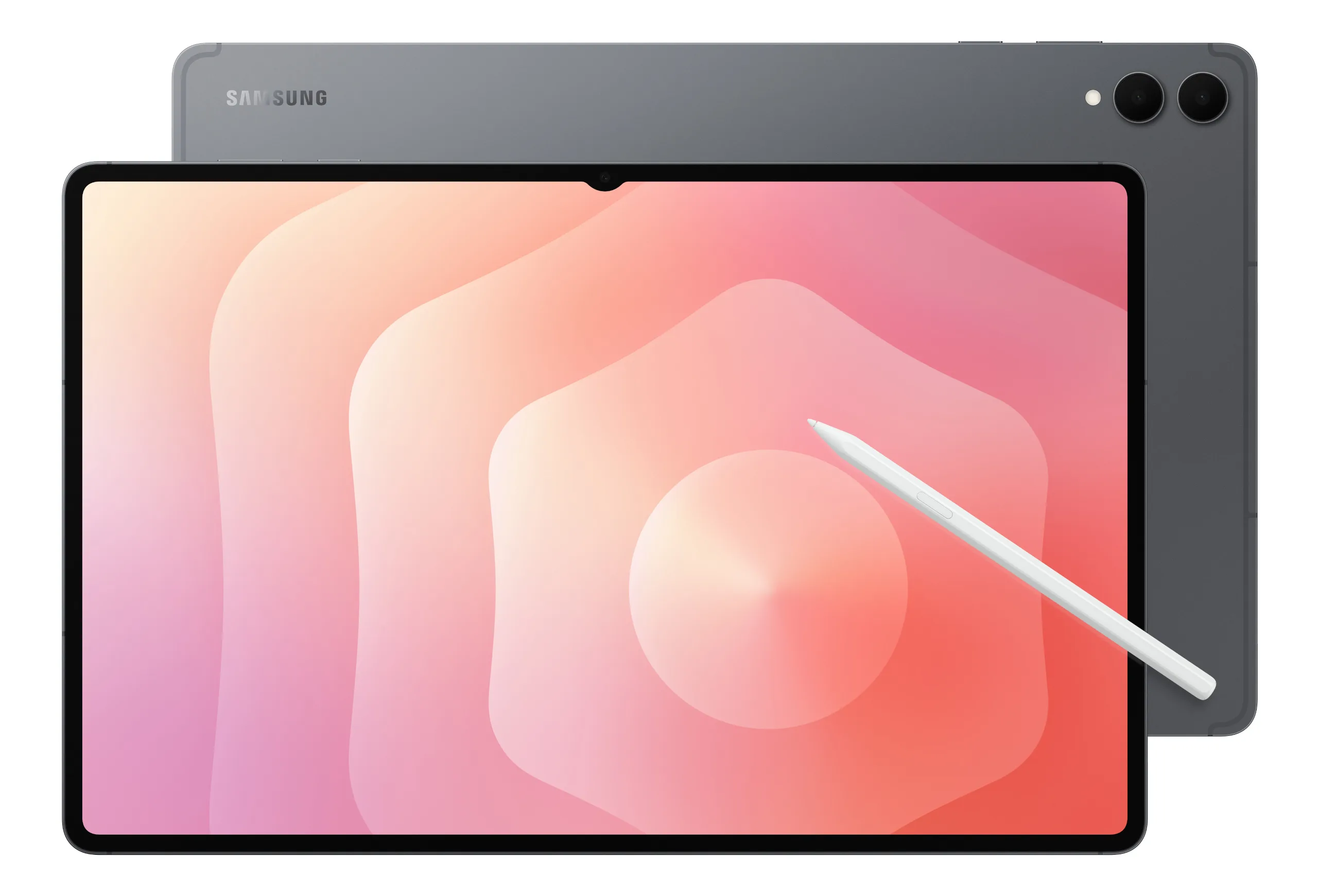
Galaxy Tab S12 Ultra or S11 Ultra: which one to choose?
The Galaxy Tab S12 Ultra (on sale from October 7, 2026) replaces the S11 Ultra. Both have the same 14.6-inch 120 Hz AMOLED screen, the same thin body (5.1 mm, 692 g) with IP68 protection, the same 11,600 mAh battery, an S Pen in the box and a microSD slot. The differences are small:
- Choose the S12 Ultra if you keep a tablet for many years: its Dimensity 9500 is about 20 % faster (Geekbench 6), Expert Reviews measured about 2.5 hours more video playback (19 h 44 min instead of 17 h 10 min), and Samsung provides security updates until September 2033.
- Choose the S11 Ultra if you find it clearly cheaper: for videos, notes and drawing you get the same screen, size, weight and pen, and seven years of updates as well.
The older S10 Ultra (2024) is dimmer (650 nits instead of 1,000) and a little heavier (718 g).
Samsung Galaxy Tab S8 / S9 / S10 Ultra
Almost as good as its successor
Samsung Galaxy Tab S10 Ultra tech specs: OS: Android 14 at launch, now Android 16 (One UI 8.5); seven years of security updates / Processor: Mediatek Dimensity 9300+ (4 nm) / RAM: 12GB or 16GB / Storage: 256GB, 512GB or 1TB / microSD slot: yes (microSDXC) / Colors: Moonstone Gray, Platinum Silver / Connections: USB 3.2 Type-C (Gen. 1) / Released: October 2024
Screen specs: Dynamic AMOLED 2X, 120Hz, HDR10+ / Size: 14.6 inches / Max brightness: Samsung announces a peak brightness of 930 nits (small areas) or 650 nits (whole screen). Notebookcheck has measured an average maximum of 603 nits (whole screen) / Min brightness: 2 cd/m² Resolution: 2960 × 1848 pixels, 240 ppi / Aspect ratio: 16:10 (1.60)
Weight: without keyboard: 25.3 ounces – 1.58 pounds – 718 grams / with “Book Cover Keyboard”: 46.8 ounces – 2.93 pounds – 1.33 kg / with “Book Cover Keyboard Slim”: 41.9 ounces – 2.62 pounds – 1.19 kg
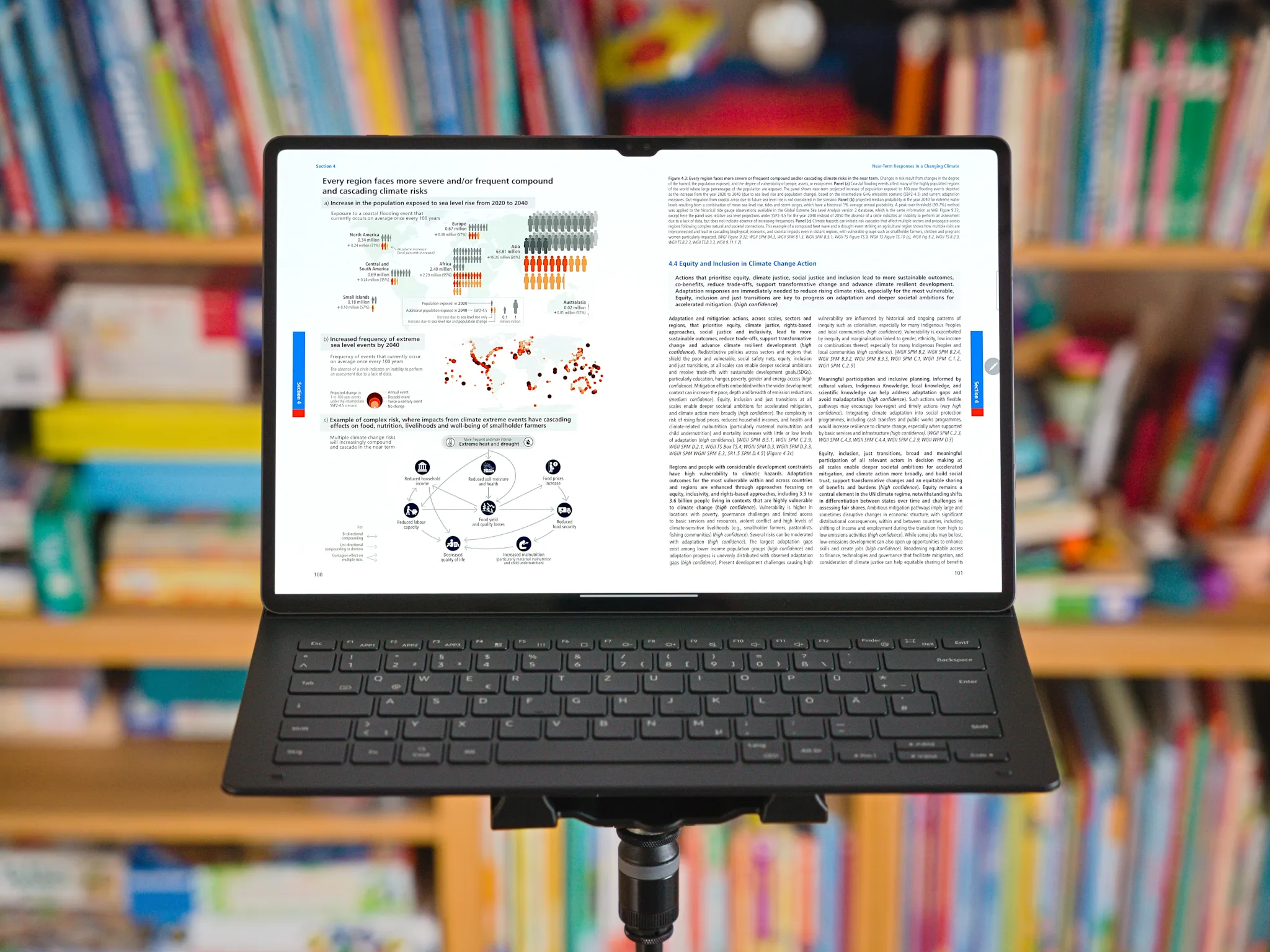
The Samsung Galaxy Tab S10 Ultra is the second-best extra large tablet from a leading brand. Image credit: large-screens.com
Almost identical to the S11 Ultra
The Samsung Galaxy Tab S10 Ultra, released in October 2024, still has the largest screen available on a tablet from a major brand – together with the S8 and S9 Ultra.
The Tab S10 Ultra is extremely similar the S11 ultra, the latter being only an incremental update with a faster processor and better security updates policy.
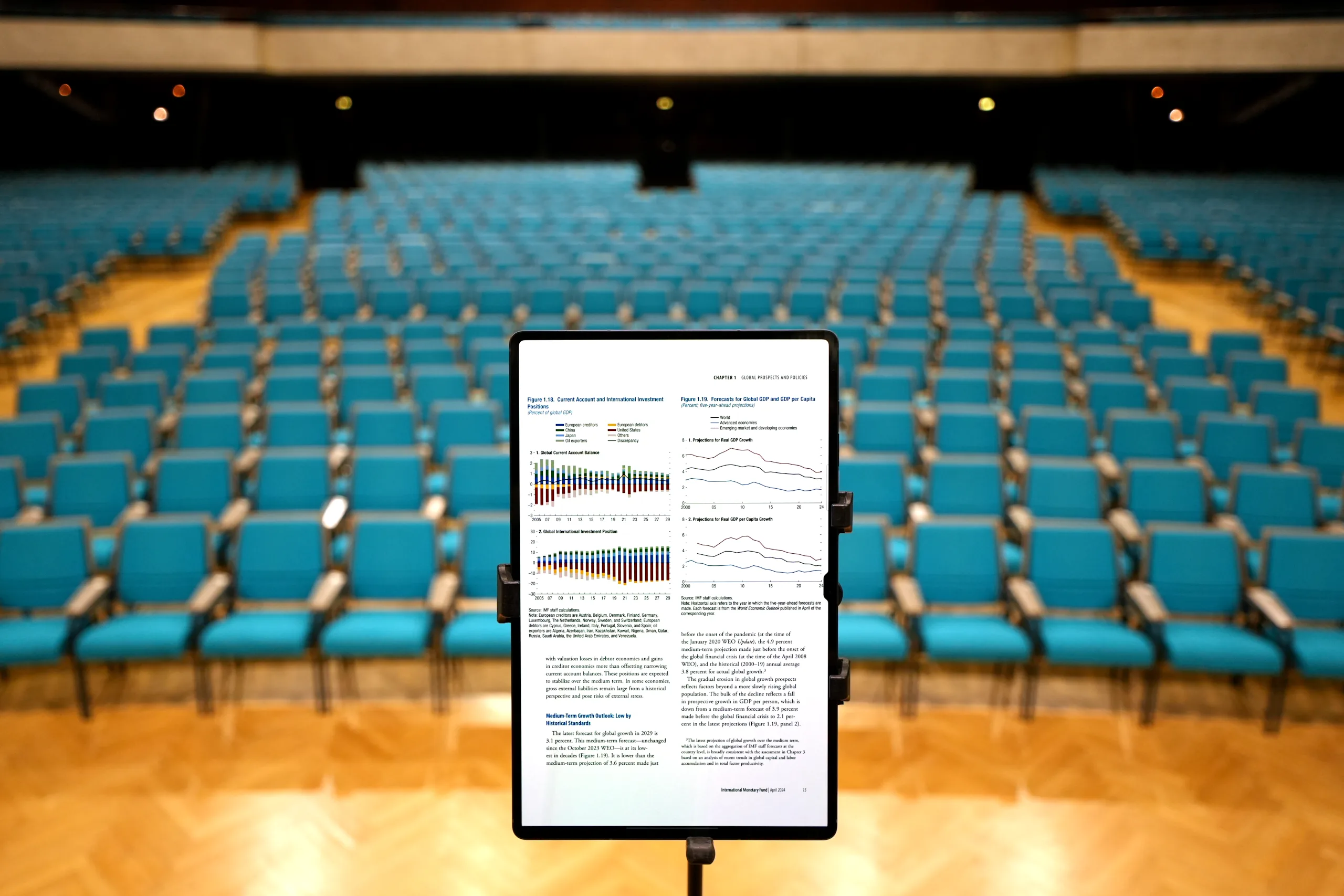
The Samsung Galaxy Tab S10 Ultra is still an excellent tablet, even in 2026, and Samsung offers seven years of security updates. Image credit: large-screens.com
Performance
The Samsung Galaxy Tab S10 Ultra is powered by the MediaTek Dimensity 9300+ processor, released in 2024 and built on a 4 nm process. It is a fast chip: demanding games, large drawings and video editing run smoothly. Compared with other large tablets:
- The Apple M5 in the Apple iPad Pro 13″ (M5) is about twice as fast.
- The MediaTek Dimensity 9500 in the Samsung Galaxy Tab S12 Ultra is about 40 % faster.
- The MediaTek Dimensity 9400+ in the Samsung Galaxy Tab S11 Ultra is about 20 % faster.
Pros
- Same pros as Galaxy Tab S11 Ultra, but also:
- More affordable
- Many used and refurbished buying options
- Security updates until October 2031
Cons
- Same cons as the S11 Ultra, but also:
- Released a while ago, in October 2024
Samsung Galaxy Tab S8/S9 Ultra
Still excellent tablets, even in 2026
Samsung Galaxy Tab S9 Ultra tech specs: OS: Android 13, upgradable to Android 16 and One UI 8.5 (Android 17 expected by the end of 2026) / Processor: Qualcomm Snapdragon 8 Gen 2 (4 nm) / RAM: 12GB or 16GB / Storage: 256GB, 512GB or 1TB / microSD slot: yes (microSDXC) / Colors: beige, graphite / Connections: USB 3.2 Type-C (Gen. 1) / Battery life: up to 10.5 hours (11,200 mAh / 43.45 Wh) / Released: August 2023
Screen specs: Dynamic AMOLED 2X, 120Hz, HDR10+ / Size: 14.6 inches / Max brightness: 420 nits with peak brightness of 930 nits (Samsung), 625 cd/m² with 900 cd/m² peak brightness (Notebookcheck) / Min brightness: 2.0 cd/m² / Resolution: 2960 × 1848 pixels, 240 ppi / Aspect ratio: 16:10 (1.60)
Weight: without keyboard: 25.8 ounces – 1.61 pounds – 732 grams / with “Book Cover Keyboard”: 49.5 ounces – 3.09 pounds – 1.40 kg / with “Book Cover Keyboard Slim”: 42.4 ounces – 2.64 pounds – 1.20 kg
Samsung Galaxy Tab S8 Ultra tech specs: OS: Android 12, upgradable to Android 16 and One UI 8 (final update) / Processor: Snapdragon 8 Gen 1 (4 nm) / RAM: 8GB, 12GB or 16GB / Storage: 128GB, 256GB or 512GB / microSD slot: yes (microSDXC) / Color: graphite / Connections: USB 3.2 Type-C (Gen. 1) / Battery life: up to 10.5 hours (11,200 or 10880 mAh / 42.21 Wh) / Released: February 2022
Screen specs: Super AMOLED, 120Hz, HDR10+ / Size: 14.6 inches / Max brightness: 614 cd/m² with 795 cd/m² peak brightness (Notebookcheck) / Min brightness: 1.5 cd/m² / Resolution: 2960 × 1848 pixels, 240 ppi / Aspect ratio: 16:10 (1.60)
Weight: without keyboard: 25.7 ounces – 1.60 pounds – 728 grams / with “Book Cover Keyboard”: 48.4 ounces – 3.02 pounds – 1.37 kg
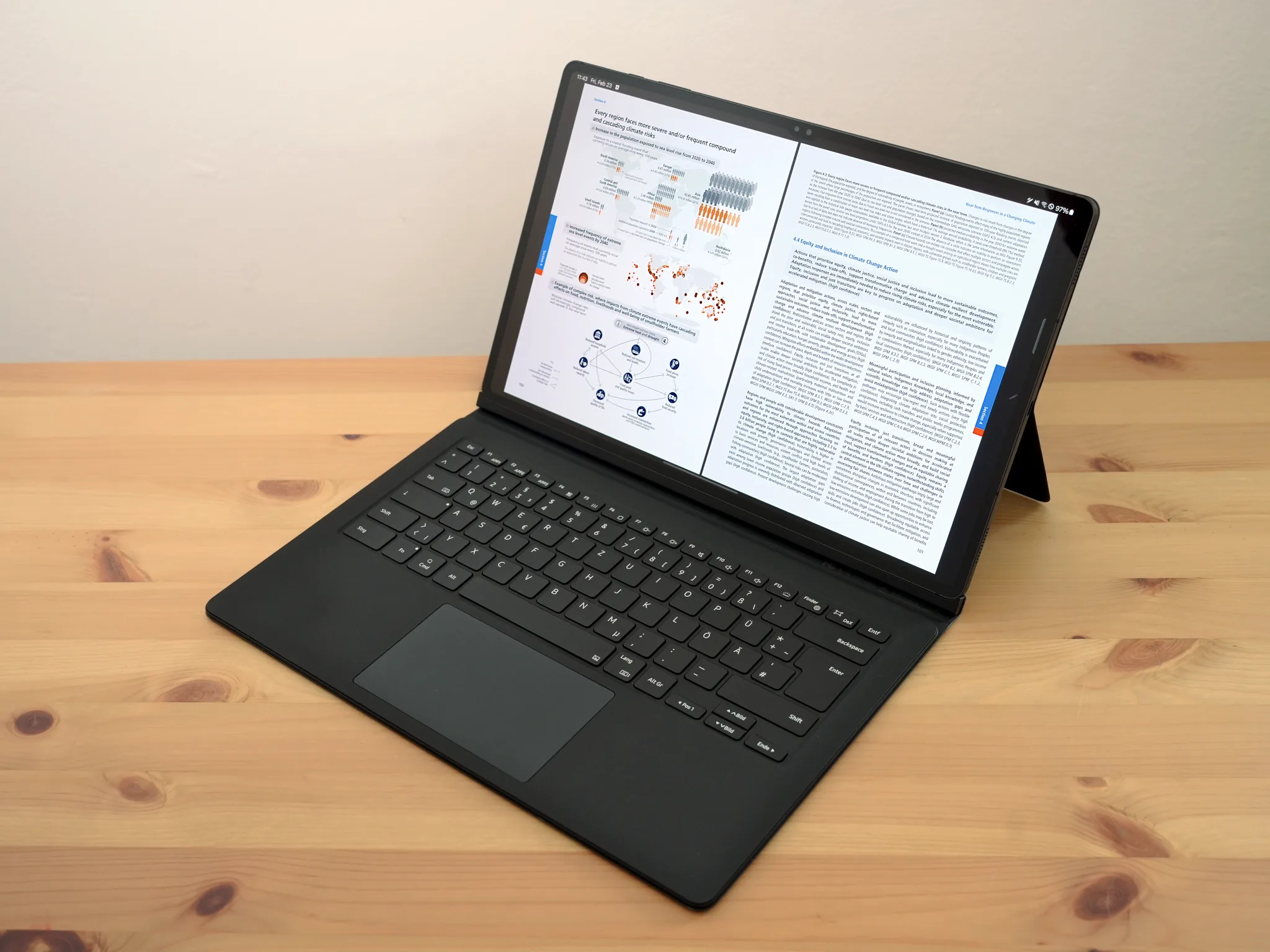
The Samsung Galaxy Tab S8 Ultra is still one of the best large Android tablets, even years after its release. Image credit: large-screens.com
The Samsung Galaxy Tab S8 Ultra and S9 Ultra have been superseded by the S10 and the S11 ultra, but they remain powerful, first-class XXL tablets. Due to their age, they can be way more affordable than their successors.
Compared with Helio G99 processor present in the even larger Meswao MES-B3 and in the TCL NxtPaper 14, the Tab S8 Ultra is at least twice as fast, and the S9 Ultra is a blaze.
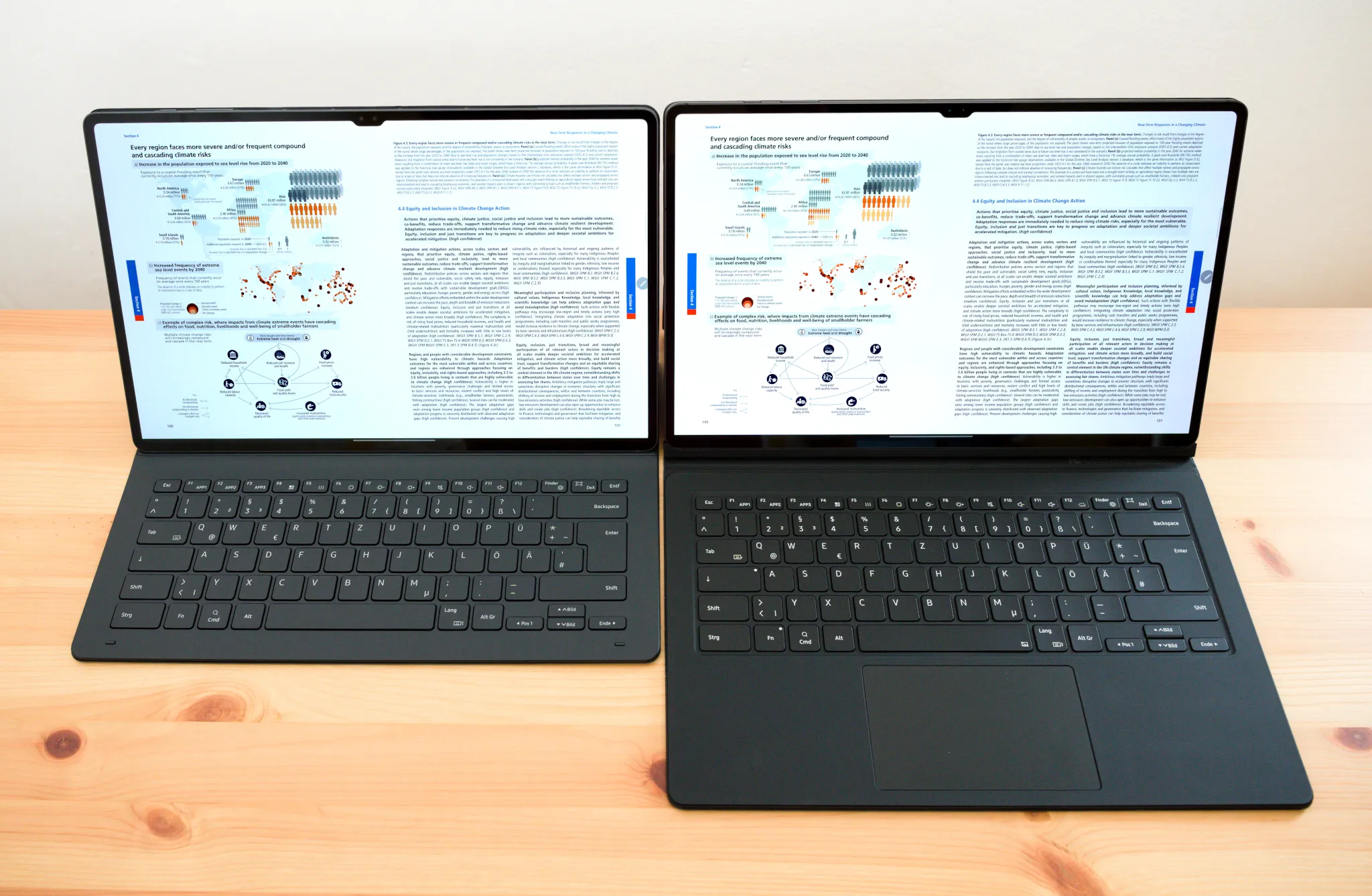
The Samsung Galaxy Tab S8 and S9 Ultra are almost indistinguishable. Here on the left, the S9 Ultra with the “Book Cover Keyboard Slim”, on the right the S8 Ultra with the “Book Cover Keyboard”. Image credit: large-screens.com
Pros
- Same pros as Galaxy Tab S10 Ultra, but also:
- Almost affordable!
- Even more used and refurbished buying options
Cons
- Same cons as the S10 Ultra, but also:
- Released long ago
- Security updates only until April 2027 (S8 Ultra) or August 2028 (S9 Ultra)
Lenovo Yoga Pad Pro 14.5 AI
14.5″ 16:10 · 3000 × 1876 · Lenovo SS1101 · 718 g
Lenovo Yoga Pad Pro 14.5 AI
14.5″ 16:10 · 3000 × 1876 · Lenovo SS1101 · 718 g
A thin 14.5-inch OLED tablet for China, with Lenovo’s own chip and video input
A thin Chinese 14.5-inch OLED tablet from 2025 with Lenovo’s own SS1101 chip, 16 GB of RAM and two USB-C ports for video in and out; bright, but only average in speed.
Lenovo Yoga Pad Pro 14.5 AI tech specs: OS: Android 15 (ZUXOS 1.1), without Google services / Processor: Lenovo SS1101 (2025) / RAM: 16 GB / Storage: 512 GB / Pen: Lenovo stylus (手写笔 Pro, marketed as “AI 妙笔”) (optional) / Keyboard: (optional) / Battery: 12,300 mAh, 68 W charging / Connections: 2 × USB-C: one USB 3.2 Gen 2 with DisplayPort output, one with DisplayPort input (the tablet can be used as a monitor); side fingerprint reader / HD streaming: yes (Widevine L1) / Released: May 2025
Screen specs: OLED, glossy, 120 Hz / Size: 14.5 inches / Max brightness: 1087 cd/m² (AndroPlus) / Resolution: 3000 × 1876 pixels, 244 ppi / Aspect ratio: 16:10 (1.60)
Weight: without keyboard: 25.3 ounces – 1.58 pounds – 718 g
Lenovo Tab Extreme
Huge and slightly more affordable
Lenovo Tab Extreme tech specs: OS: Android 13, upgradable to Android 15 (Android 16 promised by Lenovo) / Processor: Mediatek Dimensity 9000 (4 nm) / RAM: 12GB / Storage: 256GB / microSD slot: yes (microSDXC) / Colors: Storm Grey / Connections: 2 × USB Type-C (1 × 3.2 Gen 1 and 1× 2.0) / Battery life: up to 11.0 hours (12,300 mAh) / Released: June 2023
Screen specs: OLED, 120Hz, HDR10+ / Size: 14.5 inches / Brightness: 500 nits (Lenovo), 479 cd/m² (Notebookcheck) / Min brightness: 4.4 cd/m² / Resolution: 3000 × 1876 pixels, 244 ppi / Aspect ratio: 16:10 (1.60)
Weight: without keyboard: 26.1 ounces – 1.63 pounds – 740 grams / with “Lenovo Tab Extreme Keyboard”: 53.1 ounces – 3.32 pounds – 1.55 kg
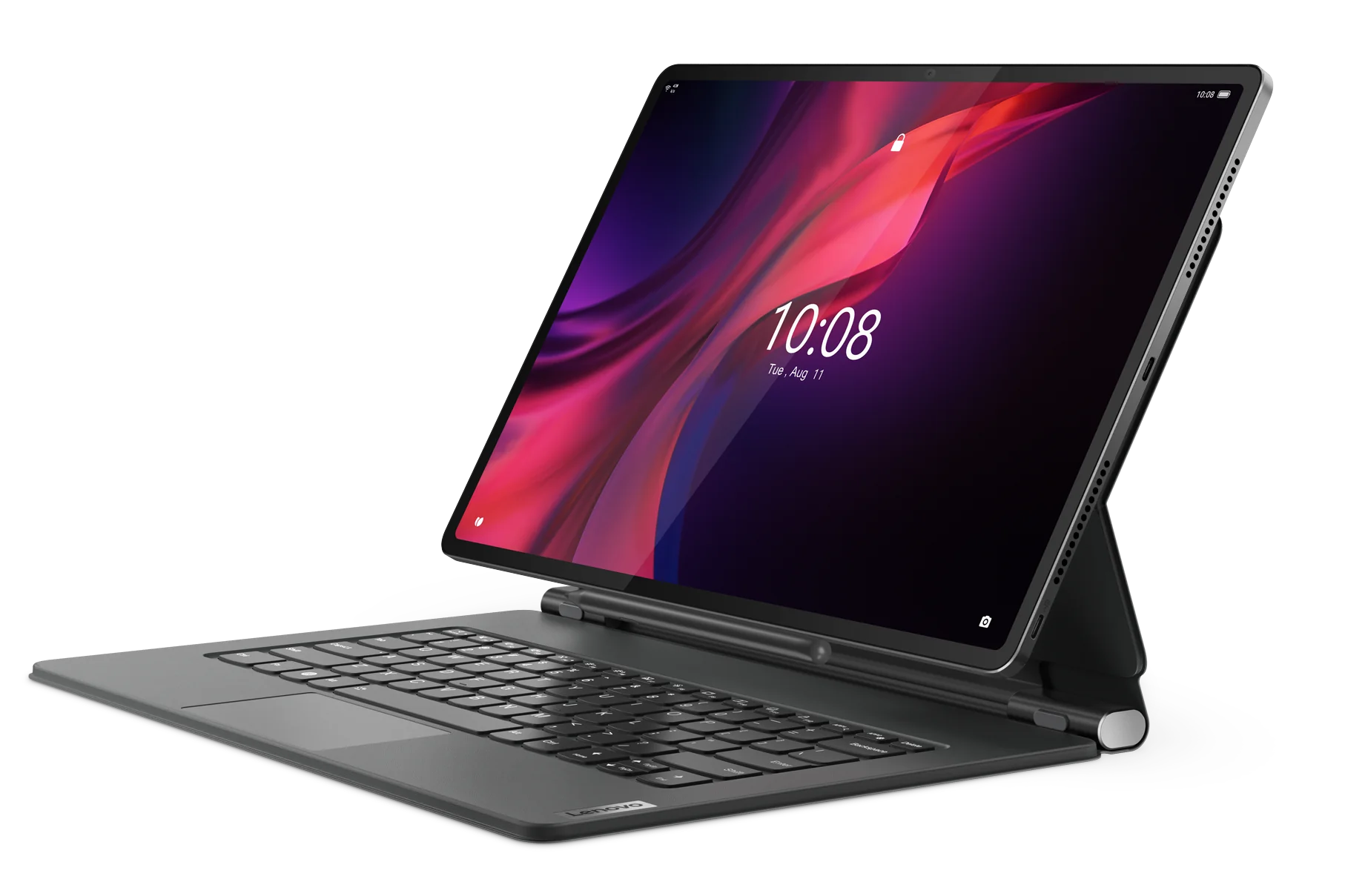
Two USB ports, an excellent keyboard and superfast charging are some outstanding features of the Lenovo Tab Extreme. Image credit: Lenovo
Performance
The Lenovo Tab Extreme is powered by the relatively old MediaTek Dimensity 9000 processor, released in 2021 and built on a 4 nm process. It is a mid-range chip, fast enough for multitasking, drawing apps and most games; only the most demanding games and video editing will push it to its limits. Compared with other large tablets:
- The Apple M5 in the Apple iPad Pro 13″ (M5) is about 3.5 times faster.
- The MediaTek Dimensity 9400+ in the Samsung Galaxy Tab S11 Ultra is about twice as fast.
- The Lenovo Tab Extreme is about 2.5 times faster than the Meswao MES-B3 (Pro) and its MediaTek Helio G99.
Pros
- Beautiful, huge OLED display
- More affordable than Apple’s and Samsung’s flagships
- 2 USB ports
- Great “Magic Keyboard”-style keyboard (optional)
- Stylus is included (Precision Pen 3)
- Superfast 68 W charging
Cons
- Display max brightness (500 nits) is ok, but not great
- Only Wi-Fi, no 5G option
- Very reflective display
- 16:10 aspect ratio is not ideal for everyone
- Only four years of security updates (until March 2027)
Lenovo Tab Extreme Tablet
Note: The Tab Extreme was also sold in the USA, at Best Buy from late May 2023.
TCL NXTPAPER 14
The largest tablet with a matte / nano-textured screen
TCL NxtPaper 14 specs: OS: Android 14 / Processor: MediaTek Helio G99 (6 nm) / RAM: 8GB / Storage: 256GB / microSD slot: yes (microSDXC) / Colors: Navy Blue / Connections: USB 2.0 Type-C / Battery life: up to 8 hours (10,000 mAh) / Released: February 2024
Screen specs: IPS, up to 60 Hz, NxtPaper 3.0 anti-glare / Size: 14.3 inches / Max brightness: 400 nits (TCL) / Resolution: 2400 × 1600 pixels, 202 ppi / Aspect ratio: 3:2 (1.50)
Weight: without keyboard: 26.8 ounces – 1.68 pounds – 760 grams
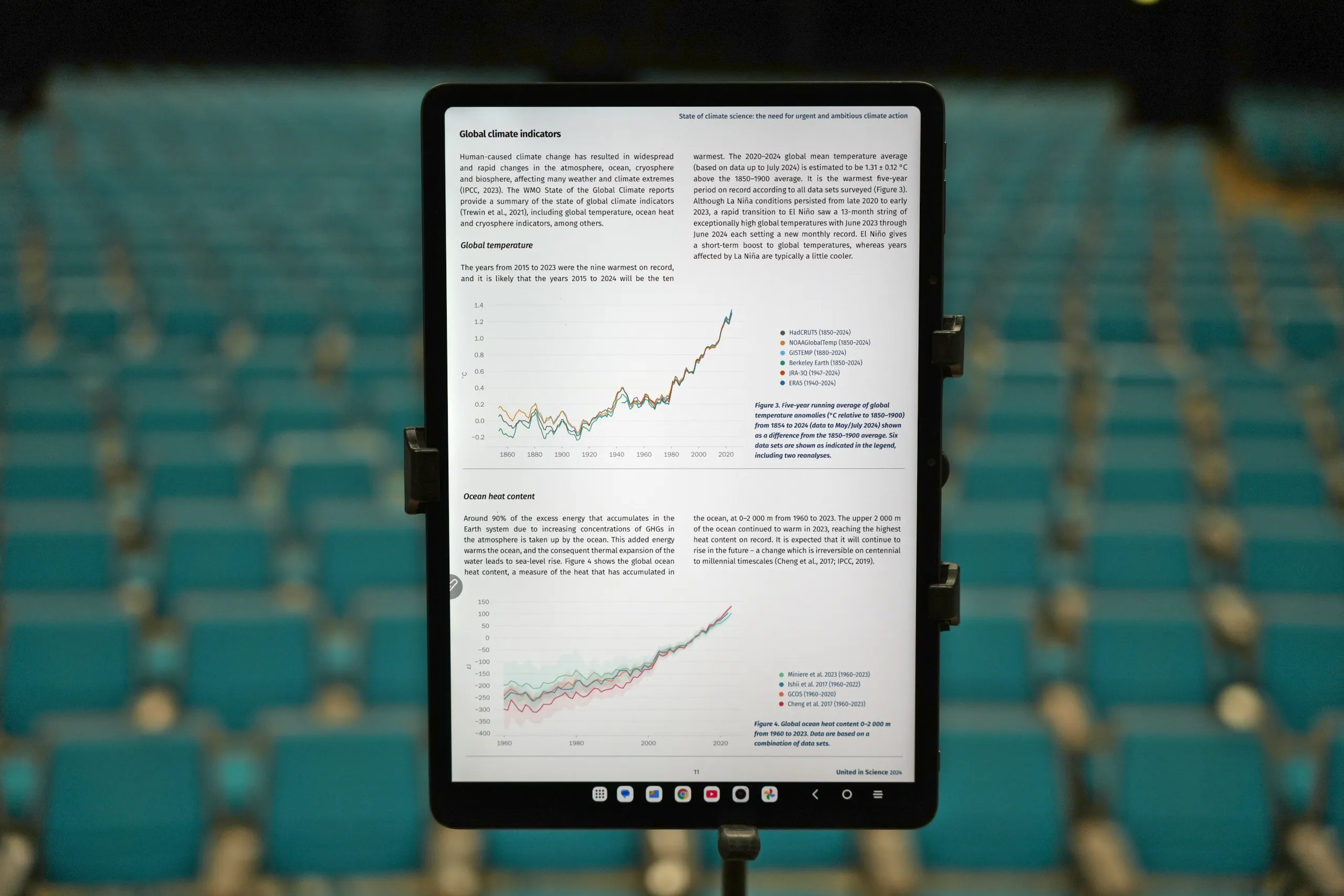
The TCL NXTPAPER 14 is the largest tablet with a matte (aka nano-textured) display. Image credit: large-screens.com
Performance
The TCL NxtPaper 14 is powered by the relatively old MediaTek Helio G99 processor, released in 2022 and built on a 6 nm process. It is fine for streaming, web browsing, documents and casual games, but it is not made for demanding games, video editing or heavy multitasking. The same chip is used in 8 other tablets of our database, including the Ugee Trio Pad UT3 and the Meswao MES-B3 (Pro). Compared with other large tablets:
- The Apple M5 in the Apple iPad Pro 13″ (M5) is about 8 times faster.
- The Qualcomm Snapdragon 855 in the Boox Note Max is about 40 % faster.
- The Unisoc T7300 in the Alldocube iPlay 70 Max Pro is about 20 % faster.
Pros
- Matte NXTPAPER screen with almost no reflections
- Large 14.3-inch 3:2 screen, good for documents
- Ink Paper (black and white) and Color Paper reading modes
- Flicker-free, with a very low minimum (6 nits measured on the Ugee twin)
- 256 GB of storage and a metal body
Cons
- Slow Helio G99 processor and storage
- Not bright enough for direct sunlight (400 nits rated)
- Only 1 Android upgrade and 3 years of security updates
- Weak speakers with little bass
- No microSD slot; pen and keyboard sold separately in the US and Europe
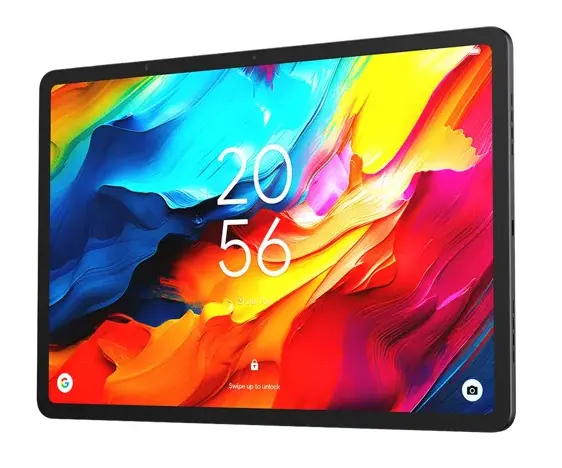
TCL NxtPaper 14 or Ugee UT3: which one to choose?
The Ugee UT3 is Ugee’s version of the TCL NxtPaper 14: the same matte 3:2 TCL screen (2400 × 1600 pixels) with its black-and-white Ink Paper mode, the same Helio G99 chip, 8 GB of RAM, 256 GB of storage (no microSD) and 760 g. What differs is the box and the support:
- Choose the Ugee UT3 for drawing and handwritten notes: a pen (4,096 pressure levels), a folio case and a drawing glove are in the box, and Widevine L1 for HD streaming is confirmed. Ugee publishes no update policy, and in October 2026 the tablet was sold out on Ugee’s US store (still available on its European store).
- Choose the TCL NxtPaper 14 for reading and typing: TCL sells a Bluetooth keyboard for it and promises one Android upgrade and three years of security updates. The pen is extra in the US and Europe.
Ugee Trio Pad UT3 (aka Fun Drawing Pad)
A rebrand of the TCL NxtPaper 14
The Ugee Trio Pad UT3 is a carbon copy of the TCL NxtPaper 14. If one of them is unavailable in your country, choose the other!
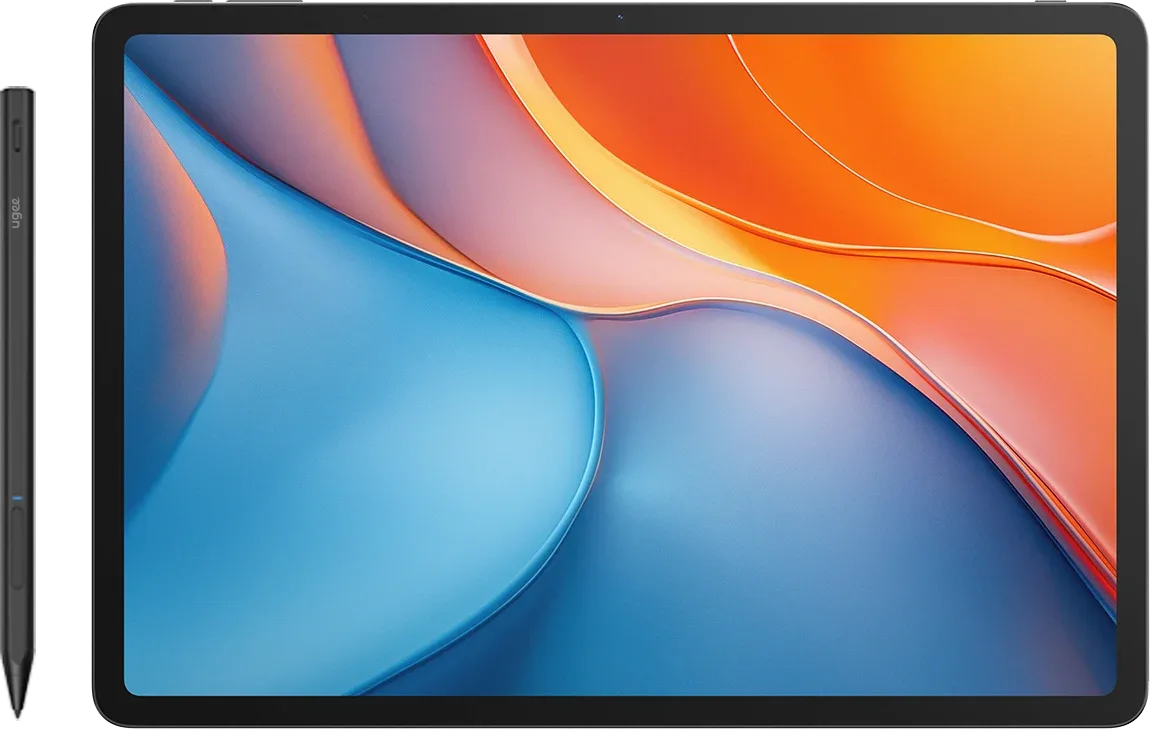
The Ugee UT3 has a nano-textured 14.25-inch screen. Image credit: ugee
Performance
The Ugee Trio Pad UT3 is powered by the relatively old MediaTek Helio G99 processor, released in 2022 and built on a 6 nm process. It is fine for streaming, web browsing, documents and casual games, but it is not made for demanding games, video editing or heavy multitasking. The same chip is used in 8 other tablets of our database, including the TCL NxtPaper 14 and the Meswao MES-B3 (Pro). Compared with other large tablets:
- The Apple M5 in the Apple iPad Pro 13″ (M5) is about 8 times faster.
- The Unisoc T7300 in the Alldocube iPlay 70 Max Pro is about 20 % faster.
- The Ugee Trio Pad UT3 is about 30 % faster than the Callsky Ctab 14 and its Unisoc T616.
Pros
- Large matte 14.25-inch 3:2 screen, no PWM flicker
- Three color modes, including black-and-white Ink Paper
- Pen, folio case and drawing glove included
- Long battery life (13 h in Notebookcheck’s Wi-Fi test)
- Widevine L1 for HD streaming
Cons
- Slow Helio G99 chip and eMMC storage
- Pen lag (20 ms) and jitter on slow diagonal lines
- Heavy to hold (760 g)
- Weak, hollow speakers
- No update policy, old security patches
- No microSD slot, no headphone jack

Acer Iconia Duo S14
14.2″ 1.57:1 · 2880 × 1840 · MediaTek Dimensity 8300 · 730 g
Acer Iconia Duo S14
14.2″ 1.57:1 · 2880 × 1840 · MediaTek Dimensity 8300 · 730 g
A thin 14.2-inch OLED Android tablet that doubles as a portable monitor
Acer’s 14.2-inch OLED Android tablet: thin and light (730 g), with a Dimensity 8300 and USB-C video in and out to double as a portable monitor; not reviewed yet.
Acer Iconia Duo S14 tech specs: OS: Android 16 / Processor: MediaTek Dimensity 8300 (4 nm, 2023) / RAM: 8 GB / Storage: 256 GB (UFS) / microSD slot: yes (up to 1 TB) / Pen: Acer Active Stylus (optional) / Keyboard: Acer detachable keyboard (optional) / Battery: 10,000 mAh, 20 W charging / Connections: 2 × USB-C (DisplayPort in and out), microSD / Released: September 2026
Screen specs: OLED, glossy, 120 Hz / Size: 14.2 inches / Max brightness: 400 nits (Acer) / Resolution: 2880 × 1840 pixels, 241 ppi / Aspect ratio: 1.57:1
Weight: without keyboard: 25.8 ounces – 1.61 pounds – 730 g

Huawei MatePad Edge
14.2″ 3:2 · 3120 × 2080 · Huawei Kirin X90A · 789 g
Huawei MatePad Edge
14.2″ 3:2 · 3120 × 2080 · Huawei Kirin X90A · 789 g
A 14.2-inch 3:2 OLED 2-in-1 with fans and a built-in stand, running HarmonyOS (China only)
Huawei’s 14.2-inch 3:2 OLED 2-in-1 with a built-in stand, cooling fans and up to 32 GB of RAM — sold only in China and running HarmonyOS NEXT, without Android apps or Google services.
Huawei MatePad Edge tech specs: OS: HarmonyOS 6.1, without Google services / Processor: Huawei Kirin X90A (2025) / RAM: 16 GB or 24 GB or 32 GB / Storage: 256 GB or 512 GB or 1 TB or 2 TB / microSD slot: no / Pen: Huawei M-Pencil Pro (optional) / Keyboard: Huawei Starry Leap floating keyboard (optional, with touchpad) / Battery: 12,900 mAh, 140 W charging / Connections: 1 × USB-C (USB 3.1 Gen 1, DisplayPort 1.2); 40 W reverse charging / Released: November 2025
Screen specs: OLED, matte version available (Soft Light / PaperMatte (柔光版)), 120 Hz / Size: 14.2 inches / Resolution: 3120 × 2080 pixels, 264 ppi / Aspect ratio: 3:2 (1.50)
Weight: without keyboard: 27.8 ounces – 1.74 pounds – 789 g
Callsky Ctab 14
A big, cheap Android tablet with a low-brightness 14.1-inch display and weak CPU.
Callsky Ctab 14 tech specs: OS: Android 14 / Processor: Unisoc Tiger T616 aka T7255, released 2021 (12 nm) / RAM: 8 GB / Storage: 256 GB / microSD slot: yes (microSD, up to 2TB) / Connections:1 × USB Type-C / Battery: 10,000 mAh / Released: December 2024
Screen specs: IPS / Size: 14.1 inches / Brightness: 290 nits (Callsky) / Resolution: 1920 × 1200 pixels, 161 ppi / Aspect ratio: 16:10 (1.60)
Weight: 35.1 ounces – 2.20 pounds – 996 grams
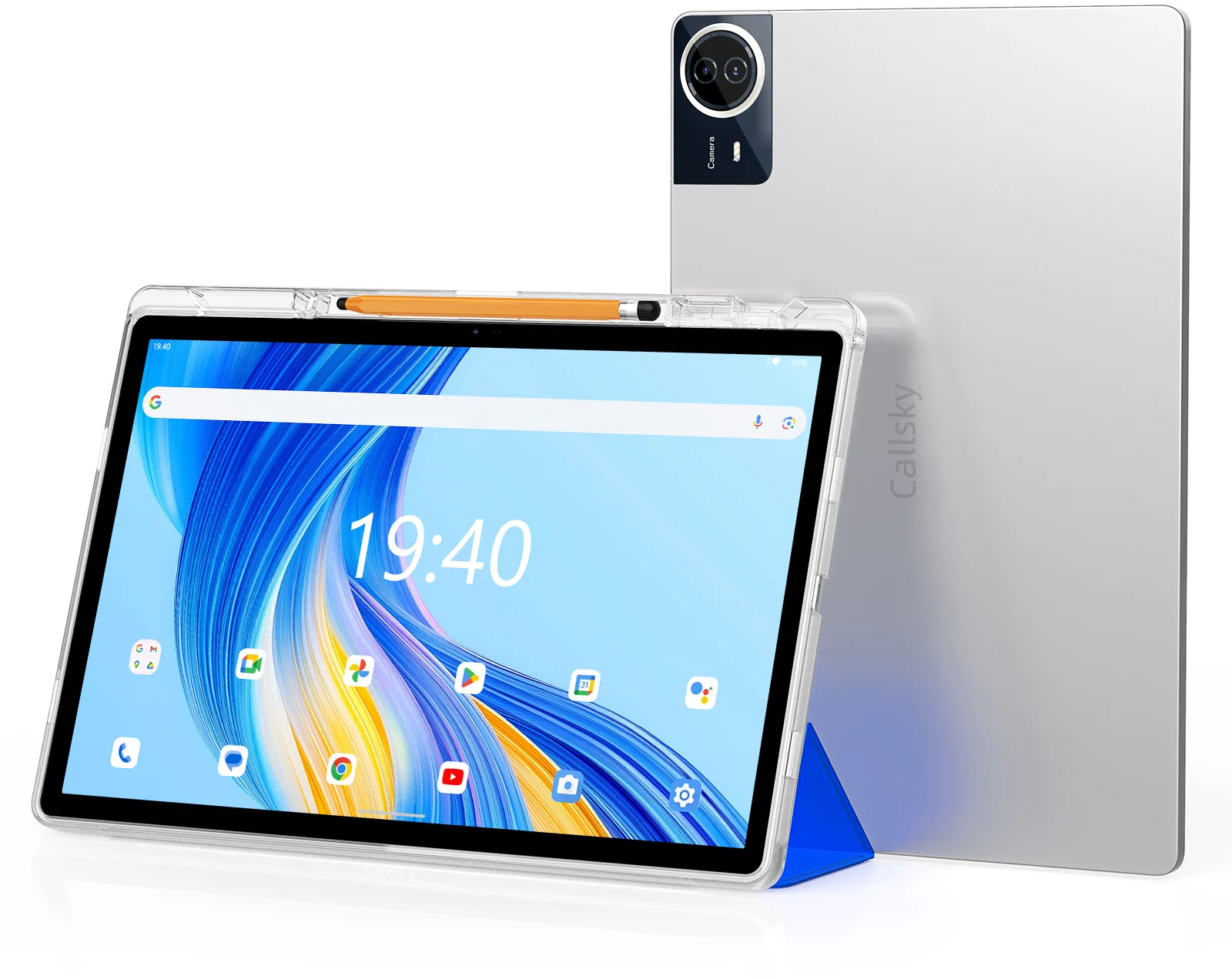
The Callsky-Tab Ctab 14 has subpar specs, but it has a large 14.1-inch screen and comes with a case and stylus. Image credit: Callsky
Performance
The Callsky Ctab 14 is powered by the relatively old Unisoc T616 processor, released in 2021 and built on a 12 nm process. It is an entry-level chip: fine for videos, web browsing, reading and taking notes, but apps open slowly and games have to run at low settings. Compared with other large tablets:
- The Apple M5 in the Apple iPad Pro 13″ (M5) is about 10 times faster.
- The MediaTek Helio G100 in the Doogee Tab E3 Max is about 10 % faster.
Pros
- Great price
- Large 14.1-inch screen
- 16:10 aspect ratio (better than 16:9)
- Comes with a case and an (ugly) stylus
- 1-year warranty, 2 years with registration
Cons
- Display max brightness is only 290 (!) nits
- Very slow Unisoc Tiger T616 processor
- Heavy (2.2 lb or 996 g)
- Slow 18 W charging
- Unclear security updates situation

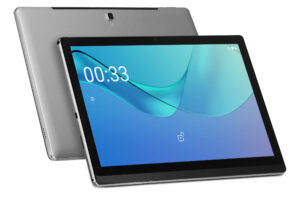
Meswao B1 (MES-B1)
14.1″ 16:9 · 1920 × 1080 · MediaTek MT6769 · 1,020 g
Meswao B1 (MES-B1)
14.1″ 16:9 · 1920 × 1080 · MediaTek MT6769 · 1,020 g
Meswao’s cheapest large tablet: a 14.1-inch Android screen at a very low price
Meswao’s cheapest large tablet: a 14.1-inch Full HD screen and an optional keyboard at a very low price, but a slow 2020 chip, a 350-nit screen and Android 13 without updates.
Meswao B1 (MES-B1) tech specs: OS: Android 13 / Processor: MediaTek MT6769 (12 nm, 2020) / RAM: 6 GB / Storage: 128 GB / microSD slot: yes (up to 2 TB [Meswao]) / Keyboard: Meswao Foldable Bluetooth Keyboard with Touchpad (optional, with touchpad) / Battery: 10,000 mAh, 15 W charging / Connections: 1 × USB-C, microSD slot / Released: October 2025
Screen specs: IPS LCD, glossy / Size: 14.1 inches / Max brightness: 350 nits (Meswao) / Resolution: 1920 × 1080 pixels, 156 ppi / Aspect ratio: 16:9 (1.78)
Weight: without keyboard: 36.0 ounces – 2.25 pounds – 1,020 g
Sponsored
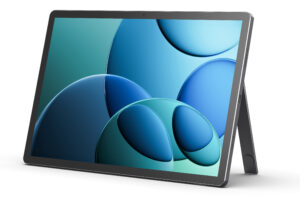
Acer Iconia X14 / A14
14.0″ 16:10 · 1920 × 1200 · Allwinner A733 · 910 g
Acer Iconia X14 / A14
14.0″ 16:10 · 1920 × 1200 · Allwinner A733 · 910 g
A low-cost 14-inch OLED tablet with a built-in kickstand, but a slow chip
A low-cost 14-inch Android tablet with an OLED screen (IPS on the A14) and a built-in kickstand, for videos and browsing; its chip is slow.
Acer Iconia X14 / A14 tech specs: OS: Android 15 / Processor: Allwinner A733 (12 nm, 2024) / RAM: 6 GB or 8 GB / Storage: 128 GB or 256 GB (UFS 3.1) / microSD slot: yes (up to 1 TB) / Pen: no official one / Keyboard: no official one / Battery: 8000 mAh / Connections: 1 × USB-C (USB 2.0) / Released: November 2025
Screen specs: OLED, glossy, 60 Hz / Size: 14.0 inches / Resolution: 1920 × 1200 pixels, 162 ppi / Aspect ratio: 16:10 (1.60)
Weight: without keyboard: 32.1 ounces – 2.01 pounds – 910 g
Sponsored
Asus ProArt PZ14
The largest Windows tablet from a major brand: a 14-inch 144 Hz OLED at 790 g
Asus ProArt PZ14 tech specs: OS: Windows 11 Home (Arm) / Processor: Qualcomm Snapdragon X2 Elite X2E88100 (18 cores) / RAM: 16 GB or 32 GB / Storage: 512 GB or 1 TB (PCIe 4.0 NVMe M.2 2230 SSD) / microSD slot: yes (SD Express 7.0 card reader) / Pen: Asus Pen 3.0 (MPP 2.6, 4,096 pressure levels, haptic feedback; listed as SA205H in the Asus spec sheet) (included) / Keyboard: Asus ProArt PZ14 detachable Bluetooth keyboard (backlit, 1.7 mm key travel, spill-resistant, Copilot key) (included, with touchpad) / Battery: 75 Wh, 68 W charging — 8.3 hours (Les Numériques) / Connections: 2 × USB4 Type-C (40 Gbps, DisplayPort, power delivery), SD Express 7.0 card reader / Released: May 2026
Screen specs: OLED, anti-reflective, 144 Hz / Size: 14.0 inches / Max brightness: 500 nits (Asus), 522 cd/m² (Notebookcheck (average; 505 centre; HDR peak 1,142. Les Numériques: 481)) / Min brightness: 8.4 cd/m² (Notebookcheck) / Resolution: 2880 × 1800 pixels, 243 ppi / Aspect ratio: 16:10 (1.60)
Weight: without keyboard: 27.9 ounces – 1.74 pounds – 790 g / with keyboard: 55.0 ounces – 3.44 pounds – 1,559 g
Verdict: a top-rated 14-inch Windows tablet for creatives
The Asus ProArt PZ14 is a 14-inch Windows 11 tablet for photographers and designers. It replaces the 13.3-inch ProArt PZ13 and went on sale in May and June 2026. Les Numériques calls it the largest Windows 11 tablet PC. Notebookcheck rated it 90 % and called it an excellent tablet for creatives; TechRadar gave it 4/5.
Screen: 144 Hz OLED, accurate colors, some PWM flicker
The screen is about 9 % larger than that of the 13-inch iPad Pro, in 16:10, a wide format made for videos. The 3K OLED panel (2880 × 1800, 243 ppi) runs at 144 Hz and is very color-accurate. Notebookcheck measured 522 nits (1,142 nits in HDR), a minimum of 8.4 nits and PWM flicker at 720 Hz, which may bother sensitive eyes. The glass is glossy with an anti-reflection coating: TechRadar saw few reflections outdoors, Gadgets 360 was bothered by office lights.
Speed: fast and quiet, but the graphics lag behind
The Snapdragon X2 Elite (18 cores) with 32 GB of RAM is fast and very quiet in everyday use, but the fans are clearly audible at full power, and its graphics are slower than in AMD and Intel rivals. On Windows on Arm, Adobe apps ran well in the reviews, but some games and older programs do not run.
Keyboard and pen in the box; 8 to 11 hours of battery
The backlit Bluetooth keyboard with touchpad and a stand cover are in the box, and in most countries also the Asus Pen 3.0 with haptic feedback. The keyboard types well on a desk, but TechRadar and Gadgets 360 found the set-up unstable on the lap. Gadgets 360 got about 11 hours of everyday use from the 75 Wh battery; Les Numériques measured 8 hours 16 minutes of video. The tablet weighs 790 g, about 1.56 kg with keyboard and cover. It has two speakers, two USB4 ports and a fast SD Express card reader, but no headphone jack.
Where it is sold, and where the pen is included
It is sold in the US and in Europe; in Germany and Spain the pen is included, in France it is not (Asus).
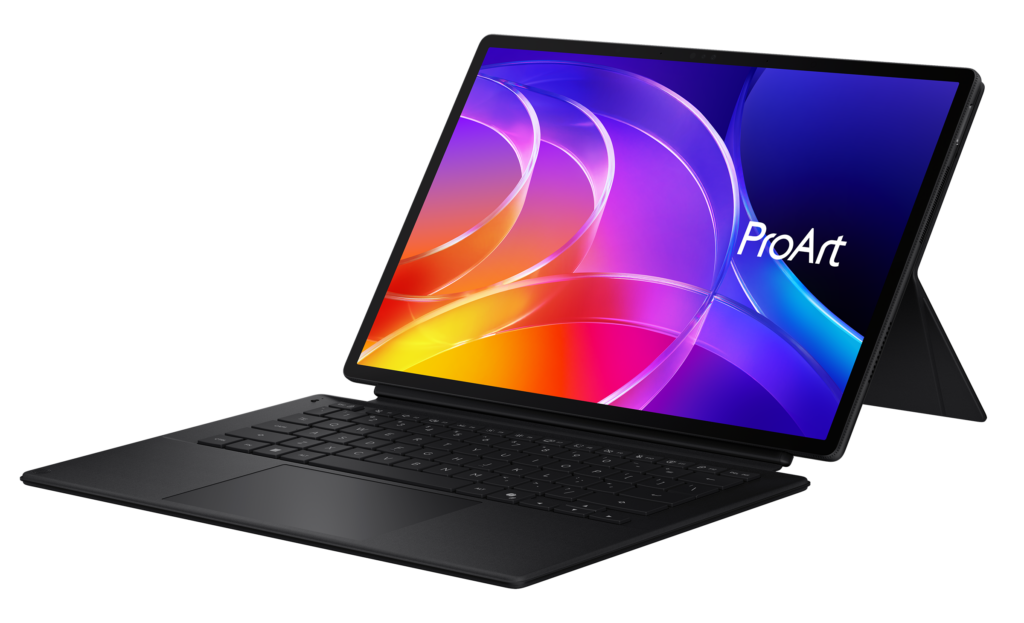
The Asus ProArt PZ14 with its detachable keyboard (included). Image: ASUS
Performance
The Asus ProArt PZ14 is powered by the Qualcomm Snapdragon X2 Elite X2E-88-100 processor, released in 2025 and built on a 3 nm process. It is one of the fastest chips in any tablet: it handles everything, including heavy video editing, 3D work and the most demanding games. Compared with other large tablets:
- The AMD Ryzen AI Max+ 395 in the Asus ROG Flow Z13 (2025) is about 20 % faster.
- The Asus ProArt PZ14 is about 40 % faster than the Microsoft Surface Pro 13-inch, 12th Edition and its Qualcomm Snapdragon X2 Plus X2P-64-100.
- The Asus ProArt PZ14 is about 60 % faster than the Asus ProArt PZ13 and its Qualcomm Snapdragon X Plus X1P-42-100.
Pros
- Color-accurate 14-inch 3K OLED at 144 Hz (Delta E 1.2 measured)
- Light for its size (790 g)
- Keyboard, stand cover and (in most countries) pen included
- Fast and very quiet in everyday use
- Good battery life (about 11 h of everyday use)
- Fast SD Express card reader (729 MB/s) and two USB4 ports
Cons
- Expensive
- Keyboard and stand unstable on the lap
- Fans loud at full power (47 dB(A) measured)
- Windows on Arm: some games and older programs do not run
- No headphone jack, only two USB-C ports
Sponsored
Doogee Tab E3 Max
A great entry-level 14-inch tablet
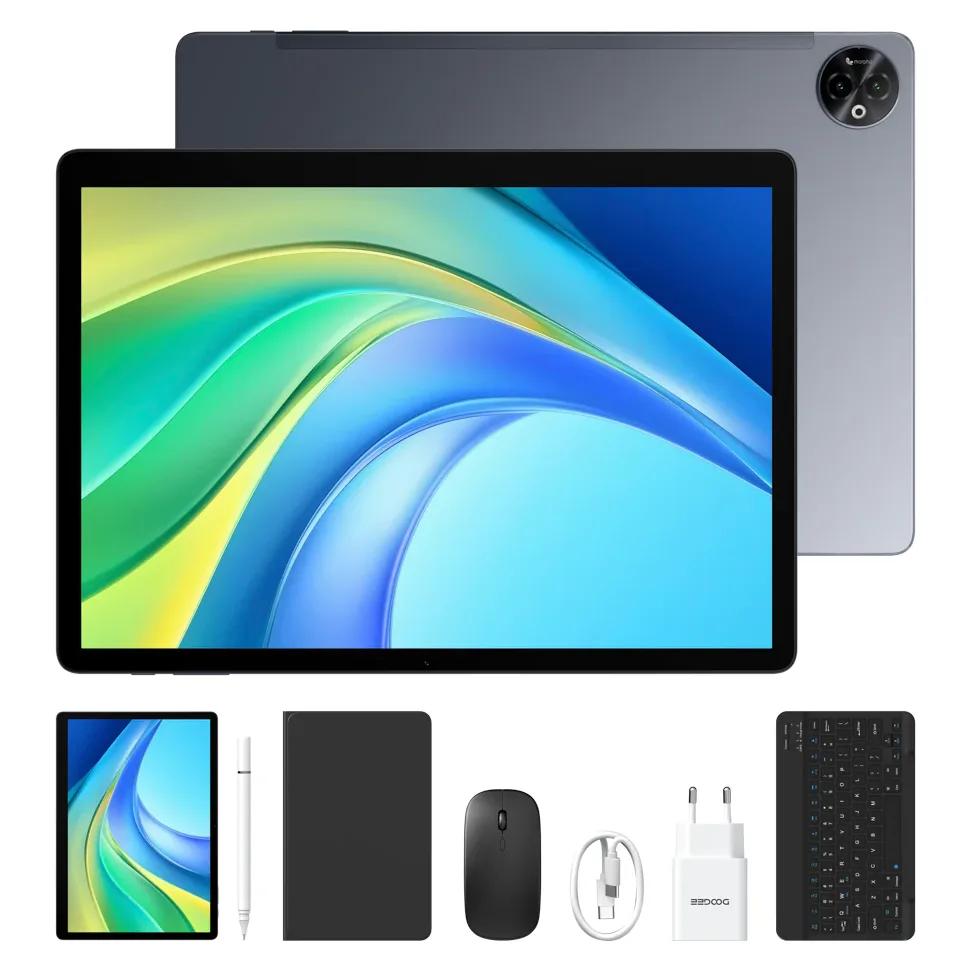
The Doogee Tab E3 Max is one of the few entry-level large tablets which come with LTE support. It also ships with many accessories by default. Image credit: Doogee
Performance
The Doogee Tab E3 Max is powered by the MediaTek Helio G100 processor, released in 2024 and built on a 6 nm process. It is an entry-level chip: fine for videos, web browsing, reading and taking notes, but apps open slowly and games have to run at low settings. The same chip is used in the Doogee Tab E3 Pro / U13 and the Teclast T70 Pro. Compared with other large tablets:
- The Apple M5 in the Apple iPad Pro 13″ (M5) is about 9 times faster.
- The Unisoc T7300 in the Alldocube iPlay 70 Max Pro is about 30 % faster.
- The Doogee Tab E3 Max is about 20 % faster than the Acer Iconia A16 and its Allwinner A733.
Pros
- Great value
- 2.1K high-resolution 14-inch screen
- 3:2 aspect ratio, good for work or browsing
- Large 13500 mAh battery
- MicroSDXC card support, up to 2TB
- Cellular / LTE support!
- Comes with many accessories
Cons
- Display max brightness is only 300 nits
- Sluggish Helio G100 processor
- Heavy (2.2 lb or 1002 g)
- Slow 18 W charging
- Unclear security updates situation
- Only 1-year warranty with shipping costs to Poland!
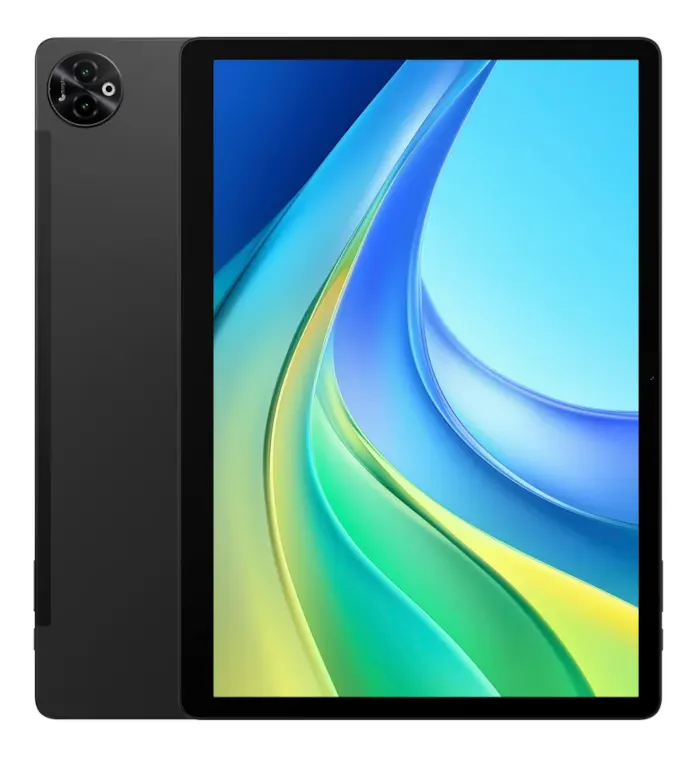

Doogee U14
14.0″ 16:10 · 2240 × 1400 · Rockchip RK3576S · 858 g
Doogee U14
14.0″ 16:10 · 2240 × 1400 · Rockchip RK3576S · 858 g
A 14-inch Android tablet with a 2.2K 90 Hz screen, six speakers and a 14,000 mAh battery
A 14-inch Android 16 tablet with a 2240 × 1400 screen, Widevine L1, six speakers and a 14,000 mAh battery, held back by a slow Rockchip chip.
Doogee U14 tech specs: OS: Android 16 / Processor: Rockchip RK3576S (8 nm) / RAM: 8 GB / Storage: 256 GB (UFS) / microSD slot: yes (up to 2 TB) / Pen: Doogee stylus (U14 + Accessories bundle) (optional) / Keyboard: Doogee Bluetooth keyboard (U14 + Accessories bundle) (optional, with touchpad) / Battery: 14,000 mAh, 33 W charging / Connections: 1 × USB-C (OTG) / HD streaming: yes (Widevine L1) / Released: September 2026
Screen specs: IPS LCD (in-cell), glossy, 90 Hz / Size: 14.0 inches / Resolution: 2240 × 1400 pixels, 189 ppi / Aspect ratio: 16:10 (1.60)
Weight: without keyboard: 30.3 ounces – 1.89 pounds – 858 g
Sponsored

Meswao MES-B2
14.0″ 16:9 · 1920 × 1080 · MediaTek MT6769 · 1,025 g
Meswao MES-B2
14.0″ 16:9 · 1920 × 1080 · MediaTek MT6769 · 1,025 g
A low-cost 14-inch Android tablet with active pen support
A low-cost 14-inch Android tablet with a wide 16:9 screen and active pen support, but an old entry-level chip, a dim low-resolution display and no independent reviews.
Meswao MES-B2 tech specs: OS: Android 13 / Processor: MediaTek MT6769 (12 nm, 2020) / RAM: 6 GB / Storage: 128 GB / microSD slot: yes (up to 2 TB [Meswao]) / Pen: Meswao Stylus Pen (Microsoft MPP 2.0) (optional) / Keyboard: Meswao Foldable Bluetooth Keyboard with Touchpad (optional, with touchpad) / Battery: 10,000 mAh, 15 W charging / Connections: 1 × USB-C / Released: 2024
Screen specs: IPS LCD, glossy / Size: 14.0 inches / Max brightness: 350 nits (Meswao) / Resolution: 1920 × 1080 pixels, 157 ppi / Aspect ratio: 16:9 (1.78)
Weight: without keyboard: 36.2 ounces – 2.26 pounds – 1,025 g
Sponsored

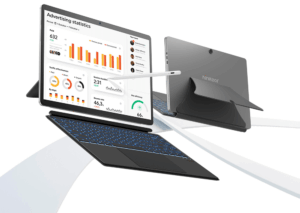
Ninkear T40
14.0″ 16:10 · 1920 × 1200 · Intel Processor N100 · 989 g
Ninkear T40
14.0″ 16:10 · 1920 × 1200 · Intel Processor N100 · 989 g
A low-cost 14-inch Windows 11 2-in-1 with keyboard, Intel N100 and 16 GB of RAM
A low-cost 14-inch Windows 11 tablet with an Intel N100, 16 GB of RAM and a backlit keyboard included, but a dim 250-nit screen and no independent review yet.
Ninkear T40 tech specs: OS: Windows 11 / Processor: Intel Processor N100 (10 nm, 2023) / RAM: 16 GB / Storage: 512 GB (SATA SSD [M.2 2242]) / microSD slot: no / Keyboard: Ninkear detachable keyboard (RGB backlit) (included, with touchpad) / Battery: 5000 mAh, 36 W charging / Connections: 2 × USB-C (1 full-featured, 1 data only), 1 × micro HDMI / Released: March 2024
Screen specs: IPS LCD, glossy / Size: 14.0 inches / Max brightness: 250 nits (Ninkear) / Resolution: 1920 × 1200 pixels, 162 ppi / Aspect ratio: 16:10 (1.60)
Weight: without keyboard: 34.9 ounces – 2.18 pounds – 989 g
Sponsored
OneXPlayer Super X
14.0″ 16:10 · 2880 × 1800 · AMD Ryzen AI Max+ 395 / Ryzen AI Max+ 388 · 1,300 g
OneXPlayer Super X
14.0″ 16:10 · 2880 × 1800 · AMD Ryzen AI Max+ 395 / Ryzen AI Max+ 388 · 1,300 g
A 14-inch Windows gaming tablet with AMD's Ryzen AI Max+ chip and a keyboard included
A 14-inch Windows gaming tablet with AMD's Ryzen AI Max+ chip, a 120 Hz 2.8K AMOLED screen and a keyboard included, at a very high price; no full independent review yet.
OneXPlayer Super X tech specs: OS: Windows 11 / Processor: AMD Ryzen AI Max+ 395 / Ryzen AI Max+ 388 (4 nm) / RAM: 48 GB or 64 GB or 128 GB / Storage: 1 TB or 2 TB (M.2 2280 PCIe 4.0 SSD + external ‘Mini SSD’ slot) / microSD slot: yes (microSD [TF 4.0], up to 2 TB) / Pen: (optional) / Keyboard: OneXPlayer 2-in-1 RGB magnetic keyboard (included) / Battery: 22,000 mAh, 100 W charging / Connections: 2 × USB4 (USB-C), 1 × USB-A 3.2, HDMI 2.1, 3.5 mm audio jack, microSD slot, Mini SSD slot, proprietary charging port, pogo pins for the keyboard / Released: February 2026
Screen specs: AMOLED, glossy, 120 Hz / Size: 14.0 inches / Resolution: 2880 × 1800 pixels, 243 ppi / Aspect ratio: 16:10 (1.60)
Weight: without keyboard: 45.9 ounces – 2.87 pounds – 1,300 g
Sponsored

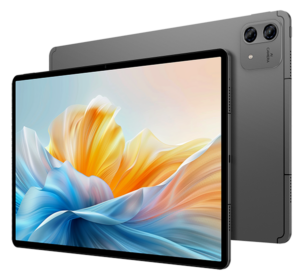
Teclast T70 Pro
14.0″ 16:10 · 2240 × 1400 · MediaTek Helio G100 · 800 g
Teclast T70 Pro
14.0″ 16:10 · 2240 × 1400 · MediaTek Helio G100 · 800 g
A thin 14-inch Android 16 tablet with 4G, a 2.2K screen and an optional keyboard case
A thin 14-inch Android 16 tablet with a 2240 × 1400 screen, dual 4G and an optional keyboard with touchpad, held back by an entry-level Helio G100 and 128 GB of storage.
Teclast T70 Pro tech specs: OS: Android 16 / Processor: MediaTek Helio G100 (6 nm, 2024) / RAM: 8 GB / Storage: 128 GB / microSD slot: yes (up to 1 TB) / Keyboard: Teclast magnetic keyboard case (optional, with touchpad) / Battery: 10,000 mAh, 18 W charging / Connections: 1 × USB-C / HD streaming: yes (Widevine L1) / Released: 2026
Screen specs: IPS LCD, glossy, 60 Hz / Size: 14.0 inches / Resolution: 2240 × 1400 pixels, 189 ppi / Aspect ratio: 16:10 (1.60)
Weight: without keyboard: 28.2 ounces – 1.76 pounds – 800 g
Sponsored
Wacom MovinkPad Pro 14
A high-quality combo of a Wacom drawing pad and a large Android tablet
MovinkPad Pro 14 specifications: OS: Android 15 / Processor: Snapdragon 8s Gen3 (4 nm, 2024) / Graphics: Qualcomm Adreno 735 / RAM: 12GB / Storage: 256GB / microSD slot: yes (microSDXC) / Color: Light Gray / Connections: USB 2.0 Type-C / Battery life: up to 10.5 hours (10,000 mAh) / Stylus: Wacom Pro Pen 3 with Nib holder, battery-free (EMR technology) / Released: October 2025
Screen specs: OLED with Wacom Premium Textured Glass, 100% sRGB, 100% DCIP3, 60/120 Hz / Size: 14.0 inches / Max brightness: 400 nits, 900 nits in HDR / Min brightness: n/a / Resolution: 2880 × 1800 pixels, 243 ppi / Aspect ratio: 16:10 (1.60)
Weight without keyboard: 24.7 ounces – 1.54 pounds – 699 grams
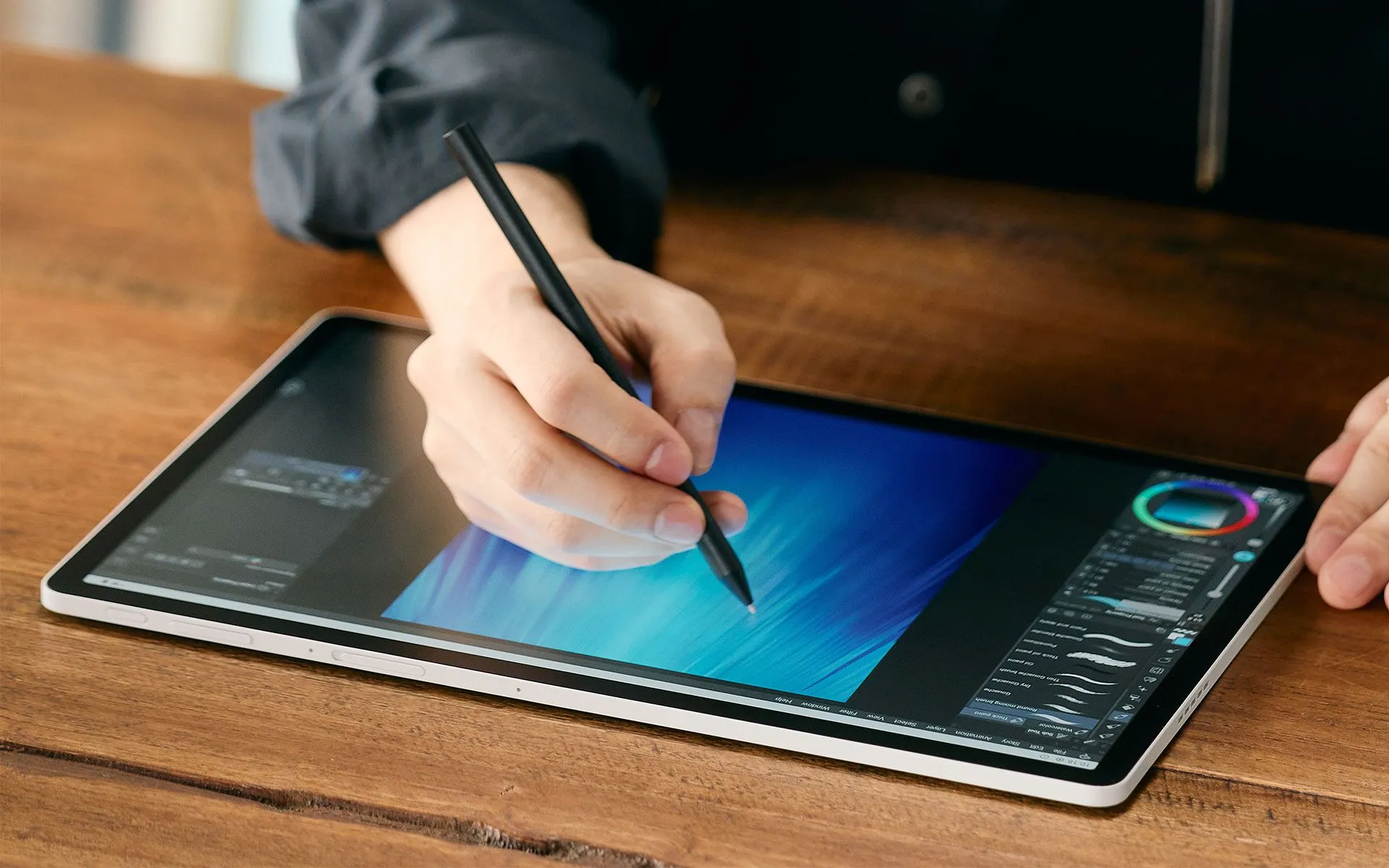
The MovinkPad Pro 14 is the first large Wacom drawing pad that doubles as a fully-fledged Android tablet. Image credit: Wacom
Performance
The Wacom MovinkPad Pro 14 is powered by the Qualcomm Snapdragon 8s Gen 3 processor, released in 2024 and built on a 4 nm process. It is a mid-range chip, fast enough for multitasking, drawing apps and most games; only the most demanding games and video editing will push it to its limits. Compared with other large tablets:
- The Apple M5 in the Apple iPad Pro 13″ (M5) is about 3 times faster.
- The MediaTek Dimensity 9500 in the Samsung Galaxy Tab S12 Ultra is about twice as fast.
- The MediaTek Dimensity 9400+ in the Samsung Galaxy Tab S11 Ultra is about 70 % faster.
Pros
- Finally, a real Wacom Android tablet and drawing pad combo!
- 3K high-resolution 14-inch OLED screen
- Anti-reflection and anti-glare textured glass
- Great stylus and broad stylus compatibility
- Good performance
Cons
- The display’s maximum brightness is only 400 nits.
- No cellular / LTE support
- Rather small battery (10,000 mAh)
- Very expensive
- No security updates and Android upgrade policy
Sponsored
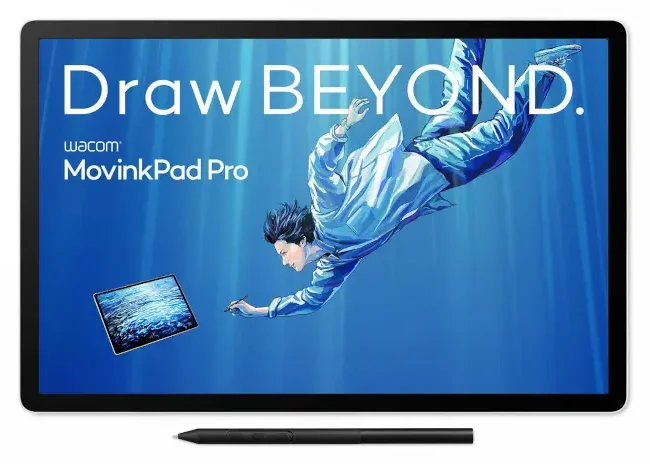
Xiaomi Pad 7 Ultra
Probably the best 14-inch tablet after the Samsung Tab S10/S11 Ultra
The Pad 7 Ultra stands out for its excellent battery life and performance. It outperforms its rival, the Samsung Tab S10 Ultra, with a 30% longer battery life and 120-watt charging. Its in-house SOC is highly performant, especially thanks to its Immortalis G925 graphics chip.
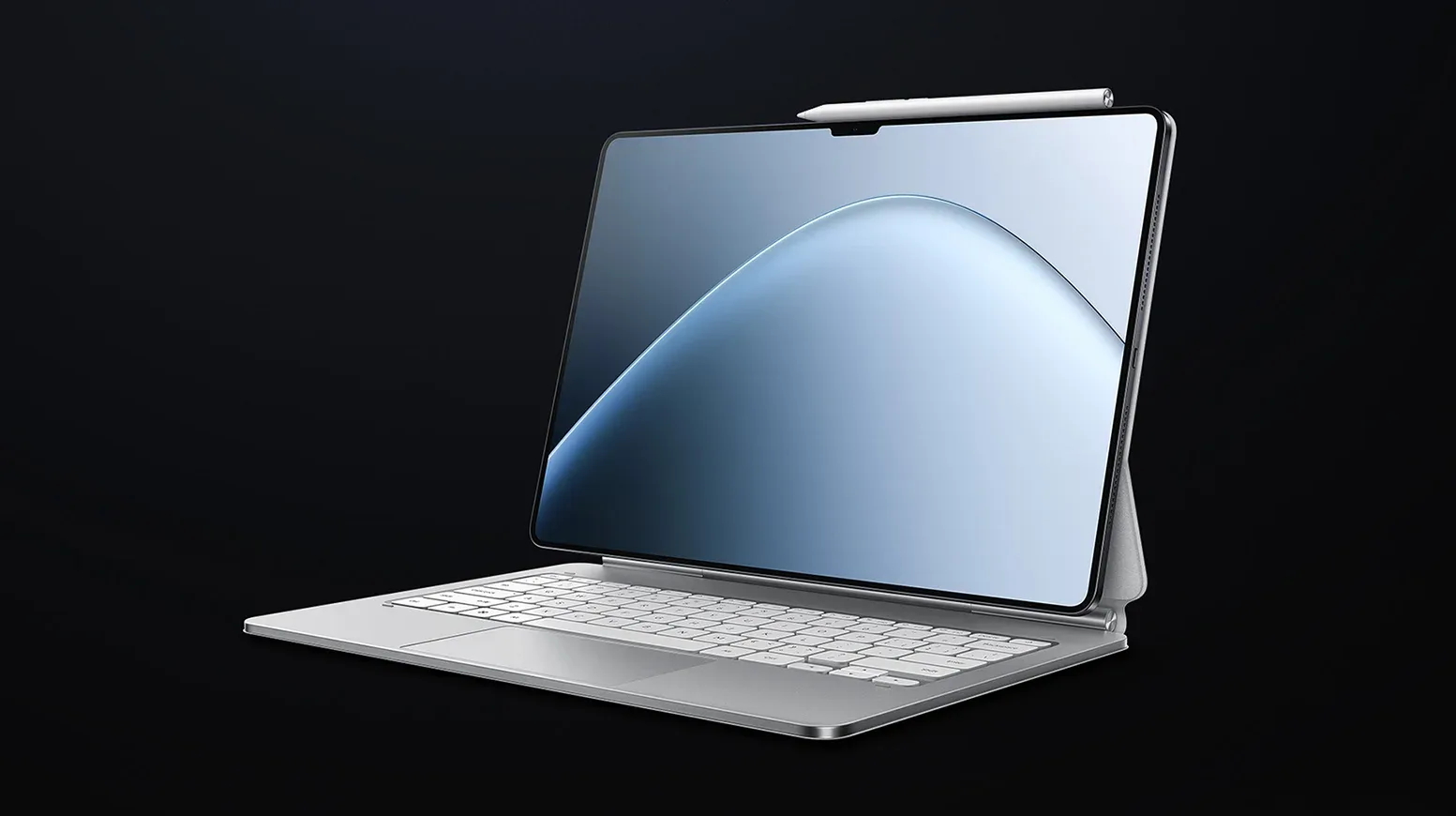
The Xiaomi Pad 7 Ultra is not officially available outside of China. Image credit: Xiaomi
Unfortunately, the Xiaomi Pad 7 Ultra has not been officially released outside of China. It has several drawbacks, including the absence of 5G and GPS, as well as import challenges such as the lack of Google Mobile Services (GMS) and limited language options. Despite these downsides, the Pad 7 Ultra is a compelling option for technophiles looking for a high-quality, large-format tablet without spending too much money.
The Xiaomi Pad 7 Ultra was reviewed by Notebookcheck and can be imported via TradingShenzhen or Giztop.
Performance
The Xiaomi Pad 7 Ultra is powered by the Xiaomi XRING O1 processor, released in 2025 and built on a 3 nm process. It is a fast chip: demanding games, large drawings and video editing run smoothly. Compared with other large tablets:
- The Apple M5 in the Apple iPad Pro 13″ (M5) is about 80 % faster.
- The Xiaomi XRING O3 in the Xiaomi Pad 9 Pro Max is about 40 % faster.
- The Xiaomi Pad 7 Ultra is about 4.5 times faster than the Meswao MES-B3 (Pro) and its MediaTek Helio G99.
Xiaomi Pad 7 Ultra: Pros
- Large 14-inch OLED panel with a 3:2 aspect ratio
- In-house XRing O1 SOC with excellent performance
- Acceptable 540 nits max brightness
- Stylus support (Xiaomi Focus Pen)
- Exceptional battery life
- Superfast 120 Watt charging
Cons
- Maximum brightness could be better
- No 5G option, no GPS positioning
- No Google Mobile Services (GMS)
- No official security upgrades policy
- Only available via import

Teclast T70
14.0″ 16:10 · 1920 × 1200 · MediaTek Helio G99 · 960 g
Teclast T70
14.0″ 16:10 · 1920 × 1200 · MediaTek Helio G99 · 960 g
A low-cost 14-inch Android tablet with 4G and a metal body
A low-cost 14-inch Android tablet with 4G, a solid metal body and long battery life, held back by a 162 ppi screen, an entry-level Helio G99 chip and a weight of 960 g.
Teclast T70 tech specs: OS: Android 14 / Processor: MediaTek Helio G99 (6 nm, 2022) / RAM: 8 GB / Storage: 256 GB (UFS 2.2) / microSD slot: yes (up to 1 TB) / Pen: no official one / Keyboard: no official one / Battery: 10,000 mAh, 18 W charging — 15.7 hours (Notebookcheck) / Connections: 1 × USB-C (USB 2.0) / HD streaming: yes (Widevine L1) / Released: November 2024
Screen specs: IPS LCD, glossy, 60 Hz / Size: 14.0 inches / Max brightness: 400 cd/m² (Notebookcheck) / Min brightness: 18.3 cd/m² (Notebookcheck) / Resolution: 1920 × 1200 pixels, 162 ppi / Aspect ratio: 16:10 (1.60)
Weight: without keyboard: 33.9 ounces – 2.12 pounds – 960 g
Sponsored
Lenovo ThinkBook Plus G5 Hybrid
A crazy and unique Windows + Android hybrid tablet
Lenovo ThinkBook Plus G5 Hybrid tech specs:
- Hybrid Tab: OS: Android 13 / Processor: Snapdragon 8+ Gen 1 (4 nm) / RAM: 12GB / Storage: 256GB / Connections: USB 2.0 Type-C with Power Delivery 3.0, PPS, OTG, Audio / Battery life: up to 6.83 hours (web browsing) or 10.3 hours (video playback), 38.7 Wh
- Hybrid Base: OS: Windows 11 Pro / Processor: Core Ultra 7 155H / RAM: 32GB / Storage: 1TB / Connections: 2× USB-C (Thunderbolt 4 / USB 4 40Gbps), with USB PD 3.0 and DisplayPort 2.1, 1×Headphone / microphone combo jack (3.5mm) / Battery life: up to 10.0 hours (75 Wh)
- Shared specs: Color: Luna grey / Released: August 2024
Screen specs: anti-reflection OLED, 60Hz, HDR10, 100% DCI-P3 / Size: 14.0 inches / Max brightness: 400 nits / Resolution: 2880 × 1800 pixels, 243 ppi / Aspect ratio: 16:10 (1.60)
Weight: tab only: 27.7 ounces – 1.73 pounds – 785 grams / station only: 34.24 ounces – 2.14 pounds – 970 g / total weight: 61.9 ounces – 3.87 pounds – 1.75 kg
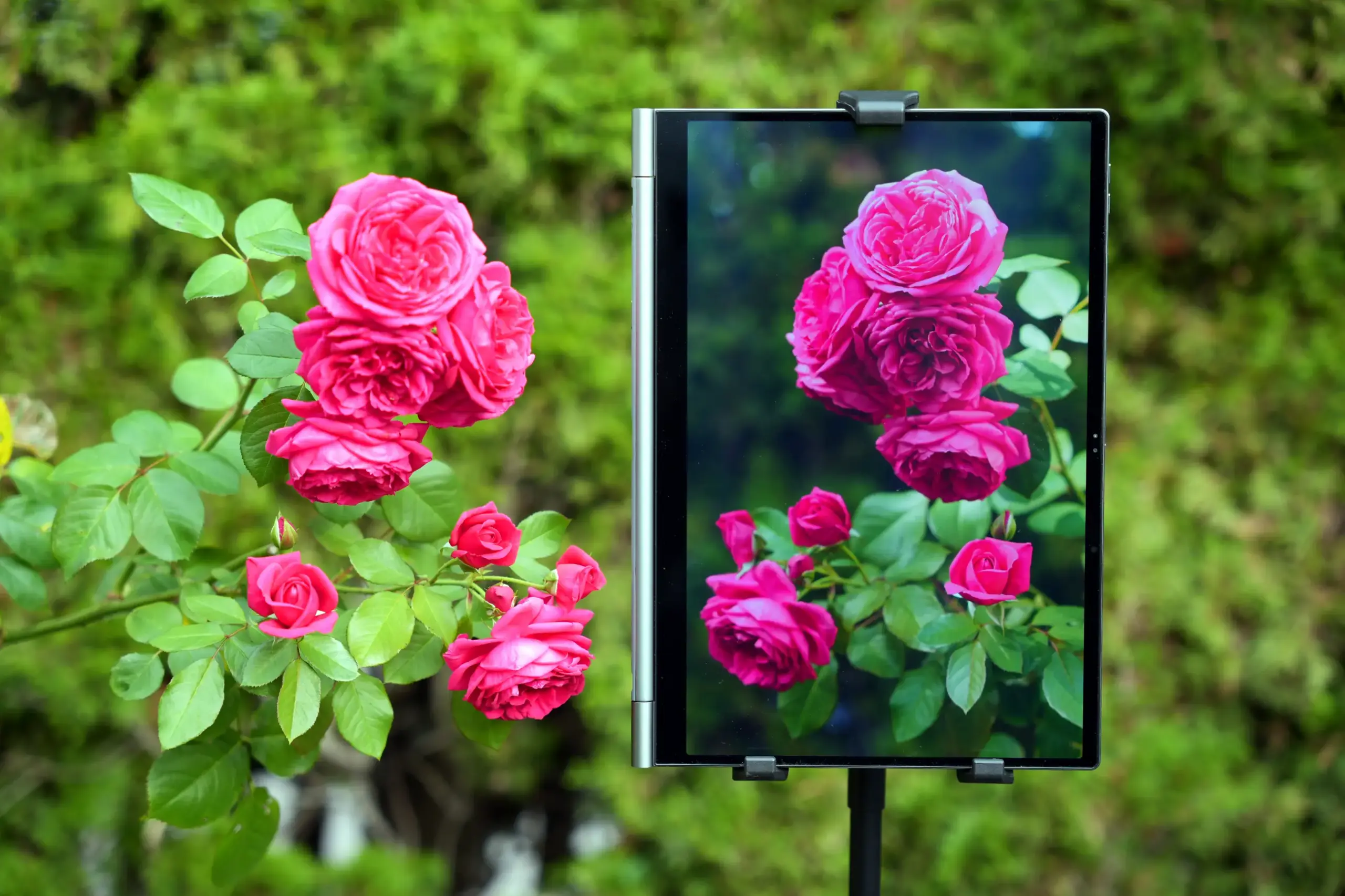
The Lenovo ThinkBook Plus G5 Hybrid features a large 14-inch detachable screen. Image credit: large-screens.com
Two devices in one: Android tablet and Windows base
The Lenovo ThinkBook Plus G5 Hybrid was released in August 2024. It is a unique combo of two devices:
- a 14-inch Android detachable tablet
- a powerful Windows-powered base, which can be used together with the tablet, or separately to power an external display.
If you’re looking for a 2-in-1 laptop and an Android tablet, the ThinkBook Plus G5 Hybrid is definitely worth considering.
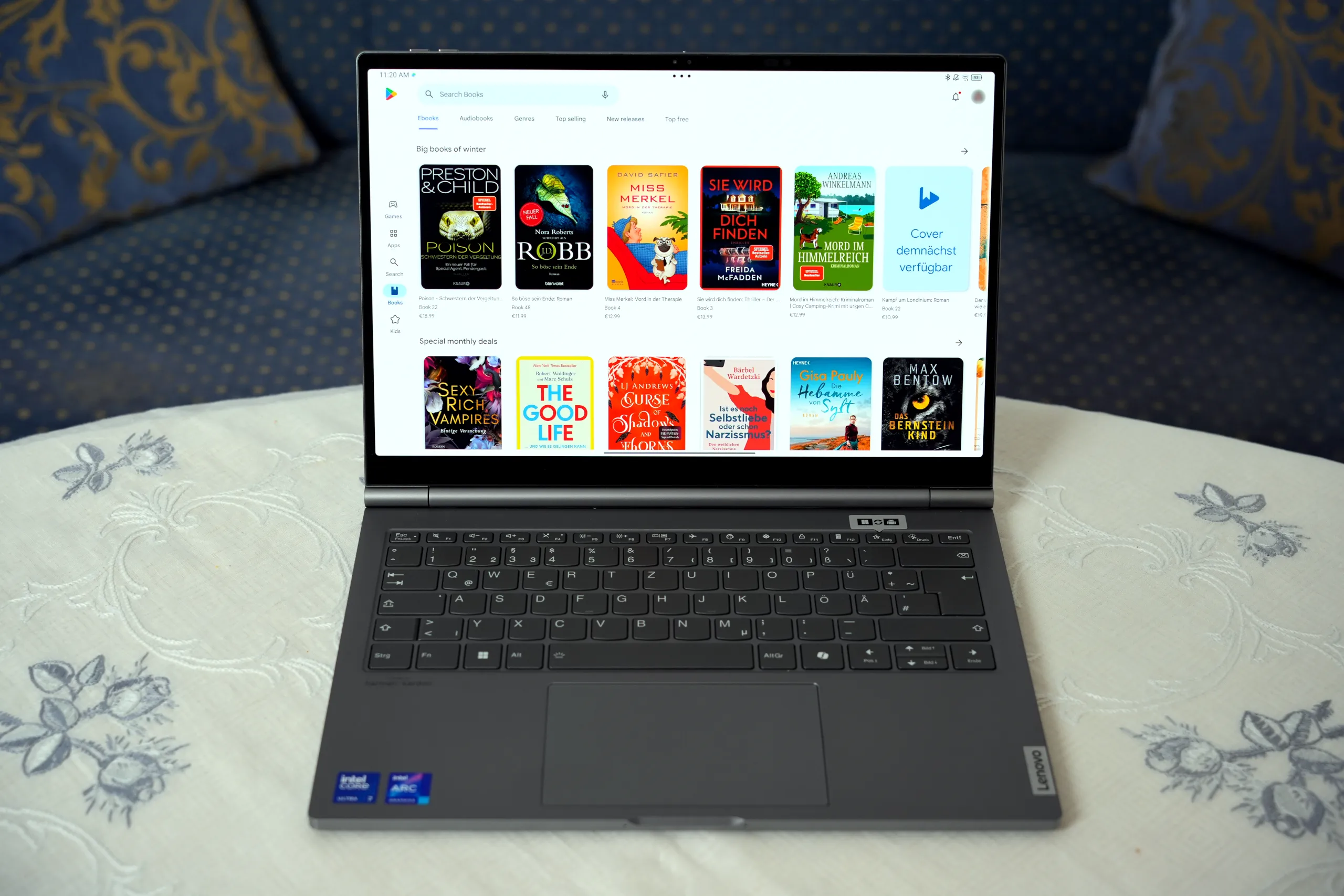
The Lenovo ThinkBook Plus G5 Hybrid is probably the best Android laptop when running in Android mode. Image credit: large-screens.com
Performance
The Lenovo ThinkBook Plus Gen 5 Hybrid is powered by the relatively old Qualcomm Snapdragon 8+ Gen 1 processor, released in 2022 and built on a 4 nm process. It is a mid-range chip, fast enough for multitasking, drawing apps and most games; only the most demanding games and video editing will push it to its limits. Compared with other large tablets:
- The Apple M5 in the Apple iPad Pro 13″ (M5) is about 3 times faster.
- The AMD Ryzen 7 8840U in the Minisforum V3 3-in-1 is about 2.5 times faster.
- The Lenovo ThinkBook Plus Gen 5 Hybrid is about 2.5 times faster than the Meswao MES-B3 (Pro) and its MediaTek Helio G99.
Pros
- Absolutely unique Windows + Android hybrid device
- Large detachable 14-inch Android tablet
- Powerful Windows laptop
- Windows/Android switch works great
- Stylus is included (Tab Pen Plus)
- Peerless device with exceptional potential
Cons
- Display max brightness is only 400 nits
- Combo is heavy
- Android tablet is a little awkward to use
- 16:10 aspect ratio
- Unclear security updates situation
- Super expensive

Minisforum V3 3-in-1
14.0″ 16:10 · 2560 × 1600 · AMD Ryzen 7 8840U · 930 g
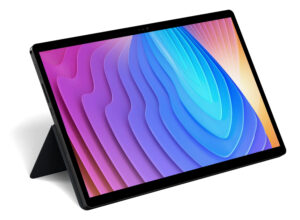
Minisforum V3 3-in-1
14.0″ 16:10 · 2560 × 1600 · AMD Ryzen 7 8840U · 930 g
A fast 14-inch Windows tablet that doubles as a portable monitor, now discontinued
A fast 14-inch Windows 11 tablet (Ryzen 7 8840U, 165 Hz screen) that doubles as a portable monitor, keyboard included, but with short battery life; now discontinued.
Minisforum V3 3-in-1 tech specs: OS: Windows 11 Pro / Processor: AMD Ryzen 7 8840U (4 nm, 2023) / RAM: 16 GB or 32 GB / Storage: 1 TB (M.2 2280 PCIe 4.0 SSD) / microSD slot: yes (full-size SD card reader [UHS-II]) / Pen: Minisforum V-Pen (MPP, 4,096 pressure levels) (optional) / Keyboard: Minisforum detachable backlit keyboard (included, with touchpad) / Battery: 50.8 Wh, 65 W charging — 5.9 hours (Notebookcheck) / Connections: 2 × USB4 (40 Gbps), 1 × USB-C (V-Link, DisplayPort input), SD card reader (UHS-II), 3.5 mm jack / Released: March 2024
Screen specs: IPS LCD, anti-reflective, 165 Hz / Size: 14.0 inches / Max brightness: 500 nits (Minisforum), 512 cd/m² (Notebookcheck (center; 495 average)) / Resolution: 2560 × 1600 pixels, 216 ppi / Aspect ratio: 16:10 (1.60)
Weight: without keyboard: 32.8 ounces – 2.05 pounds – 930 g / with keyboard: 48.3 ounces – 3.02 pounds – 1,369 g
Sponsored

Xiaomi Pad 6 Max 14
14.0″ 16:10 · 2880 × 1800 · Qualcomm Snapdragon 8+ Gen 1 · 750 g
Xiaomi Pad 6 Max 14
14.0″ 16:10 · 2880 × 1800 · Qualcomm Snapdragon 8+ Gen 1 · 750 g
Xiaomi’s first 14-inch tablet: long battery life, eight speakers, China only
Xiaomi’s first 14-inch tablet (2023, China only): a sharp 120 Hz screen, a fast chip, long battery life and eight good speakers, but Chinese software without Google Play preinstalled.
Xiaomi Pad 6 Max 14 tech specs: OS: Android 15 (Xiaomi HyperOS 2), without Google services / Processor: Qualcomm Snapdragon 8+ Gen 1 (4 nm, 2022) / RAM: 8 GB or 12 GB or 16 GB / Storage: 256 GB or 512 GB or 1 TB (UFS 3.1) / microSD slot: no / Pen: Xiaomi Focus Pen (optional) / Keyboard: Xiaomi Pad 6 Max Smart Touch Keyboard (optional, with touchpad) / Battery: 10,000 mAh, 67 W charging — 15 hours (Notebookcheck) / Connections: 1 × USB-C (USB 3.2 Gen 1, 5 Gbps, DisplayPort) / HD streaming: yes (Widevine L1) / Released: August 2023
Screen specs: IPS LCD, glossy, 120 Hz / Size: 14.0 inches / Max brightness: 630 cd/m² (Notebookcheck) / Min brightness: 1.7 cd/m² (Notebookcheck) / Resolution: 2880 × 1800 pixels, 243 ppi / Aspect ratio: 16:10 (1.60)
Weight: without keyboard: 26.5 ounces – 1.65 pounds – 750 g
The best 13-inch tablets
Asus ROG Flow Z13 (2025)
The most powerful Windows tablet
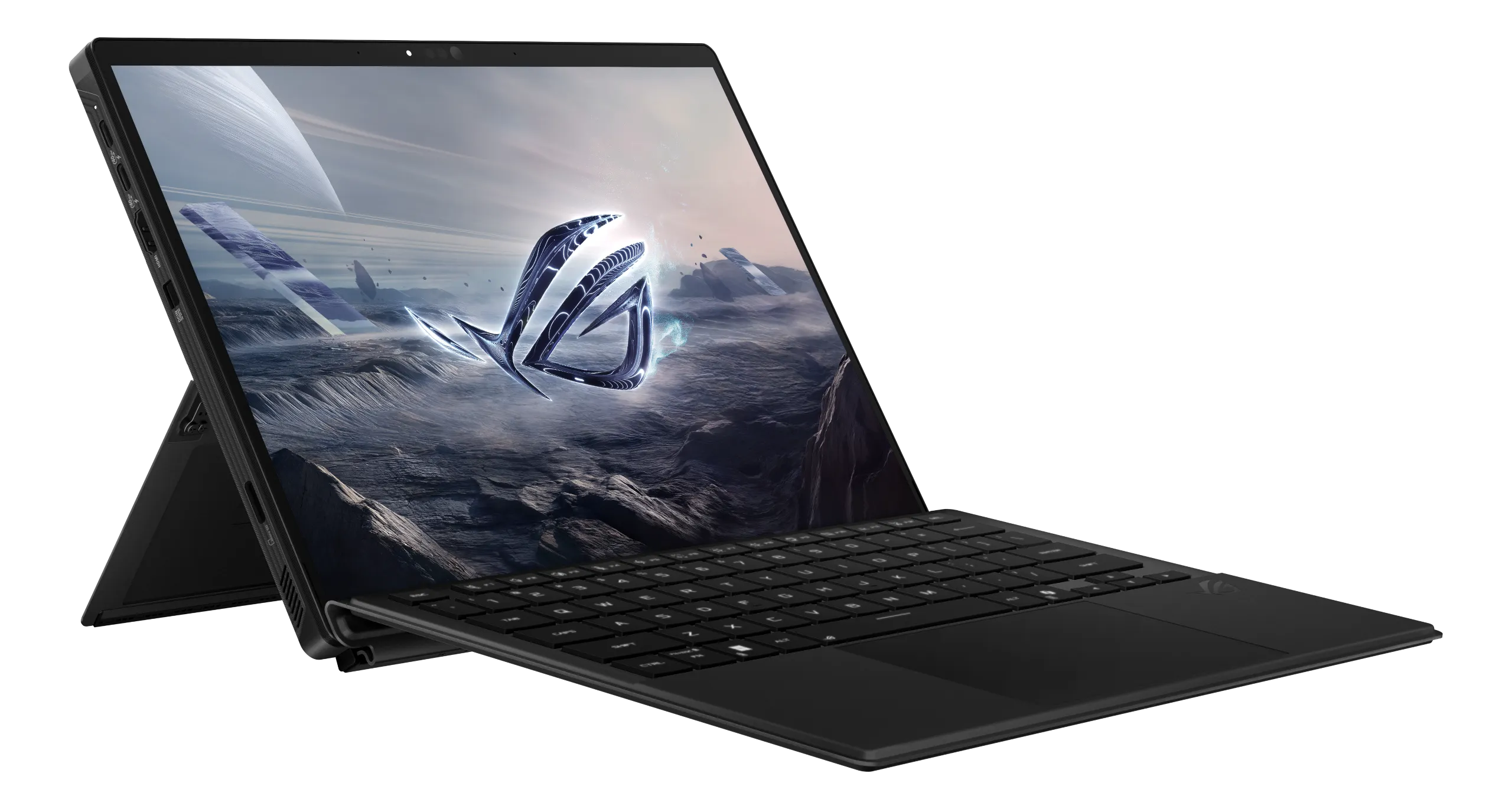
There’s nothing quite like the Asus ROG Flow Z13: it’s by far the most powerful tablet on the market, and only the 13-inch iPad Pro can stand up to it. Image credit: Asus
The 2025 edition of the ROG Flow Z13 trades its Intel processor for an AMD Ryzen AI MAX+ 395 APU, which combines both a CPU (central processing unit) and a GPU (graphics processing unit) on a single chip.
The integrated GPU is a Radeon 8060S, which is the most powerful iGPU AMD has to offer in 2025/2026. AMD states that it is more powerful than an Nvidia GeForce RTX 4070.
The Asus ROG Flow Z13 (2025) is the most powerful Windows tablet available to date. In terms of performance, it is the only tablet that can stand up to the new 13-inch iPad Pro.
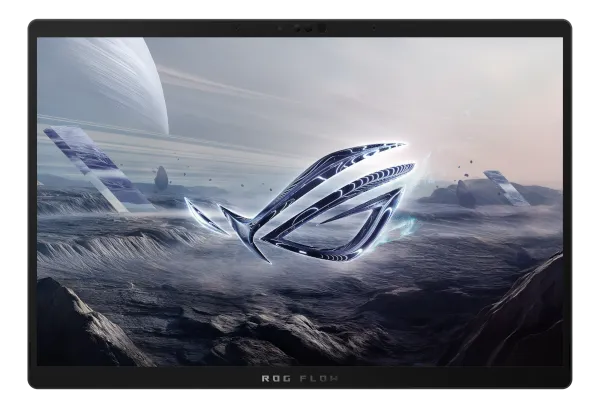
Performance
The Asus ROG Flow Z13 (2025) is powered by the AMD Ryzen AI Max+ 395 processor, released in 2025 and built on a 4 nm process. It is one of the fastest chips in any tablet: it handles everything, including heavy video editing, 3D work and the most demanding games. The same chip is used in the OneXPlayer Super X. Compared with other large tablets:
- The Asus ROG Flow Z13 (2025) is about 20 % faster than the Asus ProArt PZ14 and its Qualcomm Snapdragon X2 Elite X2E-88-100.
- The Asus ROG Flow Z13 (2025) is about 2.5 times faster than the Samsung Galaxy Tab S11 Ultra and its MediaTek Dimensity 9400+.
- The Asus ROG Flow Z13 (2025) is about 11 times faster than the Meswao MES-B3 (Pro) and its MediaTek Helio G99.
Pros
- Most powerful Windows tablet (Ryzen AI Max+ 395, Radeon 8060S)
- Bright, sharp 180 Hz screen (518 nits measured, no PWM)
- Long battery life in light use (10 hours of web browsing measured)
- Keyboard with touchpad included, 170° kickstand
- Two USB4 ports, USB-A, microSD and headphone jack
- Up to 128 GB of RAM
Cons
- Very expensive
- Heavy for a tablet (1.23 kg, 1.62 kg with keyboard)
- Only about 1.5 hours of gaming on battery
- Hot and loud under load (about 45 dB)
- Weak speakers
- Bulky 200 W power adapter (571 g)

Doogee Tab G6 Max
13.4″ 16:10 · 1920 × 1200 · Unisoc T7300 · 745 g
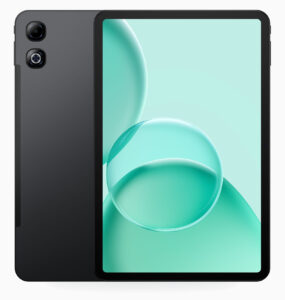
Doogee Tab G6 Max
13.4″ 16:10 · 1920 × 1200 · Unisoc T7300 · 745 g
A light, low-cost 13.4-inch Android 16 tablet with 4G and an optional keyboard bundle
A light, low-cost 13.4-inch Android 16 tablet with 4G and a large battery, held back by an entry-level chip, 6 GB of RAM and conflicting official specs.
Doogee Tab G6 Max tech specs: OS: Android 16 / Processor: Unisoc T7300 (6 nm) / RAM: 6 GB / Storage: 256 GB (UFS) / microSD slot: yes (yes [hybrid slot: second SIM or microSD]) / Pen: Doogee stylus (VIP Edition bundle) (optional) / Keyboard: Doogee Bluetooth keyboard (VIP Edition) (optional) / Battery: 11,000 mAh, 18 W charging / Connections: 1 × USB-C / HD streaming: yes (Widevine L1) / Released: November 2025
Screen specs: IPS LCD (in-cell), glossy, 120 Hz / Size: 13.4 inches / Resolution: 1920 × 1200 pixels, 169 ppi / Aspect ratio: 16:10 (1.60)
Weight: without keyboard: 26.3 ounces – 1.64 pounds – 745 g
Sponsored

Teclast T65 / T65 Plus
13.4″ 16:10 · 1920 × 1200 · Unisoc T7280 · 720 g
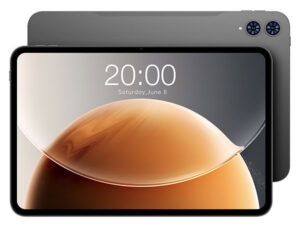
Teclast T65 / T65 Plus
13.4″ 16:10 · 1920 × 1200 · Unisoc T7280 · 720 g
A very cheap 13.4-inch tablet with a 120 Hz screen, 4G and long battery life
A very cheap 13.4-inch Android tablet with a 120 Hz screen, 4G, GPS and Widevine L1, held back by a slow chip, a grainy glossy screen and no update promise.
Teclast T65 / T65 Plus tech specs: OS: Android 16 / Processor: Unisoc T7280 (12 nm, 2024) / RAM: 6 GB or 8 GB / Storage: 128 GB or 256 GB (UFS 2.2) / microSD slot: yes (up to 1 TB [shares a slot with the second SIM]) / Pen: no official one / Keyboard: no official one / Battery: 10,000 mAh, 10 W charging — 13.7 hours (Notebookcheck) / Connections: 1 × USB-C (USB 2.0) / HD streaming: yes (Widevine L1) / Released: 2025
Screen specs: IPS LCD (in-cell), glossy, 120 Hz / Size: 13.4 inches / Max brightness: 379 cd/m² (Notebookcheck) / Min brightness: 18.5 cd/m² (Notebookcheck) / Resolution: 1920 × 1200 pixels, 169 ppi / Aspect ratio: 16:10 (1.60)
Weight: without keyboard: 25.4 ounces – 1.59 pounds – 720 g
Asus ROG Flow Z13 (2023)
Still the second most powerful Windows tablet
Asus ROG Flow Z13 (2023) tech specs: OS: Windows 11 / Processor: 13th Gen Intel Core i9-13900H / GPU: up to Nvidia GeForce RTX 4060, 65W, 8GB / RAM: 16GB (2 × 8GB LPDDR5) / Storage: 512GB or 1TB (PCIe 4.0 NVMe) / microSD slot: yes (UHS-II microSD) / Colors: black / Connections: 1 × Thunderbolt 4, 1 × USB-C 3.2 Gen 2 (part of the XG Mobile connector), 1 × USB-A 3.2 Gen 1 / Battery life: up to 5.0 hours (56 Wh) / Released: February 2023
Screen specs: IPS-panel with DDS + G-Sync, 100% DCI-P3, Pantone Validated, 165 Hz, 3 ms / Size: 13.4 inches / Max brightness: 500 nits (Asus), 537 cd/m² (Notebookcheck) / Min brightness: 27.2 cd/m² / Resolution: 2560 × 1600 pixels, 225 ppi / Aspect ratio: 16:10 (1.60)
Weight: without keyboard: 41.6 ounces – 2.60 pounds – 1.18 kg / with keyboard: 53.6 ounces – 3.35 pounds – 1.52 kg / Power supply: 16.9 ounces – 1.06 pounds – 479 g
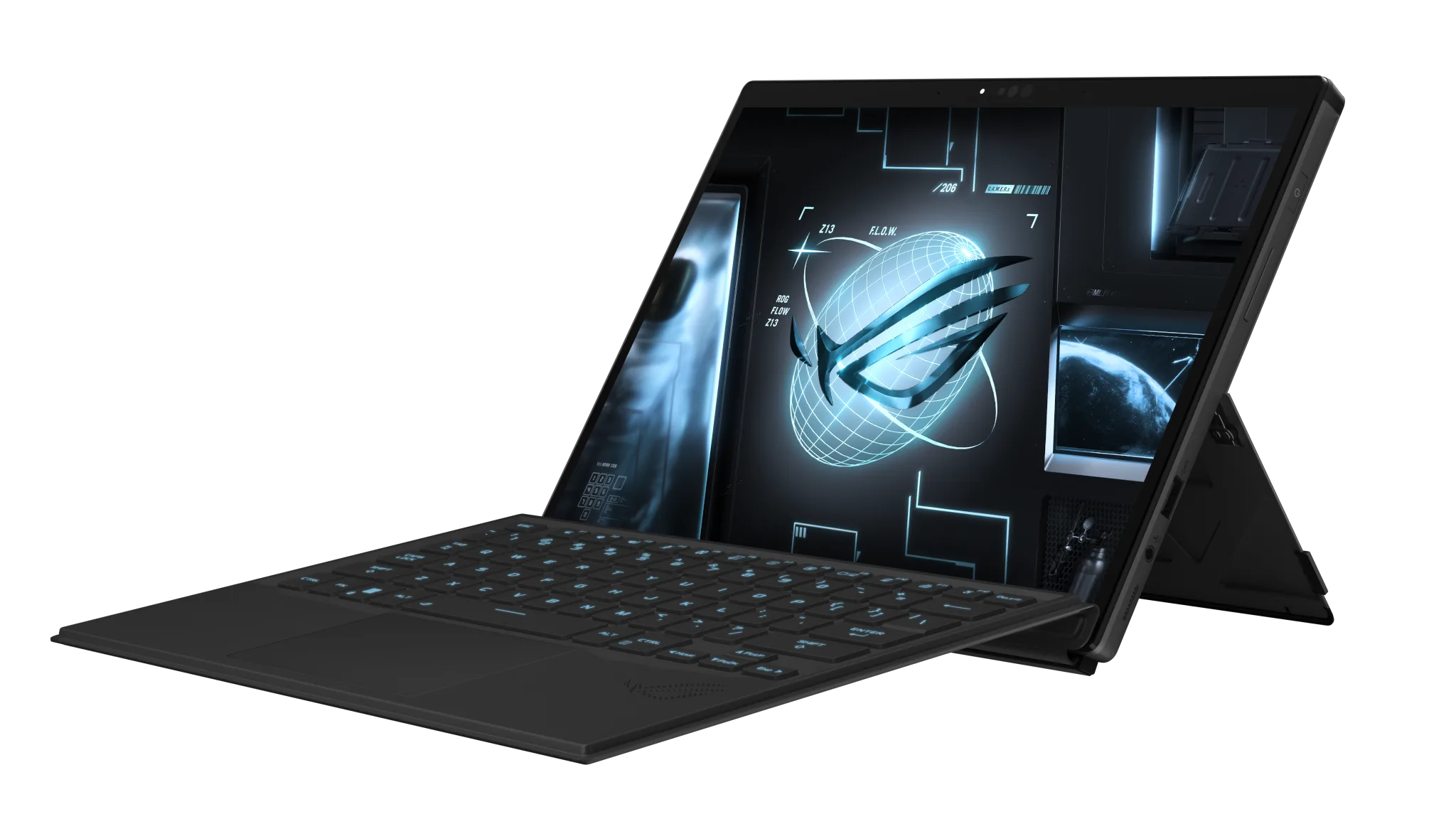
The Asus ROG Flow Z13 (2023) is the only tablet with a dedicated graphics card. It supports up to an Nvidia GeForce RTX 4060 laptop GPU. Image credit: Asus
A gaming PC in tablet form, with an RTX 4060
The Asus ROG Flow Z13 is a 2-in-1 PC with a detachable keyboard. It features an Intel Core i9-13900H CPU and, in its most powerful configuration, an Nvidia GeForce RTX 4060 Laptop GPU.
While iPad Pros are particularly popular in creative fields, the Flow Z13 is aimed at gamers and users of software requiring a high-performance graphics card.
Performance
The Asus ROG Flow Z13 (2023) is powered by the relatively old Intel Core i9-13900H processor, released in 2023 and built on a 10 nm process. It is one of the fastest chips in any tablet: it handles everything, including heavy video editing, 3D work and the most demanding games. Compared with other large tablets:
- The AMD Ryzen AI Max+ 395 in the Asus ROG Flow Z13 (2025) is about 50 % faster.
- The Qualcomm Snapdragon X2 Elite X2E-88-100 in the Asus ProArt PZ14 is about 20 % faster.
- The Asus ROG Flow Z13 (2023) is about 60 % faster than the Samsung Galaxy Tab S11 Ultra and its MediaTek Dimensity 9400+.
Asus ROG Flow Z13: Pros
- Unique device, most powerful tablet on the market
- Best pick for gamers and video editors
- Stunning specifications and connectivity
- Keyboard included
- Stylus compatibility (Asus Pen)
Cons
- Poor battery life
- Thick and massive
- Heavy power supply
- Very Expensive
BOOX Tab X C / BOOX Note Max
The largest and best e-book-readers
Onyx Boox Tab X (2023, discontinued) tech specs: OS: based on Android 11 with Google Mobile Services support, upgradable to Android 12 / Processor: 8-core Qualcomm Snapdragon 662 (11 nm), released in 2019 / GPU: Qualcomm Adreno 610 / RAM: 6GB / Storage: 128GB / microSD slot: no / Colors: black / Connections: 1x USB 2.0 Type-C / Battery life: up to 25 hours (6300 mAh) / Released: January 2023
Screen specs: Mobius Carta1250 e-Ink with touch support (inductive + capacitive), 16 shades of grey / Size: 13.3 inches / Max brightness: N/A / Resolution: 1650 × 2200 dots, 207 ppi / Aspect ratio: 4:3 (1.33)
Weight: without keyboard: 19.8 ounces – 1.23 pounds – 560 grams / no official keyboard available, works with any Bluetooth keyboard.
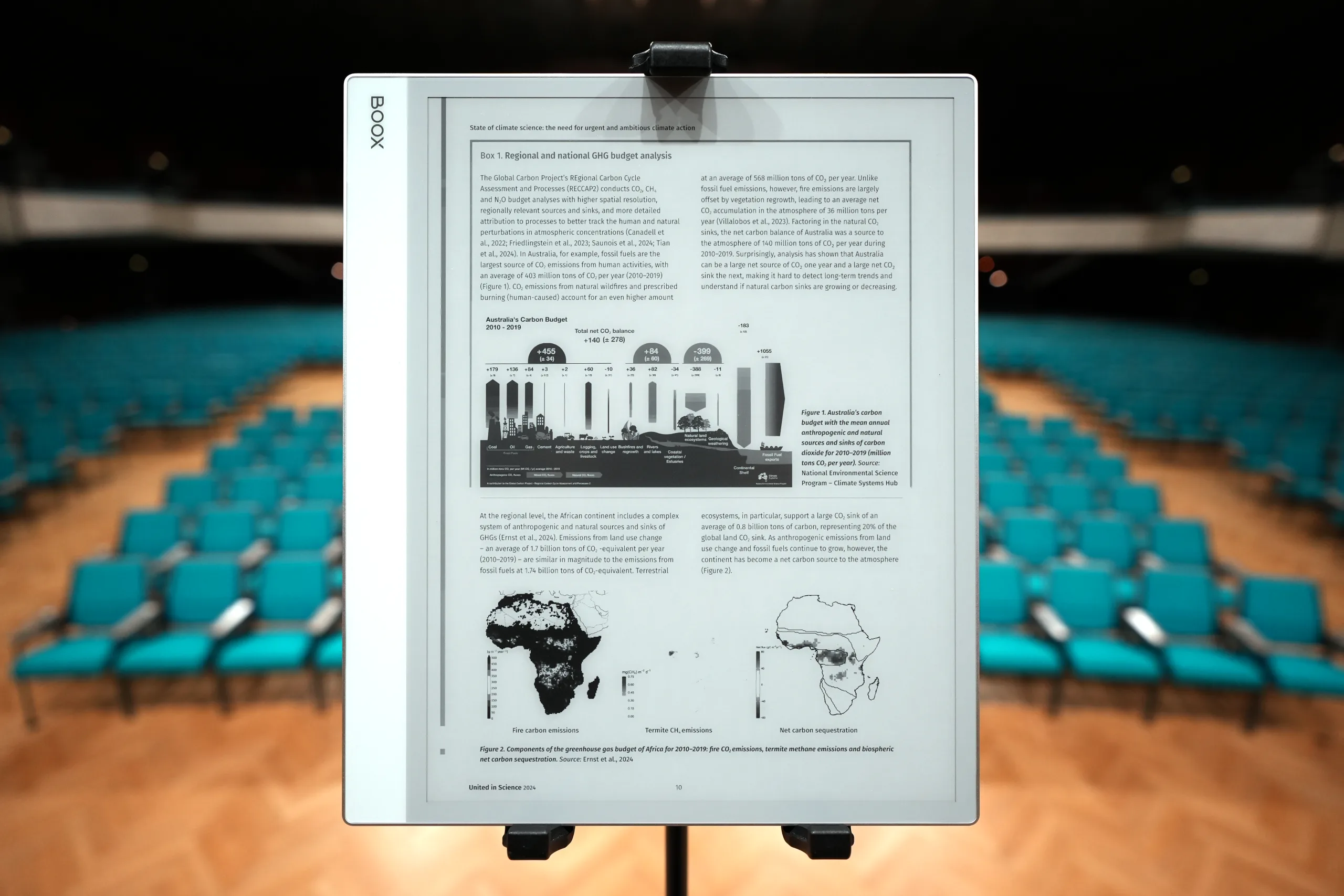
Released two years after the Tab X, the BOOX Note Max supports the latest E-Ink Carta 1300 monochrome e-paper. However, it lacks a front or backlight, which makes it difficult to read against the light. Image credit: tablets-for-musicians.com
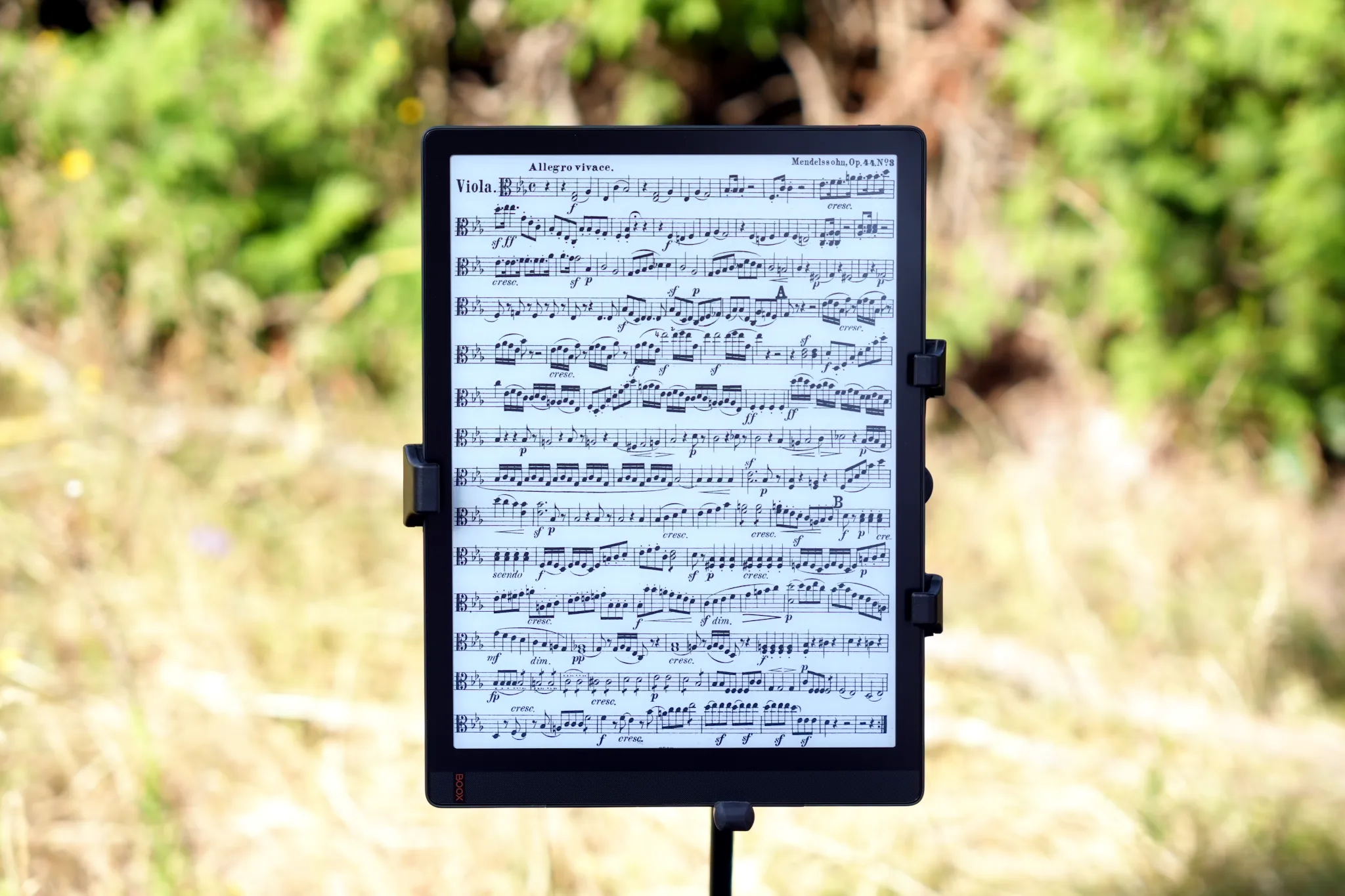
Even under the brightest sun, the Boox Tab X remains readable… but it supports only grayscale content (for example, text or sheet music). Image credit: tablets-for-musicians.com
An e-book reader, not a tablet
The Onyx Boox Tab X (2023, now discontinued) was not a tablet, but the biggest e-book reader on the market. Its successors, the monochrome Note Max and the color Tab X C, keep the same 13.3-inch size. Unlike many other e-readers that run custom operating systems, the Tab X runs Android and has access to the Play Store.
Don’t expect the Tab X to behave like a tablet, though: electronic ink is not yet compatible with anything else than reading text (or, as in my case, sheet music) and displaying grayscale content. For undistracted office work, though, the Tab X is a good option.
Performance
The Boox Note Max is powered by the relatively old Qualcomm Snapdragon 855 processor, released in 2019 and built on a 7 nm process. It is fine for streaming, web browsing, documents and casual games, but it is not made for demanding games, video editing or heavy multitasking. Compared with other large tablets:
- The Apple M5 in the Apple iPad Pro 13″ (M5) is about 5.5 times faster.
- The Samsung Exynos 1580 in the Samsung Galaxy Tab S10 FE+ is about 40 % faster.
- The Boox Note Max is about 40 % faster than the TCL NxtPaper 14 and its MediaTek Helio G99.
Onyx Boox Tab X (2023): Pros
- Large 13.3-inch screen with e-Ink technology
- Very thin (0.27 in / 6.8 mm) and light (1.24 lb / 560 g)
- Best outdoor readability, even on sunny days
- Outstanding battery life
- Best extra-large e-reader on the market
Cons
- Display lag and poor reactivity compared to tablets
- Poor performance
- Outdated Android version
- No cellular option (Wi-Fi only)
- No camera (e.g., to scan sheet music)
- Very expensive
Honor MagicPad3
A relatively affordable 13.3-inch Android tablet with great specs, but a limited worldwide availability.
Honor MagicPad3 tech specs: OS: MagicOS 9 (based on Android 15), two years of security updates / Processor: Snapdragon 8 Gen 3 (4 nm) / RAM: 16GB / Storage: 512GB / microSD slot: no / Colors: Grey, White / Connections: USB 3.2 Type-C / Released: August 2025
Screen specs: IPS LCD, up to 165 Hz, DCI-P3 wide color gamut / Size: 13.3 inches / Max brightness: 700 nits, 1000 nits in HDR (Honor) Resolution: 3200 × 2136 pixels, 289 ppi / Aspect ratio: 3:2 (1.50)
Weight without keyboard: 21.0 ounces – 1.31 pounds – 595 grams

The Honor MagicPad 3 fills the same niche as the OnePlus Pad 3, but it’s not available in the United States or Canada. Image credit: Honor
Performance
The Honor MagicPad3 is powered by the relatively old Qualcomm Snapdragon 8 Gen 3 processor, released in 2023 and built on a 4 nm process. It is a fast chip: demanding games, large drawings and video editing run smoothly. The same chip is used in the Lenovo Yoga Tab Plus. Compared with other large tablets:
- The Apple M5 in the Apple iPad Pro 13″ (M5) is about 2.5 times faster.
- The Xiaomi XRING O3 in the Xiaomi Pad 9 Pro Max is about 80 % faster.
- The Qualcomm Snapdragon 8 Elite Gen 5 in the OnePlus Pad 4 is about 60 % faster.
Honor MagicPad3: Pros
- Great harware
- Bright screen (700 nits)
- Large battery, superfast 66W charging
- Stylus compatibility (Magic-Pencil 3)
- Supports Google Mobile Services (GMS)
Cons
- No SD-Card reader
- No fingerprint scanner
- Only one OS update and two years of security updates
- Not available in North America
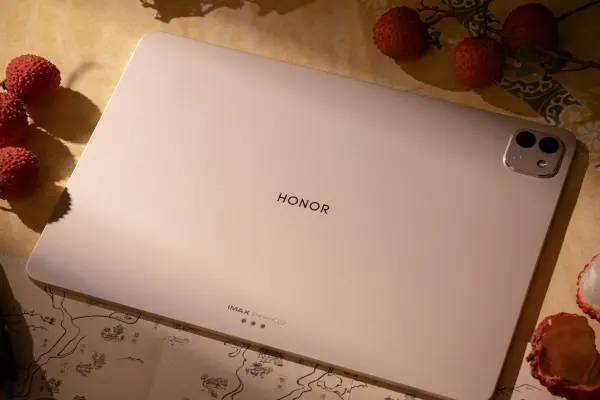
Honor MagicPad3 Pro
The Pro version is a beefed-up version of the non-pro MagicPad3 with the fastest available processor.
The Honor MagicPad 3 Pro was upgraded with the new Snapdragon 8 Elite Gen 5 SoC, but its availability outside of China is still limited. Image credit: Honor
Just three months after releasing the non-Pro MagicPad 3, Honor unveiled a “Pro” version of its largest tablet. The only notable hardware difference is the faster, newer Snapdragon 8 Elite Gen 5 SoC, the fastest mobile processor to date.
In terms of software, the Pro model has been upgraded to MagicOS 10, which is based on Android 16.
By the way, it’s not a typo: Honor consistently writes “MagicPad3” without spaces.
Xiaomi Pad 9 Pro Max
Xiaomi’s 13.3-inch 3:2 top tablet, with an optional matte screen (China only)
Xiaomi Pad 9 Pro Max tech specs: OS: Android 17 (Xiaomi HyperOS 4), without Google services / Processor: Xiaomi XRING O3 (3 nm, 2026) / RAM: 8 GB or 12 GB or 16 GB / Storage: 256 GB or 512 GB or 1 TB (UFS 4.1) / microSD slot: no / Pen: Xiaomi Focus Pen Pro (optional) / Keyboard: Xiaomi Pad 9 Pro Max floating keyboard (悬浮键盘) (optional) / Battery: 12,000 mAh, 120 W charging / Connections: 1 × USB-C (USB 3.2 Gen 2, 10 Gbit/s, “full-function”; DP-in to use the tablet as a monitor); 27 W reverse charging over USB-C; pogo pins (45 W charging in the car) / Released: September 2026
Screen specs: IPS LCD, matte version available (Soft Light (柔光版, nano-texture)), 144 Hz / Size: 13.3 inches / Max brightness: 1000 nits (Xiaomi) / Resolution: 3408 × 2272 pixels, 308 ppi / Aspect ratio: 3:2 (1.50)
Weight: without keyboard: 22.8 ounces – 1.42 pounds – 645 g
Xiaomi’s new top tablet, not reviewed yet
Launched in China on September 7, 2026, the Pad 9 Pro Max is Xiaomi’s new top tablet for work and entertainment, a little smaller than the 14-inch Pad 7 Ultra but with a faster chip. Notebookcheck and GSMArena had not reviewed it in early October 2026, so the figures below are official (ITHome).
Screen: very sharp 3:2 at 144 Hz; matte only with 16 GB
The 13.3-inch LCD has about the same area as the screen of the 13-inch iPad Pro. Its 3:2 format is taller and closer to a sheet of paper, better for documents and sheet music. With 3408 × 2272 pixels (308 ppi) it is very sharp, and it runs at up to 144 Hz. Xiaomi rates it at 1,000 nits; panel maker TCL CSOT gives 700 nits typical and 1,000 nits in high-brightness mode (ITHome). The standard screen is glossy; a matte nano-texture “Soft Light Edition” exists only with 16 GB and 512 GB or 1 TB.
Speed: Xiaomi’s XRING O3; no Google services
Xiaomi’s own XRING O3 is a ten-core 3 nm flagship chip, paired with 8 to 16 GB of RAM and 256 GB to 1 TB of storage (no microSD slot). It runs Xiaomi’s Chinese HyperOS 4 (up to six apps on screen at once) without Google services. Xiaomi has published no update policy, and HD streaming (Widevine L1) is not confirmed.
Video input: it can be a second screen for a PC
The magnetic “floating” keyboard and the Focus Pen Pro are sold separately. The 12,000 mAh battery charges at 120 W; its runtime has not been measured yet. The metal body is 5.67 mm thin and weighs 645 g. There are eight speakers but no headphone jack. The USB-C port (10 Gbit/s) also accepts a video signal, so the tablet can serve as a second screen for a PC or a handheld game console (mobidevices, ITHome).
China only; no warranty for imported units
It is sold only in China, where it launched in September 2026 from CNY 4,799 (8/256 GB). Imported units have no official warranty outside China (GSMArena).
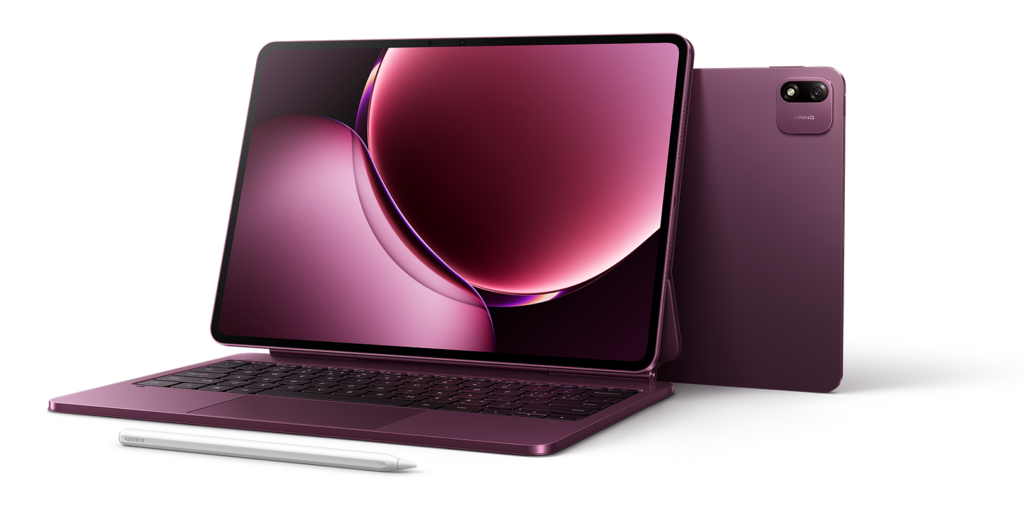
The Xiaomi Pad 9 Pro Max with its keyboard and stylus. Image: Xiaomi
Performance
The Xiaomi Pad 9 Pro Max is powered by the Xiaomi XRING O3 processor, released in 2026 and built on a 3 nm process. It is one of the fastest chips in any tablet: it handles everything, including heavy video editing, 3D work and the most demanding games. Compared with other large tablets:
- The Apple M5 in the Apple iPad Pro 13″ (M5) is about 30 % faster.
- The Xiaomi Pad 9 Pro Max is about 10 % faster than the OnePlus Pad 4 and its Qualcomm Snapdragon 8 Elite Gen 5.
- The Xiaomi Pad 9 Pro Max is about 80 % faster than the Honor MagicPad3 and its Qualcomm Snapdragon 8 Gen 3.
Pros
- Sharp 13.3-inch 3:2 screen (308 ppi, 144 Hz)
- Optional matte nano-texture screen
- Fast 3 nm XRING O3 chip, up to 16 GB of RAM
- Thin and light (5.67 mm, 645 g)
- 12,000 mAh battery with 120 W charging
- USB-C video input: usable as a monitor
Cons
- China only: no Google services, Chinese software
- No official warranty or update policy outside China
- Matte screen only on the two priciest versions
- No microSD slot, no headphone jack
Asus ProArt PZ13 (2024)
The largest Windows tablet for creatives
Asus ProArt PZ13 tech specs: OS: Windows 11 Home / Processor: Qualcomm Snapdragon X Plus X1P-42-100 / GPU: Qualcomm SD X Adreno X1-45 / RAM: 16GB (LPDDR5X) / Storage: 1TB (PCIe 4.0) / Card reader: yes (full-size SD Express 7.0, microSD adapter included) / Colors: black / Connections: 2 × USB 4 Type-C (40 Gbps) / Battery life: unknown (70 Wh) / Released: September 2024
Screen specs: ASUS Lumina OLED touchscreen with stylus support, 100% DCI-P3, Pantone Validated, 60 Hz, 0.2 ms response time / Size: 13.3 inches / Max brightness: 500 nits (Asus) / Min brightness: unknown / Resolution: 2880 × 1800 pixels (3K), 255 ppi / Aspect ratio: 16:10 (1.60)
Weight: without keyboard: 30.0 ounces – 1.87 pounds – 850 g
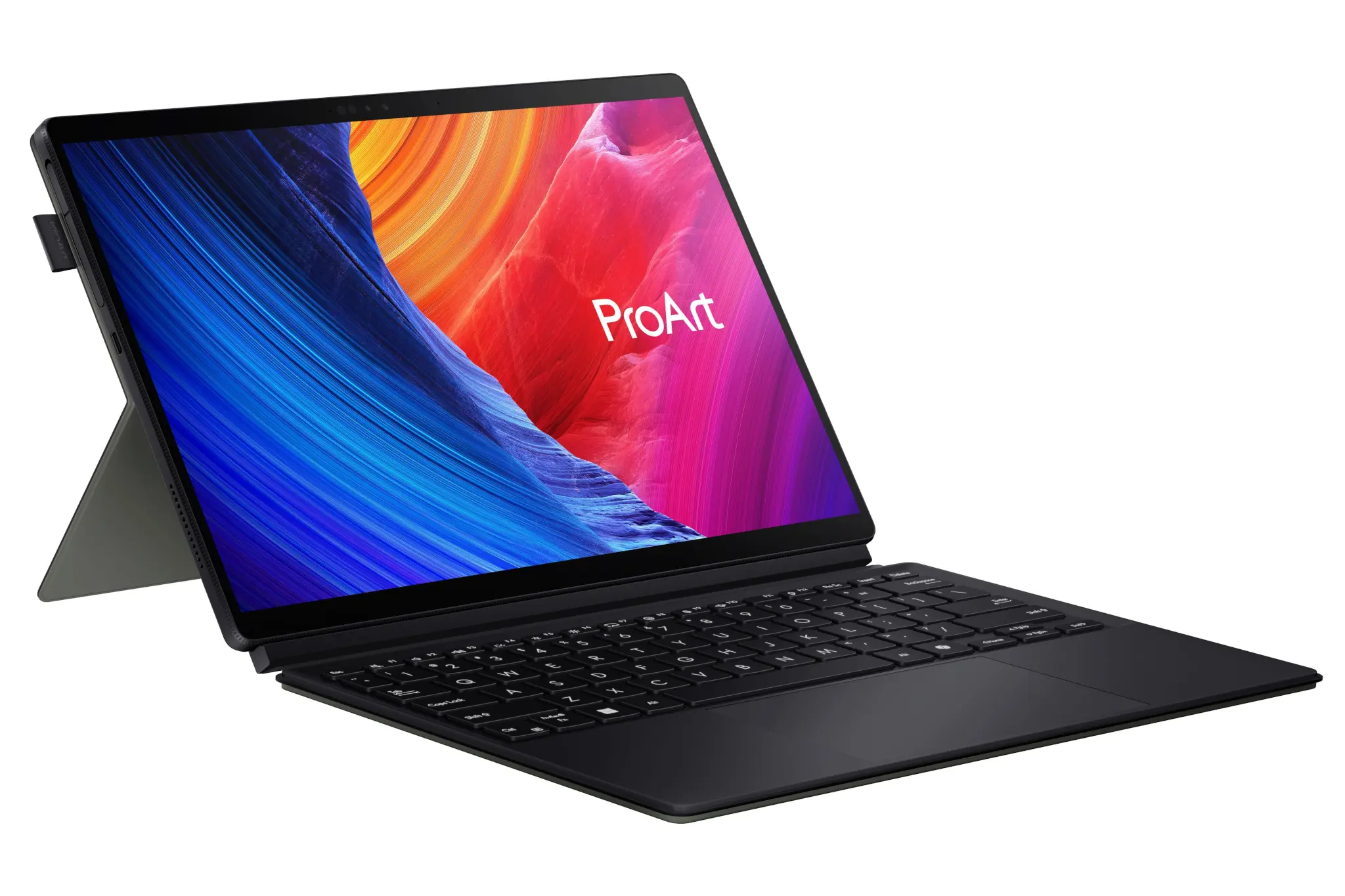
The Asus ProArt PZ13 features a large 13,3-inch OLED screen, a detachable keyboard and stylus support. It is aimed to be the best Windows tablet for creatives. Image credit: Asus
Performance
The Asus ProArt PZ13 is powered by the Qualcomm Snapdragon X Plus X1P-42-100 processor, released in 2024 and built on a 4 nm process. It is one of the fastest chips in any tablet: it handles everything, including heavy video editing, 3D work and the most demanding games. Compared with other large tablets:
- The Qualcomm Snapdragon X2 Elite X2E-88-100 in the Asus ProArt PZ14 is about 60 % faster.
- The Qualcomm Snapdragon X2 Plus X2P-64-100 in the Microsoft Surface Pro 13-inch, 12th Edition is about 20 % faster.
- The Asus ProArt PZ13 is about 30 % faster than the Samsung Galaxy Tab S11 Ultra and its MediaTek Dimensity 9400+.
Pros
- Color-accurate 3K OLED screen (Delta E 0.2 measured)
- Long battery life (15 h measured, 18 h of video)
- Keyboard and stand cover included (pen too in Europe)
- Full-size SD Express card reader and two USB4 ports
- Rugged: IP52 and MIL-STD 810H
- Good value for an OLED tablet with a keyboard
Cons
- Only 60 Hz
- Moderate brightness (361 nits measured), reflective glass
- Slowest Snapdragon X Plus: weak graphics for video editing
- Windows on Arm: some creative apps do not run
- No headphone jack, only two USB-C ports
- About 1.5 kg with keyboard and stand cover
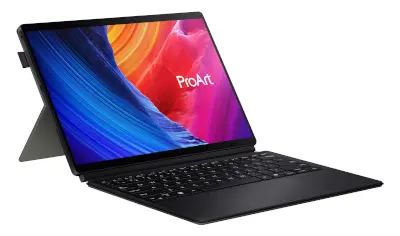

Asus Vivobook 13 Slate OLED (T3300)
13.3″ 16:9 · 1920 × 1080 · Intel Pentium Silver N6000 · 780 g
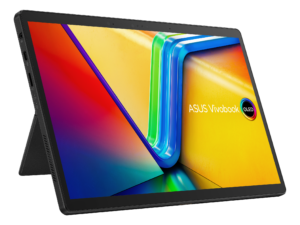
Asus Vivobook 13 Slate OLED (T3300)
13.3″ 16:9 · 1920 × 1080 · Intel Pentium Silver N6000 · 780 g
A low-cost 13.3-inch OLED Windows tablet with keyboard and pen, but a very slow chip
A 2021 Windows tablet with a 13.3-inch OLED screen and keyboard, stand and pen in the box; good for videos, but its Pentium chip is very slow.
Asus Vivobook 13 Slate OLED (T3300) tech specs: OS: Windows 11 Home / Processor: Intel Pentium Silver N6000 (2021) / RAM: 4 GB or 8 GB / Storage: 128 GB or 256 GB (M.2 NVMe PCIe 3.0 SSD or eMMC) / microSD slot: yes / Pen: Asus Pen 2.0 (included) / Keyboard: Asus detachable keyboard (included, with touchpad) / Battery: 50 Wh, 65 W charging — 7.5 hours (Notebookcheck) / Connections: 2 × USB-C (USB 3.2 Gen 2, 10 Gbps, DisplayPort, charging), 3.5 mm headphone jack, microSD card reader / Released: December 2021
Screen specs: OLED, glossy, 60 Hz / Size: 13.3 inches / Max brightness: 303 cd/m² (Notebookcheck) / Min brightness: 1.0 cd/m² (Notebookcheck) / Resolution: 1920 × 1080 pixels, 166 ppi / Aspect ratio: 16:9 (1.78)
Weight: without keyboard: 27.5 ounces – 1.72 pounds – 780 g / with keyboard: 49.0 ounces – 3.06 pounds – 1,390 g

Fujitsu (FCCL) FMV LOOX
13.3″ 16:9 · 1920 × 1080 · Intel Core i7-1250U (90/G) / Core i5-1230U (75/G) · 599 g
Fujitsu (FCCL) FMV LOOX
13.3″ 16:9 · 1920 × 1080 · Intel Core i7-1250U (90/G) / Core i5-1230U (75/G) · 599 g
A very light 13.3-inch OLED Windows tablet from Japan, with an optional Wacom pen
A 599 g 13.3-inch OLED Windows tablet sold in Japan since 2022: quick and silent, with wide colors, but warm under load, only Full HD and 385 nits.
Fujitsu (FCCL) FMV LOOX tech specs: OS: Windows 11 Home (Pro on custom models) / Processor: Intel Core i7-1250U (90/G) / Core i5-1230U (75/G) (2022) / RAM: 16 GB or 8 GB / Storage: 512 GB or 256 GB or 128 GB or 1 TB (PCIe SSD) / microSD slot: no / Pen: FMV LOOX Pen (FMV-NPN25) (optional) / Keyboard: FMV LOOX Keyboard (FMV-NKB51) (optional, with touchpad) / Battery: 35 Wh — 9.1 hours (mybest) / Connections: 1 × Thunderbolt 4 / USB4 (USB-C), 1 × USB 3.2 Gen 2 (USB-C); both with USB PD and DisplayPort / Released: June 2022
Screen specs: OLED, glossy, 60 Hz / Size: 13.3 inches / Max brightness: 385 cd/m² (PC Watch) / Resolution: 1920 × 1080 pixels, 166 ppi / Aspect ratio: 16:9 (1.78)
Weight: without keyboard: 21.1 ounces – 1.32 pounds – 599 g / with keyboard: 36.3 ounces – 2.27 pounds – 1,030 g
Lenovo Duet 5 Chromebook
The largest Chromebook with a detachable keyboard
Lenovo Duet 5 Chromebook tech specs: OS: ChromeOS / Processor: Snapdragon 7c Gen 2 (8nm), released in May 2021 / RAM: 4GB or 8GB / Storage: 64GB, 128GB or 256GB / microSD slot: no / Colors: Abyss Blue, Storm Grey / Connections: 2x USB 3.2 Gen 1 (Type-C) with Power Delivery + DisplayPort / Battery life: up to 11 hours (42 Wh) / Released: October 2021
Screen specs: OLED, 100% DCI-P3 / Size: 13.3 inches / Max brightness: 400 nits (Lenovo), 369 cd/m² (Notebookcheck) / Min brightness: 0.7 cd/m² / Resolution: 1920 × 1080 pixels, 166 ppi / Aspect ratio: 16:9 (1.78)
Weight: without keyboard: 25.2 ounces – 1.58 pounds – 715 grams / with “folio keyboard”: 36.5 ounces – 2.28 pounds – 1.04 kg
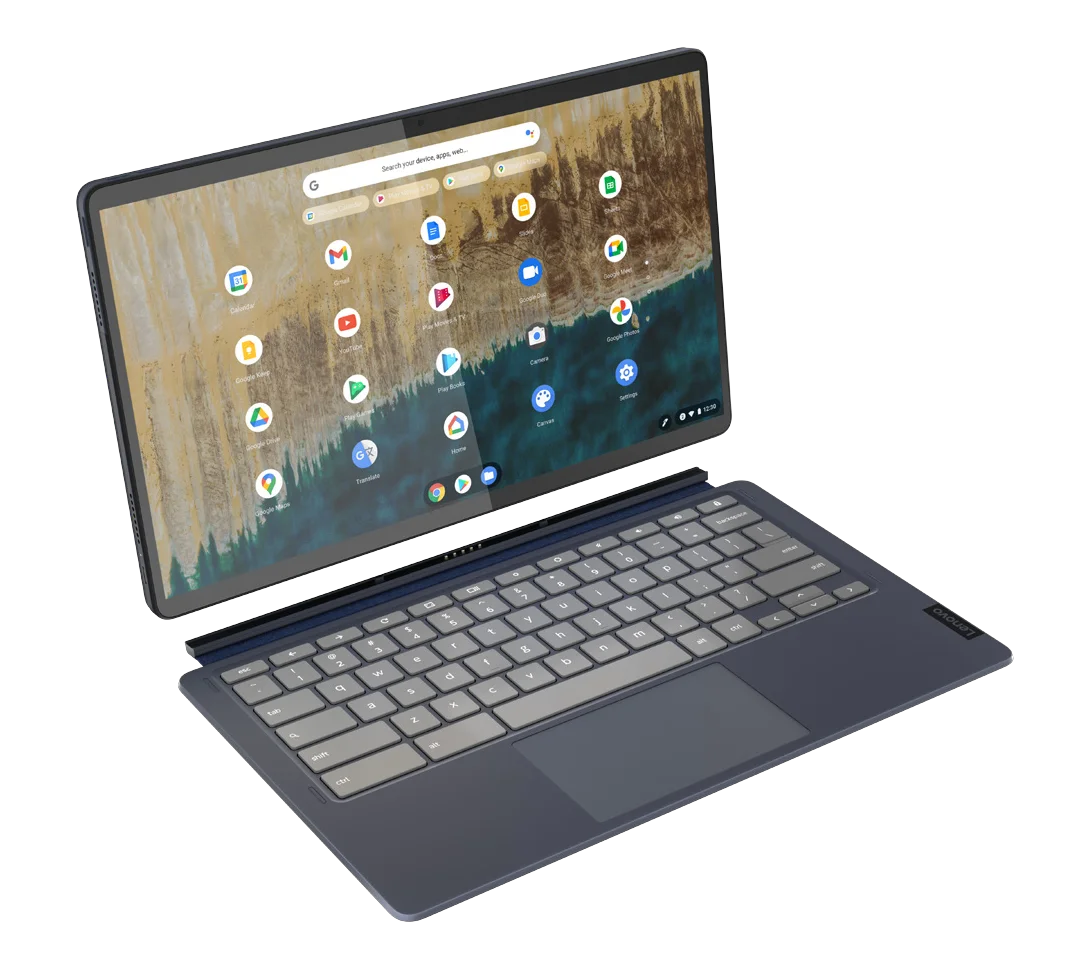
The Lenovo Duet 5 is the only Chromebook with a large display and a detachable keyboard. Image credit: Lenovo
A cheap 13.3-inch OLED Chromebook, but a slow one
The Lenovo Duet 5 is a 2-in-1 tablet that runs on Chrome OS and has access to the Play Store. It features a 13.3-inch OLED touchscreen with an unexciting resolution of 1920 × 1080 and a luminosity of 400 nits. The Duet 5 is thin and light, weighing 1.58 pounds (715 grams) and measuring 0.28 inches (7.2 mm) in thickness.
The Lenovo Duet 5 is a great option for anyone looking for a much cheaper alternative to the 12.9-inch iPad Pro. It sure has more than a few drawbacks, such as the lack of fingerprint sensor and the ultra-slow performance. But these drawbacks come with an unmatchable price: you could get almost three Duet 5 for the price of a single 12.9-inch iPad Pro!
Performance
The Lenovo IdeaPad Duet 5 Chromebook is powered by the relatively old Qualcomm Snapdragon 7c Gen 2 processor, released in 2021 and built on a 8 nm process. It is an entry-level chip: fine for videos, web browsing, reading and taking notes, but apps open slowly and games have to run at low settings. Compared with other large tablets:
- The Apple M5 in the Apple iPad Pro 13″ (M5) is about 9.5 times faster.
- The MediaTek Helio G99 in the Meswao MES-B3 (Pro) is about 20 % faster.
- The Lenovo IdeaPad Duet 5 Chromebook is about 10 % faster than the Asus Vivobook 13 Slate OLED (T3300) and its Intel Pentium Silver N6000.
Lenovo Duet 5: Pros
- Largest Chromebook with a detachable keyboard
- Great OLED display
- Two USB Type-C ports with DisplayPort
- Fanless
- Cheapest large tablet available
Cons
- Outdated hardware, slow performance
- Low display resolution
- Max brightness (400 nits) could be higher
- No cellular option (Wi-Fi only)
- No SD card reader, no fingerprint sensor

Huawei MatePad Pro Max
13.2″ 3:2 · 3000 × 2000 · Huawei Kirin T93 Pro · 499 g
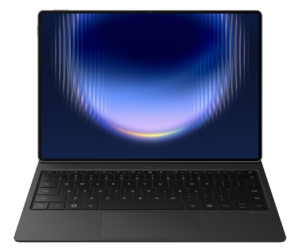
Huawei MatePad Pro Max
13.2″ 3:2 · 3000 × 2000 · Huawei Kirin T93 Pro · 499 g
The thinnest 13-inch tablet: 4.7 mm and 499 g, with an optional matte OLED screen
Huawei’s 13.2-inch OLED tablet, only 4.7 mm thin and 499 g, with an optional matte screen, excellent speakers and a good keyboard, but no Google services and weak graphics.
Huawei MatePad Pro Max tech specs: OS: HarmonyOS 4.3, without Google services / Processor: Huawei Kirin T93 Pro (2026) / RAM: 12 GB / Storage: 256 GB or 512 GB (UFS 4.1) / microSD slot: no / Pen: Huawei M-Pencil Pro (optional) / Keyboard: Huawei Glide Keyboard (optional, with touchpad) / Battery: 10,400 mAh, 66 W charging — 15.2 hours (ComputerBase) / Connections: 1 × USB-C (USB 3.1, video output); 40 W reverse charging / HD streaming: yes (Widevine L1) / Updates: 6 years of security updates / Released: May 2026
Screen specs: OLED, matte version available (PaperMatte), 144 Hz / Size: 13.2 inches / Max brightness: 908 cd/m² (Notebookcheck) / Min brightness: 2.7 cd/m² (Notebookcheck) / Resolution: 3000 × 2000 pixels, 273 ppi / Aspect ratio: 3:2 (1.50)
Weight: without keyboard: 17.6 ounces – 1.10 pounds – 499 g / with keyboard: 33.4 ounces – 2.09 pounds – 948 g
OnePlus Pad 3
The best mid-range large tablet of 2025/2026
Update October 2026: the OnePlus Pad 4 (April 2026) succeeds the Pad 3 (still sold in the USA and Europe) with the same 13.2-inch 7:5 format and a faster Snapdragon 8 Elite Gen 5.
Note: The following three devices have identical hardware!
- OnePlus Pad 3: released in June 2025, available worldwide including in Europe, North America and Australia.
- OnePlus Pad 2 Pro: this is the China-only version. It is available worldwide via import websites (the most well-known being TradingShenzhen). Even if it’s cheaper, I don’t recommend doing this, because it comes with typical import problems such as warranty limitations, no Google Mobile Services, having to download language packs, …
- Oppo Pad 4 Pro: this one is also a China-first variant, and may be released in other markets where Oppo has a strong presence, such as India and Southeast Asia. It was also available worldwide via import platforms, and was cheaper than the Pad 2 Pro; it is no longer listed there, but TradingShenzhen now sells the newer OPPO Pad 5 Pro.
I’ll focus on the OnePlus Pad 3 because it is officially available in the Western world.
Display
The Pad 3’s LTPS LCD panel offers a 3.1K resolution (3392 × 2400) and 144 Hz refresh rate. It is just a hair larger than the 13-inch displays of both the iPad Air (M2) and the iPad Pro (M4). While Apple’s tablets use slightly smaller diagonals (13.0″), most noticeable difference is the aspect ratio.
The Pad 3 opts for a unique 7:5 ratio (7.05/5 to be exact), a sweet spot between productivity-friendly 3:2 and media-optimized 16:10. As a musician myself, this is an excellent aspect ratio for displaying sheet music!
This gives the OnePlus Pad 3 more vertical space for reading and browsing than the iPad Pro/Air (3:2), and a less elongated feel than the Galaxy Tab S10/S11 Ultra’s 16:10 screen.
Display brightness
The OnePlus Pad 3’s 13.2-inch LTPS LCD typically peaks around 630 nits under the sunlight and ramps up to about 900 nits for HDR content (as measured by Notebookcheck). That outshines the 13-inch iPad Air’s ~576 nits but can’t compete with the 13-inch iPad Pro’s full-screen 1000 nit output (peaking at 1 600 nits in highlights).
To stay in the Android world, the OnePlus Pad 3 is slightly brighter than Samsung’s Galaxy Tab S10 Ultra AMOLED screen, which settles at roughly 600 nits in standard viewing with HDR peaks north of 1000 nits.
Display resolution
When it comes to sharpness, the Pad 3 packs a 3392 × 2400 resolution into 13.2 inches, yielding a crisp 315 ppi—well above the “Retina” threshold. By comparison, both the 13-inch iPad Air and Pro sit at 2732 × 2048 (264 ppi).
The S10 Ultra’s 2960 × 1848 AMOLED is also well below the Pad 3 in terms of sharpness and delivers around 240 ppi.
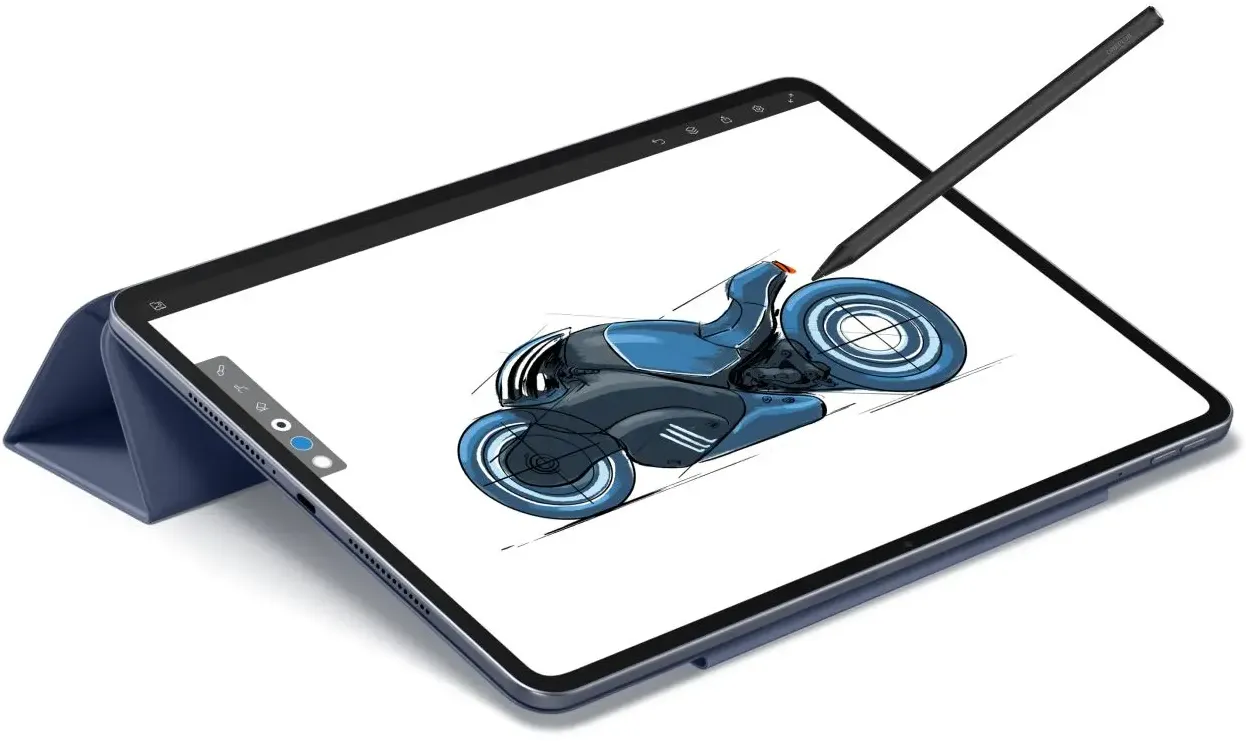
The OnePlus Pad 3 has been praised across the board in reviews and is an excellent Android alternative to the 13-inch iPad Air. Image credit: OnePlus
Battery life
The OnePlus Pad 3 carries a massive 12140 mAh cell rated for up to 18 hours of video playback and routinely delivers over 16 hours in mixed-use. Notebookcheck managed almost 24 hours of Wi-Fi browsing at 150 cd/m², way longer than the competition! It also charges superfast at 80 W (0–100 % in roughly 92 minutes).
Security support and Android updates
The OnePlus Pad 3 ships with Android 15 topped by OxygenOS 15 (ColorOS 15 if you import the hardware-identical Pad 2 Pro from China). OnePlus commits to six years of security patches — almost best in class for Android but still behind Samsung’s seven-year promise. This means that the Pad 3 will be safe to use until June 2031.
However, OS updates are limited to three major Android releases, so Android 19 will be its last version, way behind Apple’s five OS bumps.
Performance
The OnePlus Pad 3 is powered by the Qualcomm Snapdragon 8 Elite processor, released in 2024 and built on a 3 nm process. It is a fast chip: demanding games, large drawings and video editing run smoothly. The same chip is used in 4 other tablets of our database, including the OPPO Pad 4 Pro and the Lenovo Legion Y900 13. Compared with other large tablets:
- The Apple M5 in the Apple iPad Pro 13″ (M5) is about 70 % faster.
- The Apple M4 (8-core CPU) in the Apple iPad Air 13″ (M4) is about 40 % faster.
- The Qualcomm Snapdragon 8 Elite Gen 5 in the OnePlus Pad 4 is about 20 % faster.
OnePlus Pad 3: Pros
- Excellent 144-Hz 13.2-inch screen
- Unique 7:5 ratio, great for all type of content
- Top-notch performance thanks to the Snapdragon 8 Elite SoC
- Great battery life, large 12140 mAh battery
- Superfast 80 Watt charging
Cons
- LCD panel
- No fingerprint reader
- Lacks IP water/dust rating
- No cellular option (Wi-Fi only)
- Still quite expensive
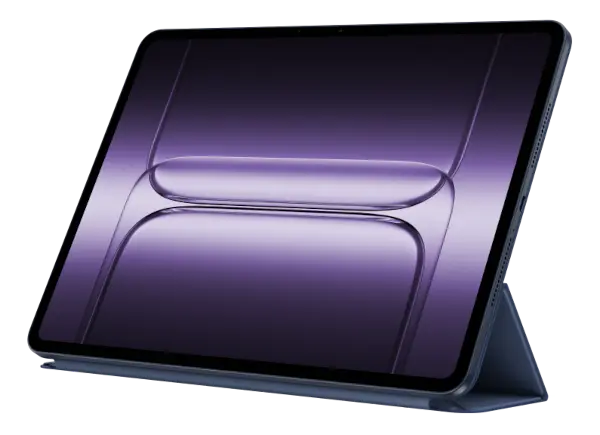
OnePlus Pad 3 or Pad 4: which one to choose?
Both have the same sharp 13.2-inch 7:5 LCD (3392 × 2400 pixels, 144 Hz), eight speakers, 80 W charging and the same thin body (about 6 mm, 672 to 675 g); neither has a microSD slot, a cellular option or GPS.
- Choose the OnePlus Pad 4 for speed and battery life: its Snapdragon 8 Elite Gen 5 is about 20 % faster (Geekbench 6), its screen is brighter (700 nits instead of 600, according to OnePlus) and its battery larger (13,380 mAh instead of 12,140). But at launch, Netflix and Prime Video played only in SD on it (no Widevine L1; Fonearena, GSMArena), OnePlus has published no update policy, and it is not sold in North America; in Europe, only some retailers sell it.
- Choose the OnePlus Pad 3 for streaming and easy buying: it has Widevine L1 for HD video, OnePlus sells it in North America, Europe and the UK, and it is cheaper.
OnePlus Pad 4
A very fast, thin 13.2-inch tablet with a 7:5 screen and over 25 hours of battery life
OnePlus Pad 4 tech specs: OS: Android 16 (OxygenOS 16) / Processor: Qualcomm Snapdragon 8 Elite Gen 5 (3 nm, 2025) / RAM: 8 GB or 12 GB / Storage: 256 GB or 512 GB (UFS 4.1 [RAM: LPDDR5X]) / microSD slot: no / Pen: OnePlus Stylo Pro (optional) / Keyboard: OnePlus Pad 4 Smart Keyboard (optional, with touchpad) / Battery: 13,380 mAh, 80 W charging — 25 hours (Notebookcheck) / Connections: 1 × USB-C (USB 3.2 Gen 1, 5 Gbit/s) / HD streaming: no (Widevine L3: SD only) / Released: May 2026
Screen specs: IPS LCD, glossy, 144 Hz / Size: 13.2 inches / Max brightness: 700 nits (OnePlus), 901 cd/m² (Notebookcheck) / Min brightness: 1.6 cd/m² (Notebookcheck) / Resolution: 3392 × 2400 pixels, 315 ppi / Aspect ratio: 7:5 (1.40)
Weight: without keyboard: 23.7 ounces – 1.48 pounds – 672 g
Verdict: excellent, but little change from the Pad 3
The OnePlus Pad 4 is a very thin Android tablet with Google services for work, reading and games. Reviewers praise its speed, screen and battery life, but note that it changes little from the Pad 3. Notebookcheck rated it 88% (very good), GSMArena calls it a very good option for productivity, and Digit recommends it to new buyers rather than Pad 3 owners.
Screen: a bright, sharp 7:5 LCD at 144 Hz
The 13.2-inch screen is about 1% larger in area than that of the 13-inch iPad Pro. Its 7:5 format is taller than the usual 16:10, which suits documents and sheet music. The glossy LCD is sharp (315 ppi), flicker-free and runs at up to 144 Hz. Notebookcheck measured 901 nits and Digit about 1,080 nits. Blacks are less deep than on OLED (1,060:1 contrast measured).
Speed: very fast, but Netflix in SD only at launch
The Snapdragon 8 Elite Gen 5 makes it one of the fastest Android tablets. It has 8 or 12 GB of RAM and 256 or 512 GB of storage, without microSD. OxygenOS 16 (Android 16) has almost no extra apps and good multitasking, but OnePlus has published no update policy. At launch, Netflix and Prime Video played only in SD, because Widevine L1 is missing (Fonearena, GSMArena).
Battery: over 25 hours; 80 W charger in the box
The Stylo Pro pen and the Smart Keyboard with touchpad are sold separately and do not fit older OnePlus Pads. Notebookcheck measured over 25 hours of Wi-Fi browsing; the 80 W charger is in the box and refills the 13,380 mAh battery in about 85 minutes. The tablet weighs 672 g for 5.94 mm. There is no fingerprint reader, cellular option or GPS.
Sold in India; in Europe only through retailers
It launched in India in April 2026; in Europe, retailers sell it, but OnePlus’s own European and US stores do not. In China the same hardware is sold as the OPPO Pad 5 Pro and the OnePlus Pad 3 Pro, with Chinese software (Fonearena).
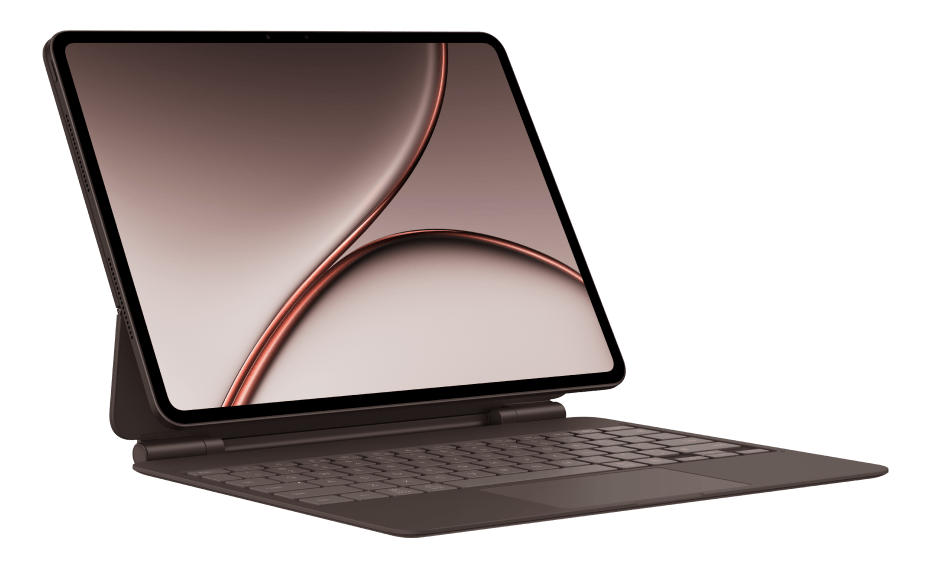
The OnePlus Pad 4 with its Smart Keyboard. Image: OnePlus
Performance
The OnePlus Pad 4 is powered by the Qualcomm Snapdragon 8 Elite Gen 5 processor, released in 2025 and built on a 3 nm process. It is one of the fastest chips in any tablet: it handles everything, including heavy video editing, 3D work and the most demanding games. The same chip is used in the vivo Pad6 Pro. Compared with other large tablets:
- The Apple M5 in the Apple iPad Pro 13″ (M5) is about 40 % faster.
- The OnePlus Pad 4 is about 20 % faster than the OnePlus Pad 3 and its Qualcomm Snapdragon 8 Elite.
- The OnePlus Pad 4 is about 60 % faster than the Honor MagicPad3 and its Qualcomm Snapdragon 8 Gen 3.
Pros
- Very fast Snapdragon 8 Elite Gen 5, little throttling
- Very long battery life (over 25 h of Wi-Fi browsing measured)
- Bright, flicker-free 144 Hz screen (901 nits measured)
- Fast 80 W charging (about 85 min), charger in the box
- Very thin (5.94 mm)
- Clean software with good multitasking
Cons
- Netflix and Prime Video only in SD at launch (no Widevine L1)
- No update policy published
- LCD with lower contrast than OLED (1,060:1 measured)
- No fingerprint reader, cellular option or GPS
- No microSD slot
- Pen and keyboard sold separately, hard to find in Europe
Sponsored
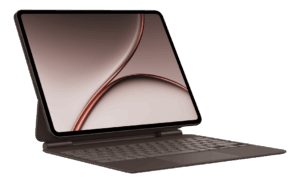

vivo Pad6 Pro
13.2″ 1.53:1 · 3840 × 2512 · Qualcomm Snapdragon 8 Elite Gen 5 · 663 g
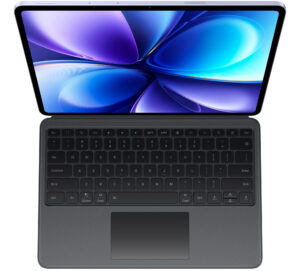
vivo Pad6 Pro
13.2″ 1.53:1 · 3840 × 2512 · Qualcomm Snapdragon 8 Elite Gen 5 · 663 g
A very sharp 13.2-inch 4K tablet with a flagship chip, sold only in China
vivo’s 2026 flagship: a very sharp 13.2-inch 4K screen and a Snapdragon 8 Elite Gen 5, but an LCD with grayish blacks, sold only in China without Google services.
vivo Pad6 Pro tech specs: OS: Android 16 (OriginOS 6), without Google services / Processor: Qualcomm Snapdragon 8 Elite Gen 5 (3 nm, 2025) / RAM: 8 GB or 12 GB or 16 GB / Storage: 256 GB or 512 GB (UFS 4.1 [RAM: LPDDR5X]) / microSD slot: no / Pen: vivo Pencil3 (optional) / Keyboard: vivo Smart Touch Keyboard 6 Pro (optional, with touchpad) / Battery: 13,000 mAh, 66 W charging / Connections: 1 × USB-C (USB 3.2 Gen 1, 5 Gbit/s) / Released: March 2026
Screen specs: IPS LCD, glossy, 144 Hz / Size: 13.2 inches / Resolution: 3840 × 2512 pixels, 348 ppi / Aspect ratio: 1.53:1
Weight: without keyboard: 23.4 ounces – 1.46 pounds – 663 g / with keyboard: 40.8 ounces – 2.55 pounds – 1,156 g

Teclast ArtPad
13.2″ 7:5 · 2240 × 1600 · Unisoc T7300 · 728 g
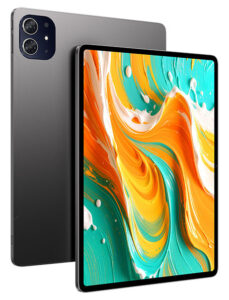
Teclast ArtPad
13.2″ 7:5 · 2240 × 1600 · Unisoc T7300 · 728 g
A 13.2-inch Android tablet with a taller 7:5 screen at 120 Hz, 4G and pen support
A 13.2-inch Android 16 tablet with a taller 7:5 120 Hz screen, 4G and pen support, announced in August 2026; entry-level chip and no reviews yet.
Teclast ArtPad tech specs: OS: Android 16 (ArtOS) / Processor: Unisoc T7300 (6 nm) / RAM: 8 GB / Storage: 128 GB (UFS) / microSD slot: yes (up to 1 TB [androidpctv], hybrid slot shared with the second SIM [Teclast]) / Pen: Teclast T-Pen2 (optional) / Keyboard: no official one / Battery: 10,000 mAh, 18 W charging / Connections: 1 × USB-C (USB 2.0) / HD streaming: yes (Widevine L1) / Released: August 2026
Screen specs: IPS LCD, glossy, 120 Hz / Size: 13.2 inches / Resolution: 2240 × 1600 pixels, 209 ppi / Aspect ratio: 7:5 (1.40)
Weight: without keyboard: 25.7 ounces – 1.60 pounds – 728 g
Not available yet. Official website ›
Huawei MatePad Pro 13.2 (2025) and MatePad Pro Max (2026)
Huawei's largest tablet takes on the iPad Pro 13
Update October 2026: its successor, the Huawei MatePad Pro Max, was released worldwide in May 2026 (Germany: July). It keeps a 13.2-inch 3:2 OLED screen (3000 × 2000 pixels, 144 Hz; Notebookcheck measured about 990 nits) and an optional PaperMatte (matte) version, but it is incredibly thin and light: 4.7 mm and 499 g. Outside China it runs HarmonyOS 4.3, which runs Android apps but has no Google services. Prices start at €1,099 in Germany (Huawei, Notebookcheck).
The second version of the Huawei MatePad Pro 13.2, released in China in December 2024, emerges as Huawei’s flagship tablet, directly challenging the iPad Pro 13-inch with its larger 13.2-inch OLED display.
The MatePad Pro 13.2 PaperMatte runs on HarmonyOS 4.3, an Android fork made by Huawei. It does not support Google Mobile Services. GMS can be installed via an application called Gbox, but Google applications are not easily accessible to normal users.
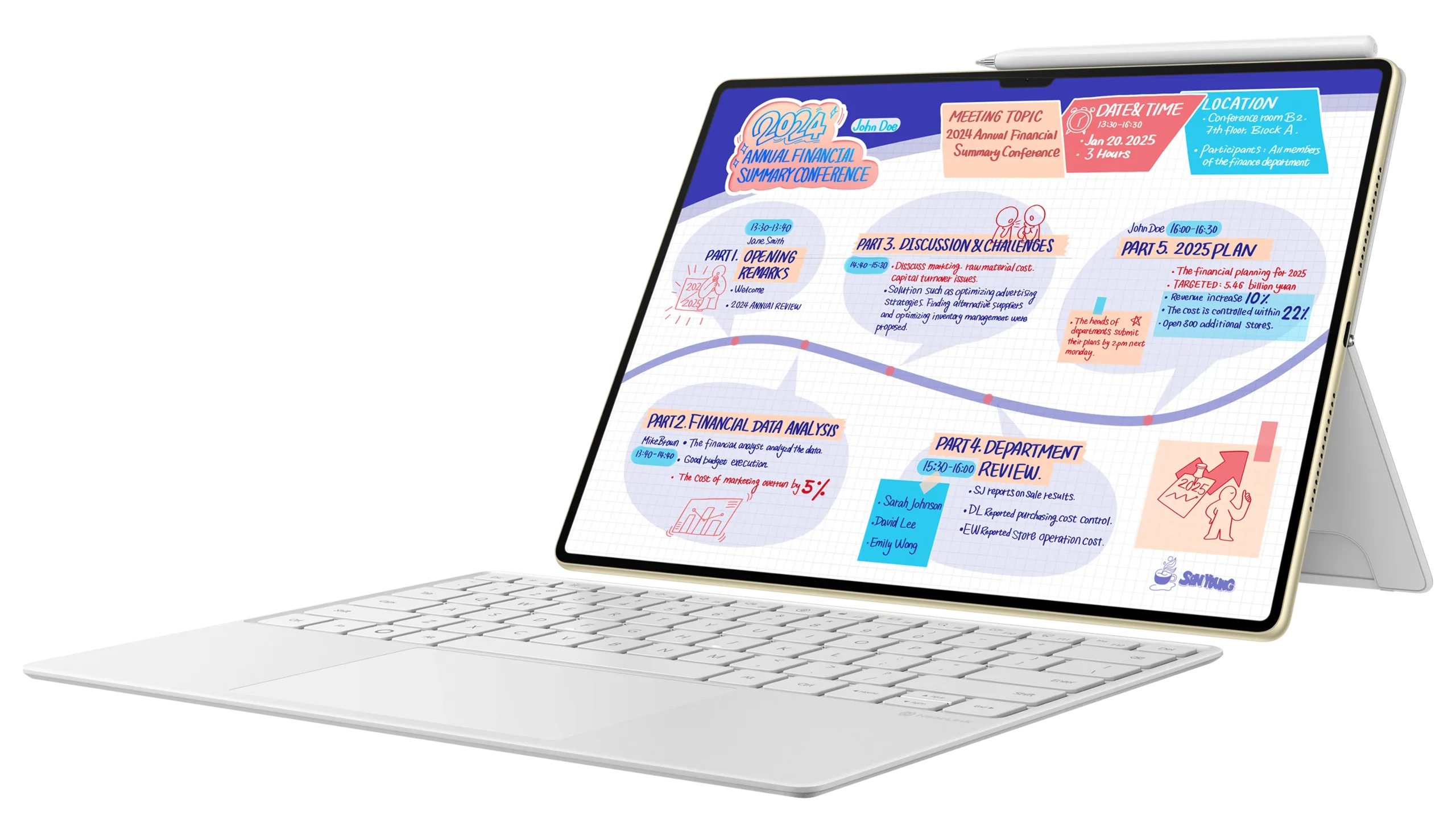
Huawei’s largest tablet, the MatePad Pro 13.2, is not widely available in North America. Image credit: Huawei
Verdict: superb hardware, but no Google apps
Despite its first-class hardware and superb large screen, this tablet is not recommendable due to software limitations and the absence of Google applications.
The new MatePad Pro 13.2 (2025) has been reviewed by PhoneArena and Forbes.
Performance
The Huawei MatePad Pro 13.2 (2025) is powered by the Huawei Kirin T92 processor, released in 2024 and built on a 7 nm process. It is a mid-range chip, fast enough for multitasking, drawing apps and most games; only the most demanding games and video editing will push it to its limits. Compared with other large tablets:
- The Apple M5 in the Apple iPad Pro 13″ (M5) is about 3 times faster.
- The Intel Core i7-1165G7 in the Huion Kamvas Studio 16 is about 30 % faster.
- The Huawei MatePad Pro 13.2 (2025) is about 2.5 times faster than the Meswao MES-B3 (Pro) and its MediaTek Helio G99.
Huawei MatePad Pro 13.2: Pros
- Great 13.2-inch screen with nanotextured glass
- 820 cd/m² (nits) maximum brightness
- Very thin (0.22 in / 5.5 mm) and light (1.28 lb / 580 g)
- Pencil and Keyboard are included
- Super-fast charging (100 watts!)
Cons
- No Google Mobile Services
- Poor performance, especially for its price category
- Usually not available in the U.S. and in Canada
- Unclear security updates and Android upgrades policy
- Very expensive
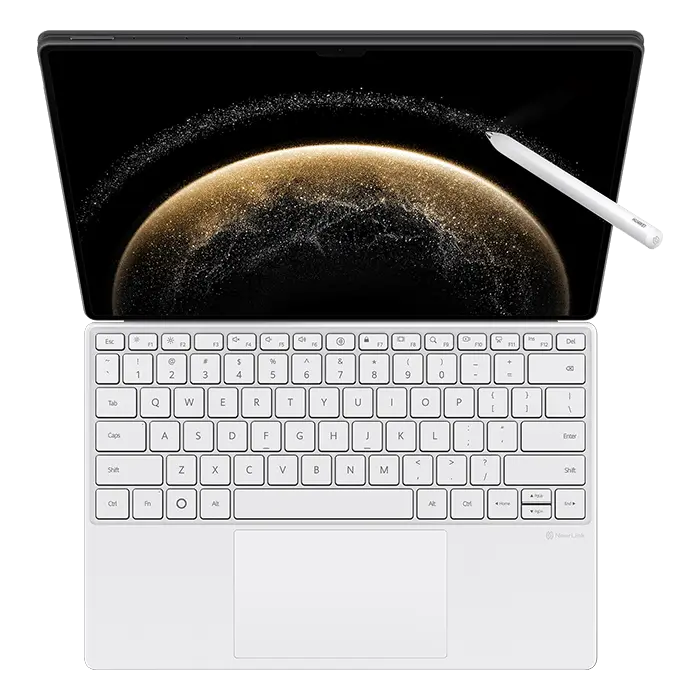

Oppo Pad 4 Pro
13.2″ 7:5 · 3392 × 2400 · Qualcomm Snapdragon 8 Elite · 675 g
Oppo Pad 4 Pro
13.2″ 7:5 · 3392 × 2400 · Qualcomm Snapdragon 8 Elite · 675 g
The Chinese twin of the OnePlus Pad 3, with a 13.2-inch 7:5 screen
The Chinese twin of the OnePlus Pad 3: a sharp 13.2-inch 7:5 screen, a Snapdragon 8 Elite and about 18 hours of battery life, but ColorOS without Google services.
OPPO Pad 4 Pro tech specs: OS: Android 15 (ColorOS 15), without Google services / Processor: Qualcomm Snapdragon 8 Elite (3 nm, 2024) / RAM: 8 GB or 12 GB or 16 GB / Storage: 256 GB or 512 GB (UFS 4.0 [RAM: LPDDR5X]) / microSD slot: no / Pen: OPPO Pencil 2 Pro (optional) / Keyboard: OPPO Pad 4 Pro Smart Touch Keyboard (智能触控键盘) (optional, with touchpad) / Battery: 12,140 mAh, 67 W charging — 18 hours (Notebookcheck) / Connections: 1 × USB-C (USB 3.2 Gen 1, 5 Gbit/s) / Released: April 2025
Screen specs: IPS LCD, glossy, 144 Hz / Size: 13.2 inches / Max brightness: 600 nits (OPPO), 672 cd/m² (Notebookcheck) / Min brightness: 0.9 cd/m² (Notebookcheck) / Resolution: 3392 × 2400 pixels, 315 ppi / Aspect ratio: 7:5 (1.40)
Weight: without keyboard: 23.8 ounces – 1.49 pounds – 675 g
Samsung Galaxy Tab S10 FE+
The second-largest Samsung tablet
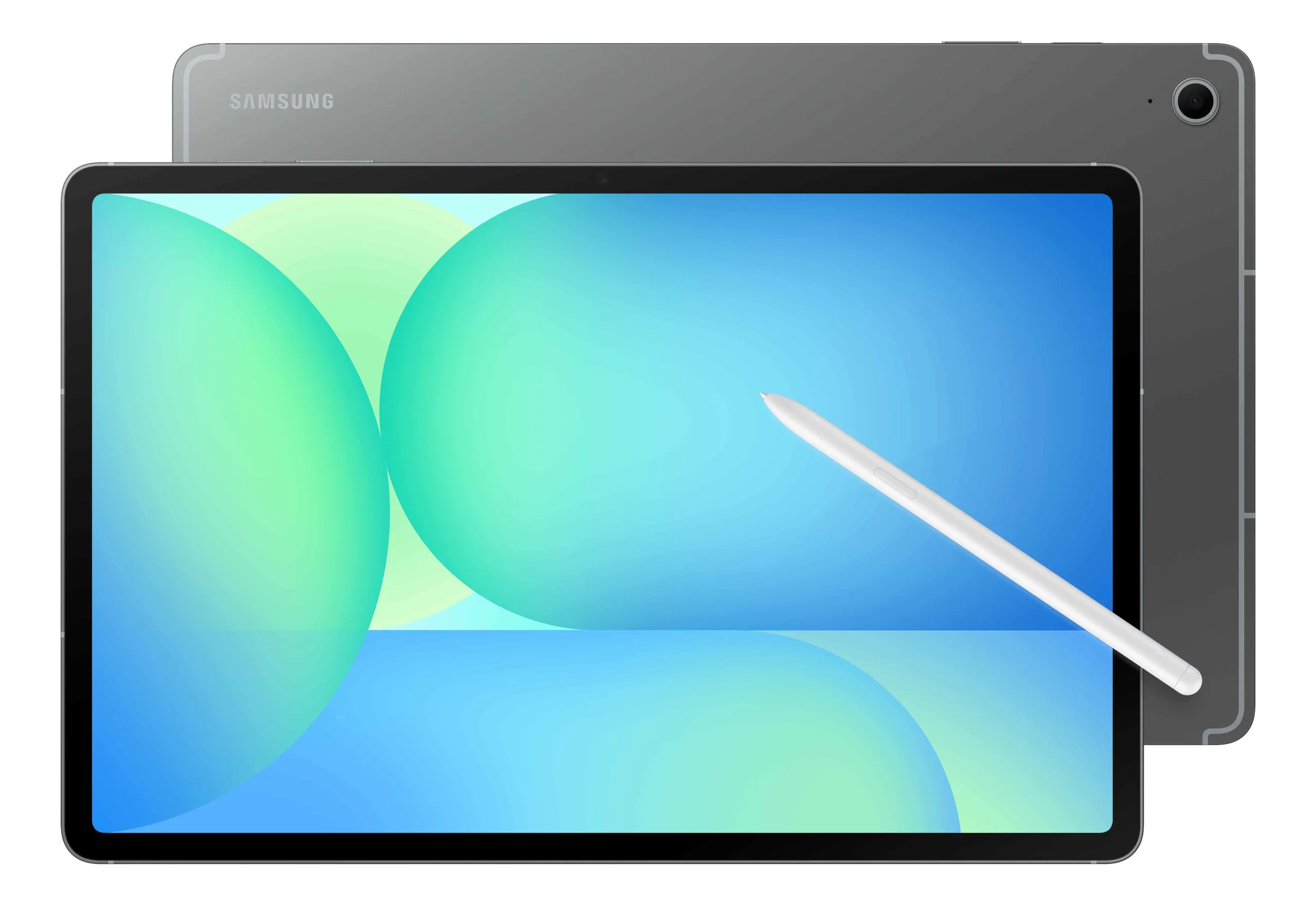
The new Galaxy Tab S10 FE+ is Samsung’s response to the iPad Air 13. It is much smaller than the S10 Ultra, but also much more affordable. Image credit: Samsung
Performance
The Samsung Galaxy Tab S10 FE+ is powered by the Samsung Exynos 1580 processor, released in 2025 and built on a 4 nm process. It is a mid-range chip, fast enough for multitasking, drawing apps and most games; only the most demanding games and video editing will push it to its limits. Compared with other large tablets:
- The Apple M5 in the Apple iPad Pro 13″ (M5) is about 4 times faster.
- The Apple M4 (8-core CPU) in the Apple iPad Air 13″ (M4) is about 3 times faster.
- The Qualcomm Snapdragon 8 Elite in the OnePlus Pad 3 is about 2.5 times faster.
Pros
- Very long battery life (18.9 h of Wi-Fi browsing measured)
- S Pen included
- IP68 water and dust resistance
- Bright, flicker-free screen (779 nits measured)
- Seven years of updates
- microSD slot (up to 2 TB)
Cons
- Mid-range Exynos 1580, slow for the price
- Expensive at its launch price
- LCD instead of OLED, only 90 Hz
- USB 2.0 port without video output
- Keyboard sold separately; no headphone jack
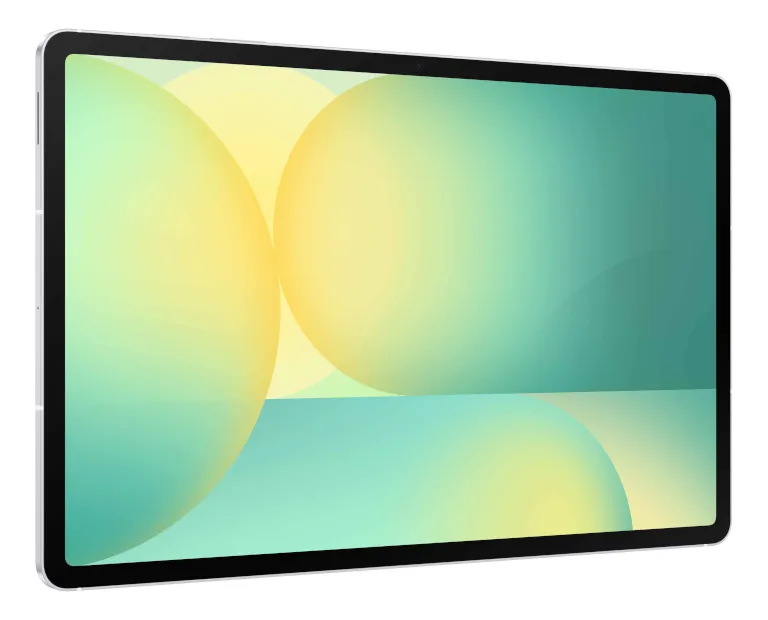

Alldocube iPlay 70 Max Pro / Ultra Pad
13.0″ 16:10 · 2560 × 1600 · Unisoc T7300 · 684 g
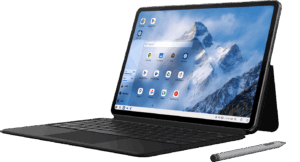
Alldocube iPlay 70 Max Pro / Ultra Pad
13.0″ 16:10 · 2560 × 1600 · Unisoc T7300 · 684 g
A low-cost 13-inch Android tablet with 4G and a sharp 2560 × 1600 screen
A low-cost 13-inch Android tablet with a sharp 2560 × 1600 screen, 4G and Widevine L1, sold officially in Europe, the US and Japan; its chip is slow and the screen is glossy.
Alldocube iPlay 70 Max Pro tech specs: OS: Android 16 (ALLDOCUBE OS 5.0L) / Processor: Unisoc T7300 (6 nm) / RAM: 8 GB / Storage: 128 GB (UFS 2.2) / microSD slot: yes (up to 1 TB) / Pen: Alldocube stylus (optional) / Keyboard: Alldocube magnetic pogo-pin keyboard (optional) / Battery: 10,000 mAh, 30 W charging / Connections: 1 × USB-C / HD streaming: yes (Widevine L1) / Released: March 2026
Screen specs: IPS LCD, glossy, 60 Hz / Size: 13.0 inches / Max brightness: 400 nits (Alldocube) / Resolution: 2560 × 1600 pixels, 232 ppi / Aspect ratio: 16:10 (1.60)
Weight: without keyboard: 24.1 ounces – 1.51 pounds – 684 g
Apple iPad Pro 13-inch
The largest and best iPad
Update October 2026: since October 22, 2025, the 13-inch iPad Pro uses the M5 chip. The tandem OLED screen is unchanged (2752 × 2064 pixels, 1000 nits full-screen, 1600 nits HDR peak), the nano-texture glass option is still limited to the 1 TB and 2 TB models, and the tablet still weighs 579 g (1.28 lb). Apple raised its price in June 2026 (Apple).
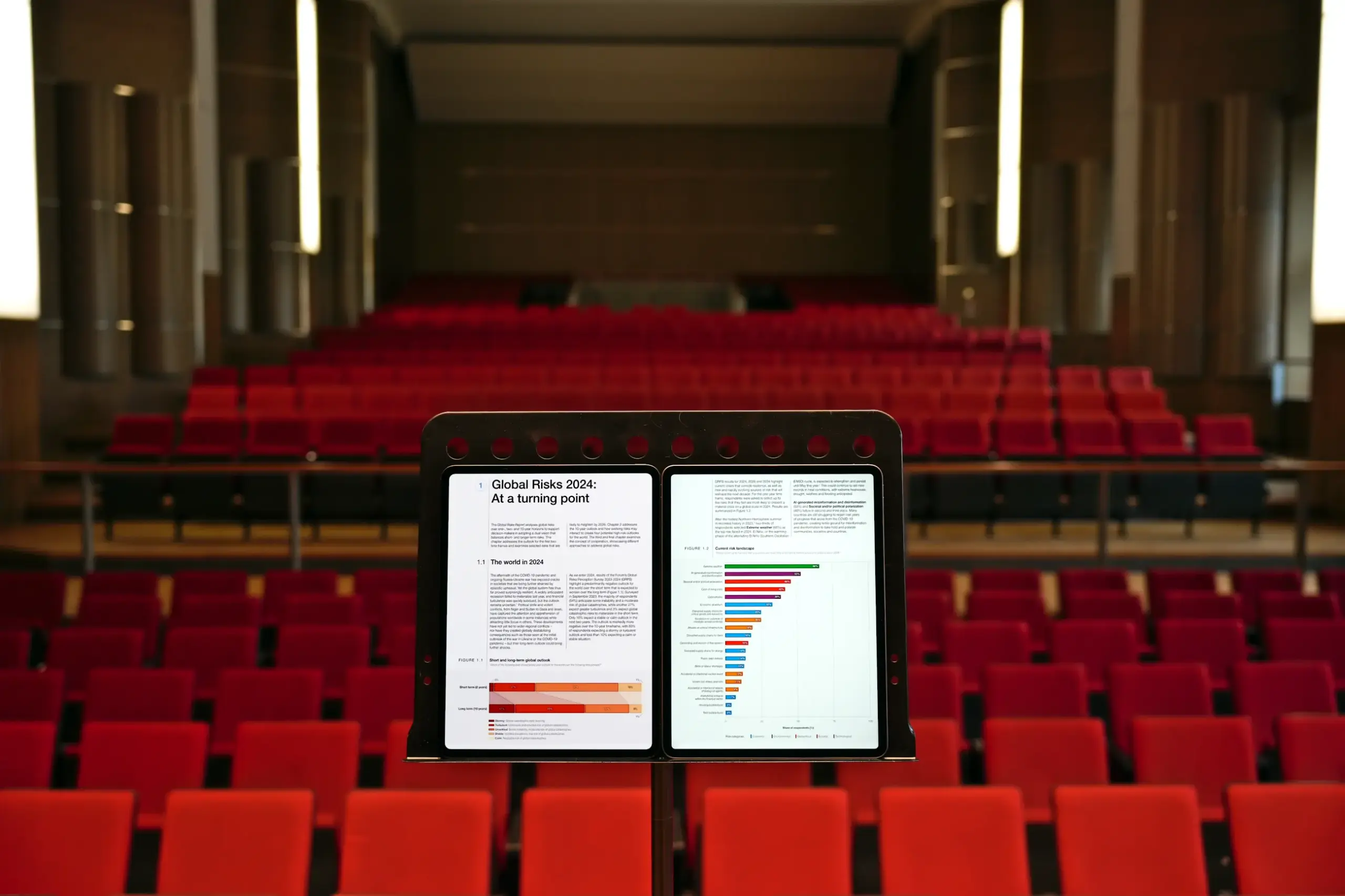
The 13-inch iPad Pro (left) has a slightly larger screen than the 13-inch iPad Air (right). Image credit: large-screens.com
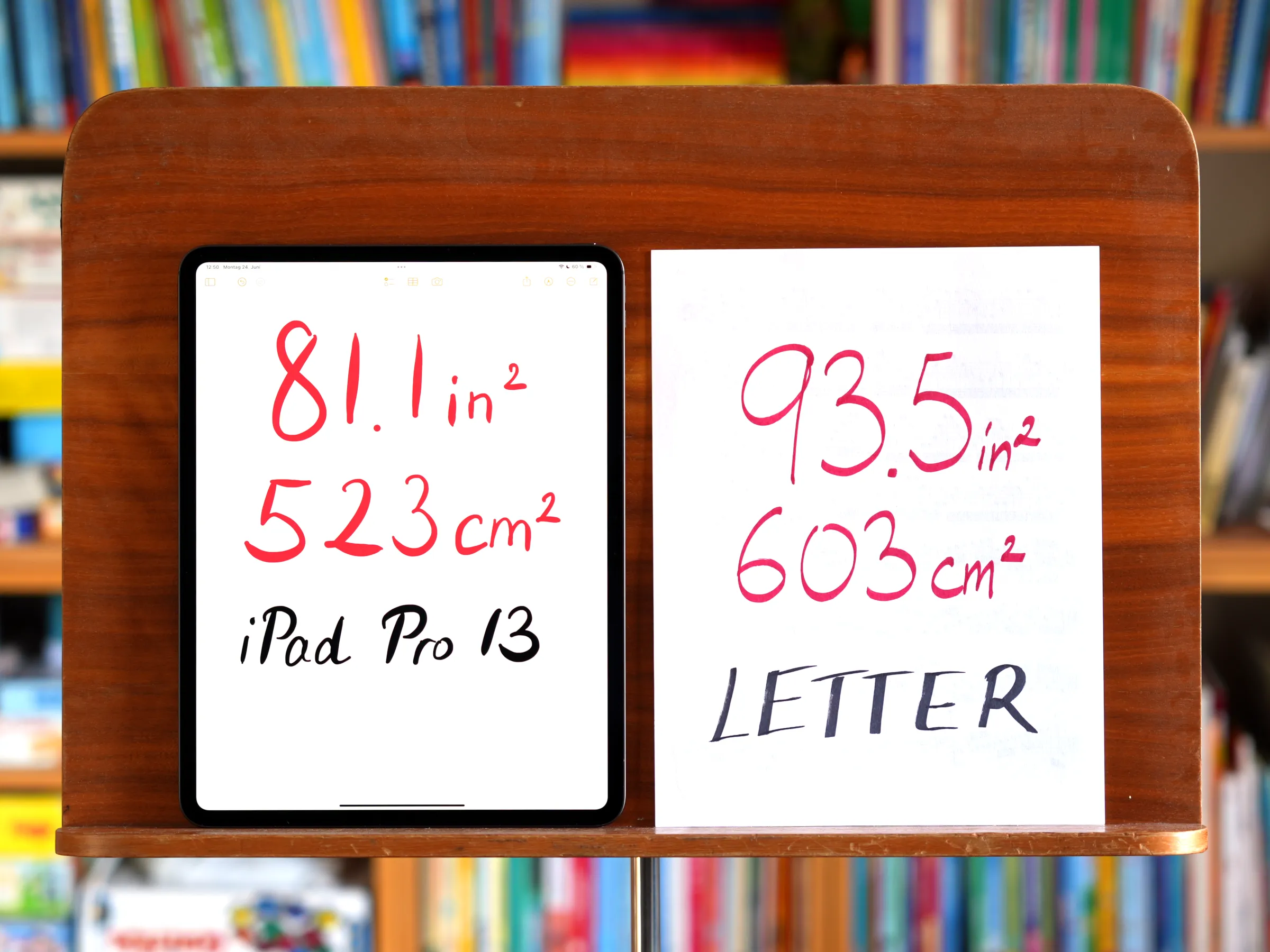
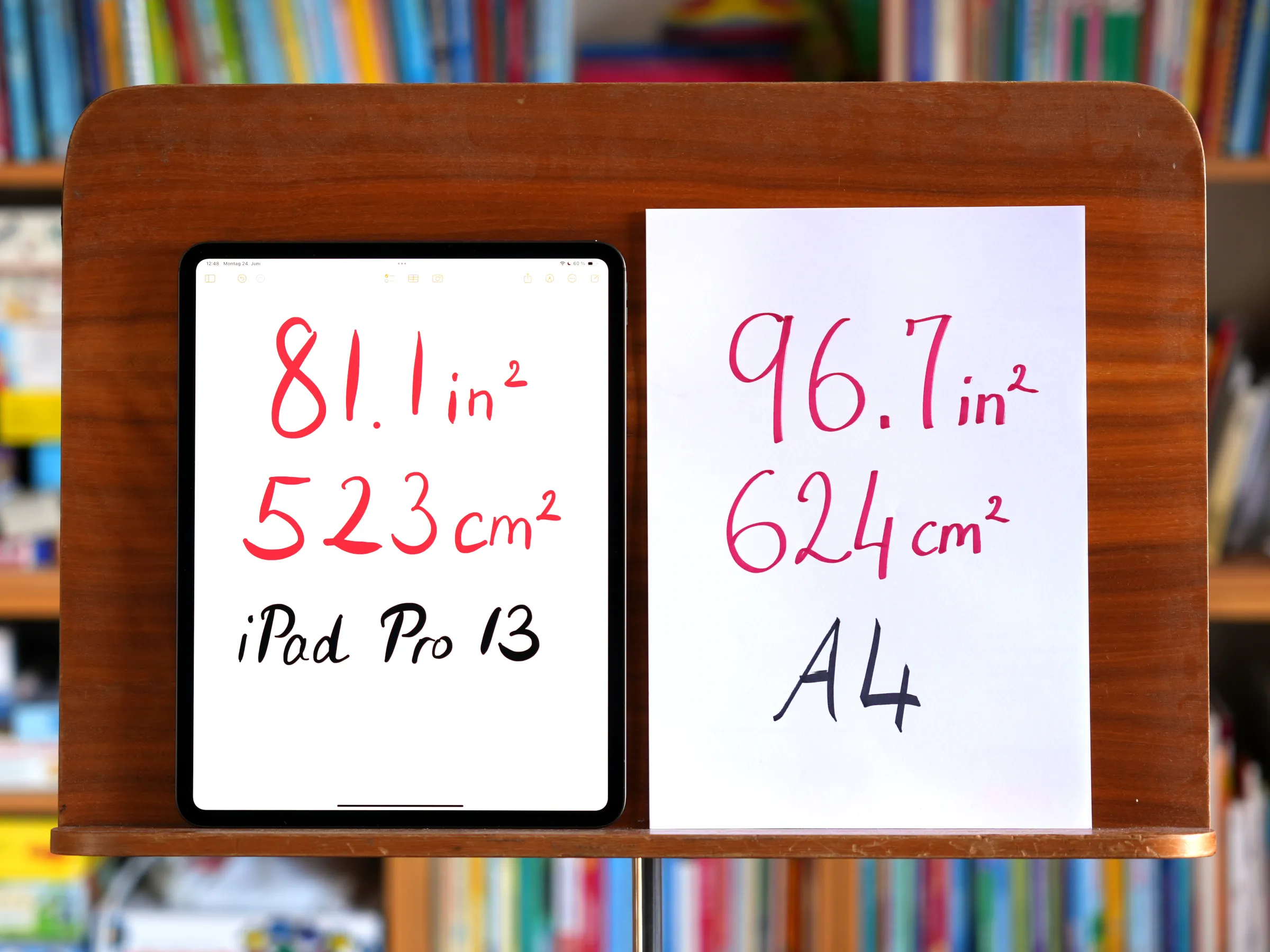
Performance
The Apple iPad Pro 13″ (M5) is powered by the Apple M5 processor, released in 2025 and built on a 3 nm process. It is one of the fastest chips in any tablet: it handles everything, including heavy video editing, 3D work and the most demanding games. Compared with other large tablets:
- The AMD Ryzen AI Max+ 395 in the Asus ROG Flow Z13 (2025) is about 40 % faster.
- The Apple iPad Pro 13″ (M5) is about 20 % faster than the Apple iPad Air 13″ (M4) and its Apple M4 (8-core CPU).
- The Apple iPad Pro 13″ (M5) is about 50 % faster than the Samsung Galaxy Tab S12 Ultra and its MediaTek Dimensity 9500.
Pros
- Excellent tandem OLED screen (989 nits full screen, 1,608 nits HDR measured)
- Optional nano-texture matte glass, almost free of reflections
- Very fast Apple M5 chip with 12 or 16 GB of RAM
- Thin and light for 13 inches (5.1 mm, 579 g)
- Long video runtime (21 hours measured by ComputerBase), fast charging
- Long software support (iPadOS 27 still runs on the 2020 model)
Cons
- Expensive, and more so since June 2026; keyboard and pencil extra
- Nano-texture glass only on the 1 TB and 2 TB models
- Nano-texture: slightly lighter blacks, harder to clean
- Battery lasts about one day in mixed use (7 to 12 hours)
- Less flexible than a MacBook Air at the same price
- No headphone jack or microSD; no charger in the box in Europe
Sponsored
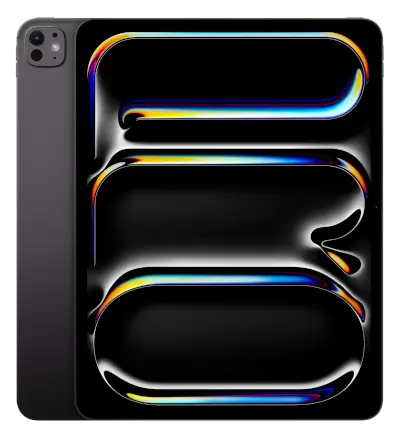
iPad Pro 13 or iPad Air 13: which one to choose?
Both have a 13-inch 4:3 screen (12.9 inches on the Air), work with the Apple Pencil Pro and a Magic Keyboard, and run iPadOS 27. The differences:
- Choose the iPad Air 13 for sheet music, notes, reading and videos indoors: its M4 is fast enough for almost everything, and it is much cheaper. Its LCD screen runs at only 60 Hz and reaches about 600 nits.
- Choose the iPad Pro 13 for drawing, photo and video editing, or for bright places: its tandem OLED screen runs at 120 Hz, is brighter (1,000 nits, 1,600 nits in HDR) and is available with matte nano-texture glass (1 TB and 2 TB models only). Its M5 is about 20 % faster (Geekbench 6), and it is lighter (579 g instead of 616 g) and thinner (5.1 mm instead of 6.1 mm), with four speakers instead of two.

Blackview Mega 8
13.0″ 16:10 · 1920 × 1200 · Unisoc T620 · 736 g
Blackview Mega 8
13.0″ 16:10 · 1920 × 1200 · Unisoc T620 · 736 g
A cheap 13-inch Android tablet with 4G LTE, long battery life and a Full HD screen
A low-cost 13-inch Android tablet with 4G, 12 GB of RAM, Widevine L1 and long battery life, held back by a Full HD screen, a slow chip for games and a basic stylus.
Blackview Mega 8 tech specs: OS: Android 15 (DokeOS_P 4.1) / Processor: Unisoc T620 (12 nm) / RAM: 12 GB / Storage: 256 GB or 512 GB / microSD slot: yes (up to 2 TB [hybrid slot: second SIM or microSD]) / Pen: Passive stylus (included) / Keyboard: Blackview wireless keyboard (optional) / Battery: 11,000 mAh, 18 W charging — 13.2 hours (heise) / Connections: 1 × USB-C (USB 2.0, OTG) / HD streaming: yes (Widevine L1) / Released: April 2025
Screen specs: IPS LCD, glossy, 90 Hz / Size: 13.0 inches / Max brightness: 420 nits (Blackview), 485 cd/m² (heise) / Resolution: 1920 × 1200 pixels, 174 ppi / Aspect ratio: 16:10 (1.60)
Weight: without keyboard: 26.0 ounces – 1.62 pounds – 736 g
Sponsored
Dell Latitude 7350 Detachable
13.0″ 3:2 · 2880 × 1920 · Intel Core Ultra 5 134U / Core Ultra 7 164U (vPro) · 790 g
Dell Latitude 7350 Detachable
13.0″ 3:2 · 2880 × 1920 · Intel Core Ultra 5 134U / Core Ultra 7 164U (vPro) · 790 g
A 13-inch 3:2 Windows business tablet with a kickstand, Thunderbolt 4 and optional 5G
Dell’s 13-inch Windows business tablet: bright 3:2 screen, kickstand, long battery life and optional 5G, but expensive, with few ports and a modest 2024 Intel chip.
Dell Latitude 7350 Detachable tech specs: OS: Windows 11 Pro / Processor: Intel Core Ultra 5 134U / Core Ultra 7 164U (vPro) / RAM: 8 GB or 16 GB or 32 GB / Storage: 256 GB or 512 GB or 1 TB or 2 TB (SSD [PCIe Gen4]) / microSD slot: no / Pen: Dell Active Pen (optional) / Keyboard: Dell Latitude 7350 Detachable Collaboration Keyboard (optional, with touchpad) / Battery: 46.5 Wh, 65 W charging — 12.8 hours (PCWorld) / Connections: 2 × Thunderbolt 4 (USB-C, 40 Gbps, DisplayPort), audio jack, optional nano-SIM and smart card reader / Released: 2024
Screen specs: IPS LCD, anti-reflective, 60 Hz / Size: 13.0 inches / Max brightness: 500 nits (Dell), 507 cd/m² (Notebookcheck) / Resolution: 2880 × 1920 pixels, 266 ppi / Aspect ratio: 3:2 (1.50)
Weight: without keyboard: 27.9 ounces – 1.74 pounds – 790 g / with keyboard: 44.4 ounces – 2.78 pounds – 1,260 g
Sponsored

Doogee Tab E3 Pro / U13
13.0″ 16:10 · 1920 × 1200 · MediaTek Helio G100 · 718 g
Doogee Tab E3 Pro / U13
13.0″ 16:10 · 1920 × 1200 · MediaTek Helio G100 · 718 g
A thin, low-cost 13-inch Android tablet with 4G, GPS and 8 GB of RAM
A thin, low-cost 13-inch Android tablet with 4G, GPS and 8 GB of RAM, but with an entry-level chip and no update policy; the cheaper U13 adds Widevine L1.
Doogee Tab E3 Pro / U13 tech specs: OS: Android 15 / Processor: MediaTek Helio G100 (6 nm, 2024) / RAM: 8 GB / Storage: 256 GB (UFS) / microSD slot: yes (yes [shared with the SIM tray]) / Pen: (optional) / Keyboard: (optional) / Battery: 11,000 mAh, 18 W charging / Connections: 1 × USB-C / Released: May 2025
Screen specs: IPS LCD (in-cell), glossy, 90 Hz / Size: 13.0 inches / Max brightness: 350 nits (Doogee) / Resolution: 1920 × 1200 pixels, 174 ppi / Aspect ratio: 16:10 (1.60)
Weight: without keyboard: 25.3 ounces – 1.58 pounds – 718 g
Sponsored

Honor Pad X9 Max
13.0″ 16:10 · 2500 × 1560 · Qualcomm Snapdragon 6s 4G Gen 2 · 618 g
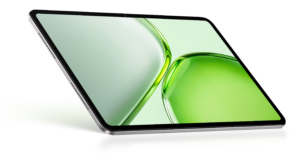
Honor Pad X9 Max
13.0″ 16:10 · 2500 × 1560 · Qualcomm Snapdragon 6s 4G Gen 2 · 618 g
A light, low-cost 13-inch Android tablet with long battery life but a slow chip
A light 13-inch Android tablet with a sharp 120 Hz screen, loud speakers and long battery life, held back by a slow entry-level chip.
Honor Pad X9 Max tech specs: OS: Android 16 (MagicOS 10) / Processor: Qualcomm Snapdragon 6s 4G Gen 2 (6 nm) / RAM: 4 GB or 6 GB / Storage: 128 GB or 256 GB / microSD slot: yes (up to 2 TB) / Pen: Honor Magic-Pencil 4s (USB-C) (optional) / Keyboard: HONOR Pad X9 Max Smart Bluetooth Keyboard (optional) / Battery: 10,100 mAh, 45 W charging — 19 hours (iXBT) / Connections: 1 × USB-C (USB 2.0) / Released: July 2026
Screen specs: IPS LCD, matte version available (Paperlike Edition (Soft Light in China)), 120 Hz / Size: 13.0 inches / Max brightness: 590 cd/m² (iXBT) / Min brightness: 2.0 cd/m² (iXBT) / Resolution: 2500 × 1560 pixels, 227 ppi / Aspect ratio: 16:10 (1.60)
Weight: without keyboard: 21.8 ounces – 1.36 pounds – 618 g
Lenovo Yoga Tab Plus Gen 2
A 13-inch 3:2 Android tablet with a haptic pen and seven years of updates
Lenovo Yoga Tab Plus Gen 2 tech specs: OS: Android 17 / Processor: Qualcomm Snapdragon 8 Elite (2024) / RAM: 12 GB or 16 GB / Storage: 256 GB or 512 GB (UFS 4.0) / microSD slot: yes (up to 2 TB) / Pen: Lenovo Tab Pen Pro 2 (included) / Keyboard: Lenovo All-in-One Clamshell Keyboard for Yoga Tab Plus Gen 2 (included, with touchpad) / Battery: 12,700 mAh, 68 W charging / Connections: 1 × USB-C (USB 5 Gbps) with charging, DisplayPort out and audio; microSD slot; 3-point pogo connector / Updates: 7 years of security updates / Released: September 2026
Screen specs: LTPS LCD, glossy, 144 Hz / Size: 13.0 inches / Max brightness: 700 nits (Lenovo) / Resolution: 3840 × 2560 pixels, 355 ppi / Aspect ratio: 3:2 (1.50)
Weight: without keyboard: 21.3 ounces – 1.33 pounds – 605 g
Lenovo’s new top tablet, with seven Android upgrades
The Yoga Tab Plus Gen 2 is Lenovo’s top Android tablet, presented at IFA in September 2026. It replaces the 12.7-inch Yoga Tab Plus with a larger screen, a microSD slot and seven Android upgrades, with security updates until 2033 (Lenovo). No full review with measurements was available in October 2026; first hands-on reports praise the bright screen and the pen, but find the tablet expensive and not very slim (IT Pro, WinFuture).
Screen: a very sharp 3:2 LCD for documents, 144 Hz
The 13-inch LCD has a 3:2 format, taller than the usual 16:10, which suits documents and sheet music. It is very sharp (3840 × 2560, 355 ppi) and runs at up to 144 Hz; Lenovo gives 700 nits typical and 1,100 nits peak. It is glossy (no anti-reflection layer listed) and about 4 % smaller than the screen of the 13-inch iPad Pro (Lenovo PSREF).
Speed: a 2024 flagship chip, Android 17 with Google Play
The Snapdragon 8 Elite, a 2024 flagship chip, remains one of the fastest Android chips. It has 12 or 16 GB of RAM, 256 or 512 GB of storage and a microSD slot. Android 17 with Google Play adds a desktop mode; Widevine L1 (HD streaming) is not confirmed yet.
A haptic pen, six speakers and a 20-hour battery claim
IT Pro calls the haptic Tab Pen Pro 2 the real star; WinFuture reports a touchpad on the magnetic keyboard. Lenovo claims about 20 hours of web browsing from the 12,700 mAh battery; 68 W charging is supported, but the boxed charger gives 45 W, or none. The tablet weighs 605 g and is 6.1 mm thin (8.3 mm at the camera), with six speakers and one USB-C port with video output, but no headphone jack.
Sold with keyboard and pen; a twin in China
In the US it is sold with keyboard and pen (ChannelNews). In Germany, Lenovo first sold only the 16/256 GB version with keyboard and pen, more expensive than the price it had announced for Europe (Notebookcheck). The China-only Legion Y900 13 shares its screen, chip and battery.
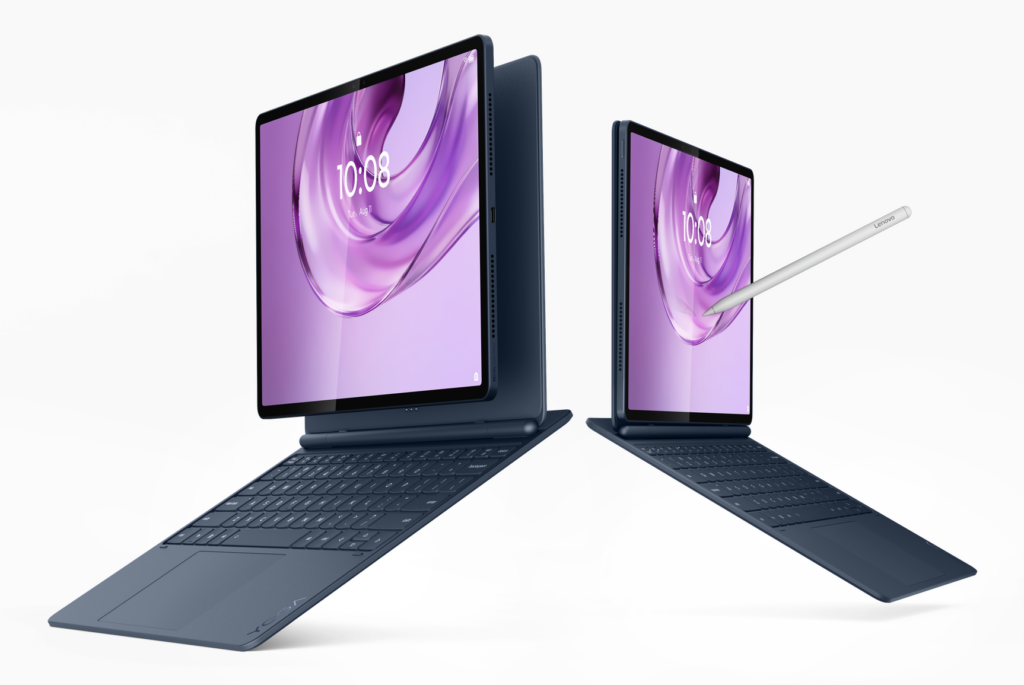
The Lenovo Yoga Tab Plus Gen 2 with its keyboard. Image: Lenovo
Performance
The Lenovo Yoga Tab Plus Gen 2 is powered by the Qualcomm Snapdragon 8 Elite processor, released in 2024 and built on a 3 nm process. It is a fast chip: demanding games, large drawings and video editing run smoothly. The same chip is used in 4 other tablets of our database, including the OnePlus Pad 3 and the Lenovo Legion Y900 13. Compared with other large tablets:
- The Apple M5 in the Apple iPad Pro 13″ (M5) is about 70 % faster.
- The Lenovo Yoga Tab Plus Gen 2 is about 40 % faster than the Lenovo Yoga Tab Plus and its Qualcomm Snapdragon 8 Gen 3.
- The Lenovo Yoga Tab Plus Gen 2 is about 5 times faster than the Meswao MES-B3 (Pro) and its MediaTek Helio G99.
Pros
- Very sharp 13-inch 3:2 screen (3840 × 2560, 355 ppi, 144 Hz)
- Haptic pen and keyboard in the box (US)
- Seven Android upgrades, security updates until 2033
- Fast Snapdragon 8 Elite with 12 or 16 GB of RAM
- microSD slot (up to 2 TB) and USB-C video output
Cons
- LCD, not OLED
- Glossy screen (no anti-reflection coating listed)
- Expensive in Europe with keyboard
- Not especially slim; better on a desk than in the hand
- No headphone jack and only one USB-C port
- 45 W charger in the box (or none), though 68 W is supported
Sponsored

Lenovo Legion Y900 13
13.0″ 3:2 · 3840 × 2560 · Qualcomm Snapdragon 8 Elite · 599 g
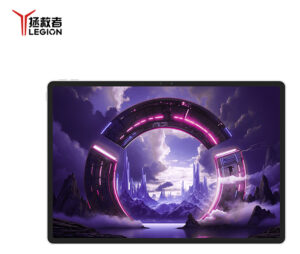
Lenovo Legion Y900 13
13.0″ 3:2 · 3840 × 2560 · Qualcomm Snapdragon 8 Elite · 599 g
A light 13-inch 3:2 gaming tablet with a Snapdragon 8 Elite, sold only in China
A light 13-inch 3:2 gaming tablet (3840 × 2560, 144 Hz) with a Snapdragon 8 Elite, sold only in China and much cheaper than its sibling, the Yoga Tab Plus Gen 2.
Lenovo Legion Y900 13 tech specs: OS: Android 16 (ZUXOS), without Google services / Processor: Qualcomm Snapdragon 8 Elite (3 nm, 2024) / RAM: 8 GB or 12 GB or 16 GB / Storage: 256 GB or 512 GB (UFS 4.1) / microSD slot: yes (up to 2 TB) / Pen: Lenovo Pen Pro (2nd gen) (optional) / Keyboard: Lenovo smart touch keyboard (智能触控键盘) (optional, with touchpad) / Battery: 12,700 mAh, 68 W charging / Connections: 1 × USB-C (USB 3.2 Gen 1, 5 Gbps) with DisplayPort out; microSD slot; accessory pins for the keyboard / Released: May 2026
Screen specs: IPS LCD, glossy, 144 Hz / Size: 13.0 inches / Resolution: 3840 × 2560 pixels, 355 ppi / Aspect ratio: 3:2 (1.50)
Weight: without keyboard: 21.1 ounces – 1.32 pounds – 599 g

Lenovo Idea Tab Pro Gen 2
13.0″ 16:10 · 3504 × 2190 · Qualcomm Snapdragon 8s Gen 4 (SM8735P) · 598 g
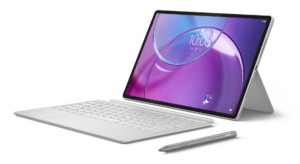
Lenovo Idea Tab Pro Gen 2
13.0″ 16:10 · 3504 × 2190 · Qualcomm Snapdragon 8s Gen 4 (SM8735P) · 598 g
A light, fast 13-inch Android tablet with a sharp 144 Hz screen, but short updates
A light 13-inch Android tablet with a fast Snapdragon 8s Gen 4, a sharp 144 Hz screen and a microSD slot; battery life and update policy are below average.
Lenovo Idea Tab Pro Gen 2 tech specs: OS: Android 16 (ZUI 18) / Processor: Qualcomm Snapdragon 8s Gen 4 (SM8735P) (4 nm, 2025) / RAM: 8 GB or 12 GB / Storage: 128 GB or 256 GB or 512 GB (UFS 3.1 [128 GB], UFS 4.0 [256/512 GB]) / microSD slot: yes (up to 2 TB) / Pen: Lenovo Tab Pen Plus (optional) / Keyboard: Lenovo 2-in-1 Keyboard Pack for Idea Tab Pro Gen 2 (optional, with touchpad) / Battery: 10,200 mAh, 45 W charging — 14.2 hours (Notebookcheck) / Connections: 1 × USB-C (USB 3.2 Gen 1, 5 Gbps) with charging, DisplayPort out and audio; microSD slot; 3-point pogo connector / Updates: 4 years of security updates / Released: March 2026
Screen specs: LTPS IPS LCD, matte version available (Paper-like anti-glare), 144 Hz / Size: 13.0 inches / Max brightness: 600 nits (Lenovo), 618 cd/m² (Notebookcheck) / Min brightness: 2.1 cd/m² (Notebookcheck) / Resolution: 3504 × 2190 pixels, 318 ppi / Aspect ratio: 16:10 (1.60)
Weight: without keyboard: 21.1 ounces – 1.32 pounds – 598 g
Sponsored

Lenovo Xiaoxin Pad Pro GT 13 (2026)
13.0″ 16:10 · 3504 × 2190 · Qualcomm Snapdragon 8 Elite · 610 g
Lenovo Xiaoxin Pad Pro GT 13 (2026)
13.0″ 16:10 · 3504 × 2190 · Qualcomm Snapdragon 8 Elite · 610 g
A China-only 13-inch tablet with a flagship chip at a mid-range price
A China-only 13-inch Android tablet with the flagship Snapdragon 8 Elite, a sharp 144 Hz screen and a 12,000 mAh battery at a low price, without Google services.
Lenovo Xiaoxin Pad Pro GT 13 (2026) tech specs: OS: Android 16 (ZUXOS), without Google services / Processor: Qualcomm Snapdragon 8 Elite (3 nm, 2024) / RAM: 8 GB or 12 GB / Storage: 256 GB or 512 GB (UFS 4.0) / microSD slot: yes (up to 2 TB [Lenovo]) / Pen: Lenovo Stylus Pro (2nd gen) (optional) / Keyboard: Xiaoxin Pro 13 series magnetic keyboard and stand (optional) / Battery: 12,000 mAh, 68 W charging / Connections: 1 × USB-C / Released: March 2026
Screen specs: IPS LCD, glossy, 144 Hz / Size: 13.0 inches / Resolution: 3504 × 2190 pixels, 318 ppi / Aspect ratio: 16:10 (1.60)
Weight: without keyboard: 21.5 ounces – 1.34 pounds – 610 g
Microsoft Surface Pro 13-inch (11th and 12th Edition)
Maybe the best Windows PC with a detachable keyboard
Update October 2026: the Surface Pro 13-inch, 12th Edition was released on June 16, 2026, with Snapdragon X2 Plus or X2 Elite chips. The 13-inch 3:2 screen (2880 × 1920, 120 Hz) is available as LCD (about 600 nits) or OLED (900 nits; Notebookcheck measured 600 cd/m² in SDR). The tablet weighs 895 g (1.97 lb) without the optional Flex Keyboard. An Intel version for businesses (Core Ultra Series 3) had been released a month earlier, on May 19, 2026 (Microsoft, Notebookcheck).
The Surface Pro 11 is a 13-inch Windows tablet with a detachable keyboard. It was released in 2024, but in early 2025, following the release of the new 12-inch Surface Pro, Microsoft “renamed” the Surface Pro 11 the “Surface Pro 13-inch,” removing the version number.
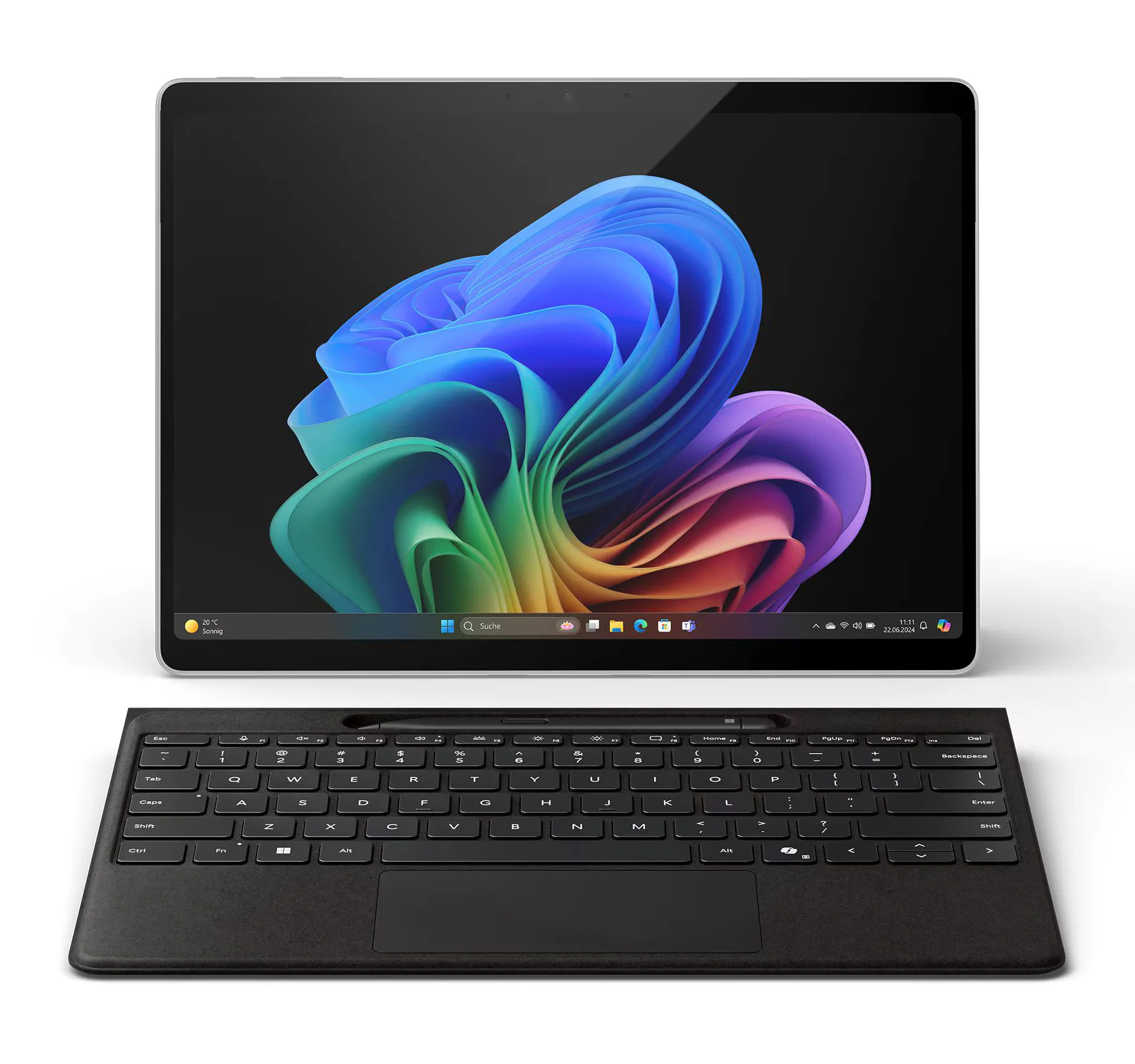
The Surface Pro 11th Edition, a “Copilot+ PC”, ships with a powerful ARM-powered processor by Qualcomm. Image credit: Microsoft
Performance
The Microsoft Surface Pro 13-inch, 12th Edition is powered by the Qualcomm Snapdragon X2 Plus X2P-64-100 processor, released in 2026 and built on a 3 nm process. It is one of the fastest chips in any tablet: it handles everything, including heavy video editing, 3D work and the most demanding games. Compared with other large tablets:
- The Qualcomm Snapdragon X2 Elite X2E-88-100 in the Asus ProArt PZ14 is about 40 % faster.
- The Microsoft Surface Pro 13-inch, 12th Edition is about 20 % faster than the Asus ProArt PZ13 and its Qualcomm Snapdragon X Plus X1P-42-100.
- The Microsoft Surface Pro 13-inch, 12th Edition is about 50 % faster than the Samsung Galaxy Tab S11 Ultra and its MediaTek Dimensity 9400+.
Pros
- Sharp 13-inch 3:2 screen (266 ppi, 120 Hz)
- Bright, accurate OLED option (600 nits, 930 nits HDR measured)
- Full Windows 11 with a built-in 165° kickstand
- Faster graphics than the 2024 model, up to 64 GB of RAM
- Two USB4 ports, Wi-Fi 7, replaceable SSD
- Driver and firmware updates until June 2032
Cons
- Expensive, keyboard and pen extra
- Small upgrade over 2024 (CPU only a few percent faster)
- Gets hot under load and in games
- OLED flickers (PWM, 480 Hz) at 80 % brightness and below
- Windows on Arm: some games and drivers don’t work
- No headphone jack, no card reader; no charger in Germany

Ninkear S13 Neo
13.0″ 3:2 · 3000 × 2000 · Intel Processor N150 · 878 g
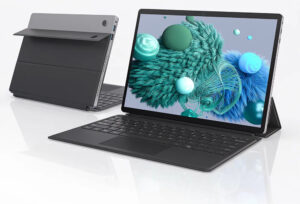
Ninkear S13 Neo
13.0″ 3:2 · 3000 × 2000 · Intel Processor N150 · 878 g
A low-cost Surface-style Windows 2-in-1 with a sharp 3:2 screen but a very slow Intel N150
A 13-inch Windows 11 2-in-1 with a sharp 3000 × 2000 3:2 screen and a keyboard included, held back by a very slow Intel N150 and 4 to 5 hours of battery life.
Ninkear S13 Neo tech specs: OS: Windows 11 / Processor: Intel Processor N150 / RAM: 12 GB / Storage: 512 GB (SATA SSD) / Pen: (included) / Keyboard: Ninkear magnetic detachable keyboard (included, with touchpad) / Battery: 6000 mAh, 36 W charging — 5.1 hours (Antyweb) / Connections: 1 × USB-C (full-featured: charging, DisplayPort), 1 × USB-C (data only), 2 × USB-A 3.2 Gen 1, 3.5 mm jack, DC-in / Released: June 2026
Screen specs: IPS LCD, matte / Size: 13.0 inches / Max brightness: 350 nits (Ninkear), 320 cd/m² (Antyweb) / Resolution: 3000 × 2000 pixels, 277 ppi / Aspect ratio: 3:2 (1.50)
Weight: without keyboard: 31.0 ounces – 1.94 pounds – 878 g
Sponsored
Juno Tab 4
A 13-inch Linux tablet PC with an Intel Core Ultra 5, keyboard and pen included
Juno Tab 4 tech specs: OS: Debian Forky (GNOME, KDE Plasma, Phosh or Plasma Mobile), Ubuntu 26.04 LTS or Kubuntu 26.04 LTS / Processor: Intel Core Ultra 5 115U / RAM: 16 GB / Storage: 1 TB (M.2 2280 NVMe PCIe 3.0 ×4 [removable]) / Pen: 4096-level pressure-sensitive pen (included) / Keyboard: Juno backlit type cover (included) / Battery: 3600 mAh, 65 W charging / Connections: 2 × USB-C 3.1 (charging, video out up to 4096 × 2160 at 60 Hz, OTG), 1 × USB-A 3.0 / Released: June 2026
Screen specs: IPS LCD, glossy, 60 Hz / Size: 13.0 inches / Max brightness: 500 nits (Juno) / Resolution: 2560 × 1600 pixels, 232 ppi / Aspect ratio: 16:10 (1.60)
Weight: without keyboard: 30.0 ounces – 1.87 pounds – 850 g / with keyboard: 43.4 ounces – 2.71 pounds – 1,230 g
A Linux tablet PC from Britain, still on pre-order
The Juno Tab 4 is a 13-inch tablet PC from Juno Computers, a small British maker of Linux computers. It comes with Debian (including the touch-friendly Phosh and Plasma Mobile), Ubuntu or Kubuntu 26.04 LTS, plus a backlit keyboard cover and a pen. Announced in June 2026, it was still on pre-order in October 2026: production started on July 16, and Juno ships about 90 to 100 days after the pre-order campaign ends (Juno Computers). There is no independent review yet; Liliputing, 9to5Linux and ComputerBase only reported the launch, so the figures below come from Juno.
Screen and speed: a sharp 16:10 and a laptop chip
The touchscreen has the same diagonal as the 13-inch iPad Pro but about 6% less area, because its 16:10 format, a wide format made for videos, is less tall than the iPad’s 4:3. With 2560 × 1600 pixels (232 ppi), the image is sharp; Juno gives 500 nits and 60 Hz. The Intel Core Ultra 5 115U is a 15-watt laptop processor cooled by two fans, with 16 GB of RAM and a removable 1 TB SSD: roughly the speed of a mid-range thin laptop, enough for office work, web browsing and 4K video. It runs desktop Linux programs, not Android apps (no Google Play); updates come from Debian and Ubuntu.
Pen and keyboard included; a short 5.5-hour battery
The pen has 4,096 pressure levels, and the magnetic keyboard is sold with a US International (ANSI) layout only. Juno rates the 42.71 Wh battery at about 5.5 hours of average use, which is short for a tablet. It weighs 850 g, or 1.23 kg with the keyboard. It has two USB-C 3.1 ports (charging and video output up to 4K at 60 Hz), a full-size USB-A 3.0 port, Wi-Fi 6, two speakers and 5 MP cameras on both sides, but no cellular modem. It costs $989 in Juno’s US and Canada store and £949 including VAT in its UK and Europe store (October 2026).
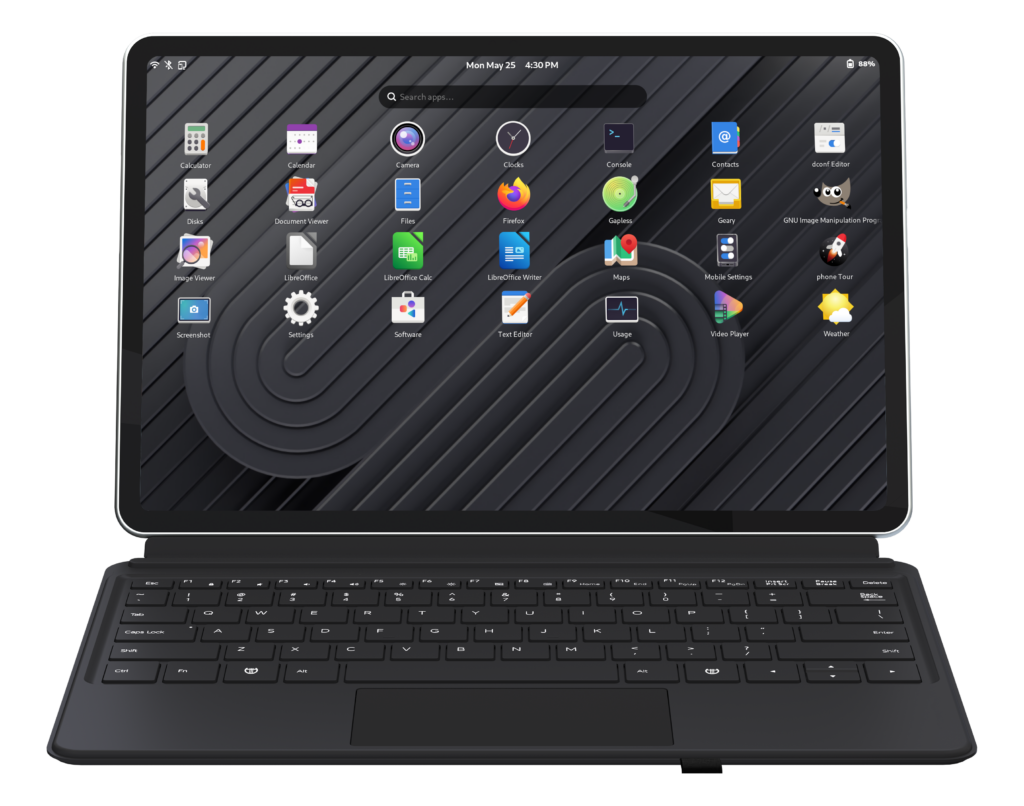
The Juno Tab 4 with its keyboard (included). Image: Juno Computers
Performance
The Juno Tab 4 is powered by the relatively old Intel Core Ultra 5 115U processor, released in 2023 and built on a 7 nm process. It is a fast chip: demanding games, large drawings and video editing run smoothly. Compared with other large tablets:
- The Apple M5 in the Apple iPad Pro 13″ (M5) is about twice as fast.
- The Intel Core Ultra 7 164U in the Dell Latitude 7350 Detachable is about 10 % faster.
- The Juno Tab 4 is about 4 times faster than the Meswao MES-B3 (Pro) and its MediaTek Helio G99.
Pros
- Linux pre-installed (Debian, Ubuntu or Kubuntu)
- Keyboard cover and 4,096-level pen included
- 16 GB RAM and a removable 1 TB SSD
- Sharp 13-inch screen (2560 × 1600, 232 ppi)
- USB-A port and two USB-C ports with 4K video out
Cons
- No independent review yet
- Pre-order only (dispatch 90–100 days after pre-orders close)
- Short battery life (about 5.5 hours, Juno)
- US keyboard layout only
- No Android apps or Google Play
Not available yet. Official website ›

vivo Pad5 Pro
13.0″ 3:2 · 3096 × 2064 · MediaTek Dimensity 9400 · 635 g
vivo Pad5 Pro
13.0″ 3:2 · 3096 × 2064 · MediaTek Dimensity 9400 · 635 g
A thin 13-inch 3:2 tablet with long battery life and an optional matte screen, China only
A thin 13-inch 3:2 tablet with a Dimensity 9400, a bright screen and long battery life, rated 85 % by Notebookcheck, but sold only in China.
vivo Pad5 Pro tech specs: OS: Android 15 (OriginOS 5), without Google services / Processor: MediaTek Dimensity 9400 (3 nm, 2024) / RAM: 8 GB or 12 GB or 16 GB / Storage: 128 GB or 256 GB or 512 GB (UFS 3.1 [128 GB] / UFS 4.1 [256, 512 GB]) / microSD slot: no / Pen: vivo Pencil3 (optional) / Keyboard: vivo Smart Touch Keyboard 5 Pro (optional, with touchpad) / Battery: 12,050 mAh, 66 W charging — 19.0 hours (Notebookcheck) / Connections: 1 × USB-C (USB 3.2 Gen 1) / Released: April 2025
Screen specs: IPS LCD, matte version available (Soft Light (柔光版)), 144 Hz / Size: 13.0 inches / Max brightness: 683 cd/m² (Notebookcheck) / Resolution: 3096 × 2064 pixels, 286 ppi / Aspect ratio: 3:2 (1.50)
Weight: without keyboard: 22.4 ounces – 1.40 pounds – 635 g

Dell Latitude 7320 Detachable
13.0″ 3:2 · 1920 × 1280 · Intel Core i5-1130G7, i5-1140G7 vPro / i7-1180G7 vPro (11th gen, 12 W); Core i3 in the US base model · 789 g
Dell Latitude 7320 Detachable
13.0″ 3:2 · 1920 × 1280 · Intel Core i5-1130G7, i5-1140G7 vPro / i7-1180G7 vPro (11th gen, 12 W); Core i3 in the US base model · 789 g
A light 2021 Windows business tablet with a 13-inch 3:2 screen, kickstand and pen slot
Dell’s light 2021 13-inch Windows business tablet: bright 3:2 screen, kickstand, Thunderbolt 4 and a pen slot, but a wobbly stand and weak speakers; now refurbished or used only.
Dell Latitude 7320 Detachable tech specs: OS: Windows 10 Home / Pro / Enterprise (at launch; Windows 11 capable) / Processor: Intel Core i5-1130G7, i5-1140G7 vPro / i7-1180G7 vPro (11th gen, 12 W); Core i3 in the US base model (10 nm, 2021) / RAM: 4 GB or 8 GB or 16 GB / Storage: 128 GB or 256 GB or 512 GB or 1 TB (M.2 2230 PCIe Gen 3 x4 NVMe SSD) / microSD slot: no / Pen: Dell Latitude 7320 Detachable Active Pen (PN7320A) (optional) / Keyboard: Dell Latitude 7320 Detachable Travel Keyboard (optional, with touchpad) / Battery: 40 Wh, 65 W charging — 9.3 hours (Laptop Mag) / Connections: 2 × Thunderbolt 4 (USB4 Type-C, DisplayPort, charging), 3.5 mm audio jack, optional nano-SIM (4G LTE), optional smart card reader and NFC, wedge lock slot / Released: 2021
Screen specs: IPS LCD, anti-reflective, 60 Hz / Size: 13.0 inches / Max brightness: 500 nits (Dell), 504 cd/m² (Notebookcheck) / Resolution: 1920 × 1280 pixels, 178 ppi / Aspect ratio: 3:2 (1.50)
Weight: without keyboard: 27.8 ounces – 1.74 pounds – 789 g / with keyboard: 39.6 ounces – 2.48 pounds – 1,124 g

Dell XPS 13 2-in-1 (9315)
13.0″ 3:2 · 2880 × 1920 · Intel Core i5-1230U / Core i7-1250U (12th gen, fanless) · 736 g
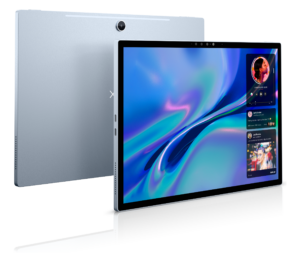
Dell XPS 13 2-in-1 (9315)
13.0″ 3:2 · 2880 × 1920 · Intel Core i5-1230U / Core i7-1250U (12th gen, fanless) · 736 g
A thin, fanless 13-inch Windows tablet (2022) with a 3:2 screen and a folio keyboard
Dell’s discontinued 13-inch Windows tablet (2022): a sharp 3:2 screen, a thin, silent fanless body and a good folio keyboard, but short battery life and only two ports.
Dell XPS 13 2-in-1 (9315) tech specs: OS: Windows 11 / Processor: Intel Core i5-1230U / Core i7-1250U (12th gen, fanless) (2022) / RAM: 8 GB or 16 GB / Storage: 512 GB or 1 TB (SSD [M.2 PCIe NVMe]) / microSD slot: no / Pen: Dell XPS Stylus (optional) / Keyboard: Dell XPS Folio (optional, with touchpad) / Battery: 49.5 Wh, 45 W charging — 9.0 hours (Notebookcheck) / Connections: 2 × Thunderbolt 4 (USB-C, DisplayPort, Power Delivery); USB-C to 3.5 mm and USB-C to USB-A adapters in the box / Released: August 2022
Screen specs: IPS LCD, glossy, 60 Hz / Size: 13.0 inches / Max brightness: 500 nits (Dell), 486 cd/m² (Notebookcheck) / Resolution: 2880 × 1920 pixels, 266 ppi / Aspect ratio: 3:2 (1.50)
Weight: without keyboard: 26.0 ounces – 1.62 pounds – 736 g / with keyboard: 45.9 ounces – 2.87 pounds – 1,300 g
HP Elite x2 G8
13.0″ 3:2 · 1920 × 1280 · Intel Core i3-1125G4, i5-1135G7 / i5-1145G7 / i7-1165G7 / i7-1185G7 (11th gen) · 820 g
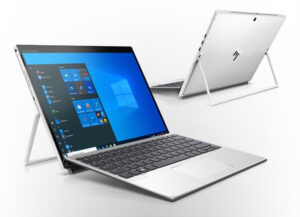
HP Elite x2 G8
13.0″ 3:2 · 1920 × 1280 · Intel Core i3-1125G4, i5-1135G7 / i5-1145G7 / i7-1165G7 / i7-1185G7 (11th gen) · 820 g
HP’s 13-inch 3:2 business tablet with a kickstand, Thunderbolt 4 and optional LTE (2021)
HP’s 2021 13-inch Windows business tablet with a 3:2 screen, kickstand, backlit keyboard, Thunderbolt 4 and optional LTE; discontinued, so refurbished or used only.
HP Elite x2 G8 tech specs: OS: Windows 10 Pro (at launch; later Windows 11 Pro) / Processor: Intel Core i3-1125G4, i5-1135G7 / i5-1145G7 / i7-1165G7 / i7-1185G7 (11th gen) (10 nm, 2020) / RAM: 8 GB or 16 GB / Storage: 256 GB or 512 GB or 1 TB or 2 TB (SSD [M.2 PCIe NVMe]) / microSD slot: no / Pen: HP Rechargeable Active Pen G3 (optional) / Keyboard: HP Elite x2 G8 Collaboration Keyboard (included, with touchpad) / Battery: 47 Wh, 65 W charging / Connections: 2 × USB4 Type-C (Thunderbolt 4), 1 × USB-C 3.1 (charging, DisplayPort), 3.5 mm headphone/microphone jack, optional nano-SIM / Released: 2021
Screen specs: IPS LCD, glossy / Size: 13.0 inches / Max brightness: 400 nits (HP) / Resolution: 1920 × 1280 pixels, 178 ppi / Aspect ratio: 3:2 (1.50)
Weight: without keyboard: 28.9 ounces – 1.81 pounds – 820 g / with keyboard: 41.4 ounces – 2.59 pounds – 1,175 g

Honor MagicPad 13
13.0″ 1.57:1 · 2880 × 1840 · Qualcomm Snapdragon 888 · 660 g
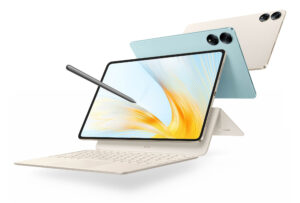
Honor MagicPad 13
13.0″ 1.57:1 · 2880 × 1840 · Qualcomm Snapdragon 888 · 660 g
Honor’s first 13-inch tablet: 144 Hz, eight speakers, sold only in China
Honor’s first 13-inch tablet (2023, China only): a sharp 144 Hz screen, eight speakers and an optional touchpad keyboard, but an older chip and no Google services.
Honor MagicPad 13 tech specs: OS: Android 13 (MagicOS 7.2), without Google services / Processor: Qualcomm Snapdragon 888 (5 nm) / RAM: 8 GB or 12 GB or 16 GB / Storage: 256 GB or 512 GB / microSD slot: no / Pen: Honor Magic-Pencil 3 (optional) / Keyboard: Honor MagicPad 13 Smart Touch Keyboard (荣耀平板MagicPad 13智能触控键盘) (optional, with touchpad) / Battery: 10,050 mAh, 66 W charging / Connections: 1 × USB-C (USB 3.2 Gen 1, video output up to 4K 60 Hz) / Released: July 2023
Screen specs: IPS LCD, glossy, 144 Hz / Size: 13.0 inches / Resolution: 2880 × 1840 pixels, 263 ppi / Aspect ratio: 1.57:1
Weight: without keyboard: 23.3 ounces – 1.46 pounds – 660 g

Lenovo Yoga Tab 13
13.0″ 16:10 · 2160 × 1350 · Qualcomm Snapdragon 870 · 830 g
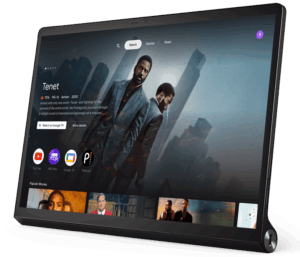
Lenovo Yoga Tab 13
13.0″ 16:10 · 2160 × 1350 · Qualcomm Snapdragon 870 · 830 g
A 13-inch video tablet with a built-in stand, great speakers and an HDMI input
Lenovo’s 2021 13-inch video tablet with a built-in stand, excellent JBL speakers, long battery life and a micro-HDMI input; the 60 Hz screen is dim and it is heavy.
Lenovo Yoga Tab 13 tech specs: OS: Android 11 (at launch; Android 13 update in 2023) / Processor: Qualcomm Snapdragon 870 / RAM: 8 GB / Storage: 128 GB or 256 GB (UFS 3.0) / microSD slot: no / Pen: Lenovo Precision Pen 2 (optional) / Keyboard: no official one / Battery: 10,200 mAh, 30 W charging — 17.6 hours (Notebookcheck) / Connections: 1 × USB-C 3.1 (charging, DisplayPort 1.4), 1 × micro-HDMI input (HDCP 1.4) / HD streaming: yes (Widevine L1) / Released: June 2021
Screen specs: LTPS LCD, glossy, 60 Hz / Size: 13.0 inches / Max brightness: 400 nits (Lenovo), 404 cd/m² (Notebookcheck) / Min brightness: 4.0 cd/m² (Notebookcheck) / Resolution: 2160 × 1350 pixels, 196 ppi / Aspect ratio: 16:10 (1.60)
Weight: without keyboard: 29.3 ounces – 1.83 pounds – 830 g
vivo Pad3 Pro
13.0″ 3:2 · 3096 × 2064 · MediaTek Dimensity 9300 · 679 g
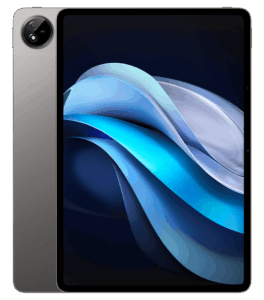
vivo Pad3 Pro
13.0″ 3:2 · 3096 × 2064 · MediaTek Dimensity 9300 · 679 g
A fast 13-inch 3:2 tablet with a Dimensity 9300 and eight speakers, sold only in China
vivo’s 2024 13-inch 3:2 tablet: a fast Dimensity 9300, eight speakers and good battery life, but sold only in China with Chinese software and now import-only.
vivo Pad3 Pro tech specs: OS: Android 14 (OriginOS 4), without Google services / Processor: MediaTek Dimensity 9300 (4 nm, 2023) / RAM: 8 GB or 12 GB or 16 GB / Storage: 128 GB or 256 GB or 512 GB (UFS 3.1 [128 GB] / UFS 4.0 [256, 512 GB]) / microSD slot: no / Pen: vivo Pencil2 (optional) / Keyboard: vivo Smart Touch Keyboard 3 Pro (optional, with touchpad) / Battery: 11,500 mAh, 66 W charging — 10.5 hours (MyDrivers (快科技)) / Connections: 1 × USB-C (USB 3.2 Gen 1) / Released: March 2024
Screen specs: IPS LCD, glossy, 144 Hz / Size: 13.0 inches / Max brightness: 625 cd/m² (Anzhuo.cn (锋潮科技)) / Resolution: 3096 × 2064 pixels, 286 ppi / Aspect ratio: 3:2 (1.50)
Weight: without keyboard: 24.0 ounces – 1.50 pounds – 679 g
Chuwi Hi10 Max
A low-cost 13-inch Windows tablet with a sharp 3:2 screen and a Core Ultra 5 chip
Chuwi Hi10 Max tech specs: OS: Windows 11 Pro / Processor: Intel Core Ultra 5 125U / RAM: 12 GB / Storage: 512 GB (PCIe 3.0 SSD [upgradeable to 1 TB]) / microSD slot: no / Pen: Chuwi HiPen H7 (optional) / Keyboard: Chuwi magnetic docking keyboard (optional) / Battery: 4820 mAh, 65 W charging — 5.2 hours (Smartzone (Intel N100 version)) / Connections: 2 × USB-C 3.2 Gen 2 (10 Gbps, PD, DisplayPort), 1 × USB-A 3.2 Gen 1, 1 × micro HDMI, 3.5 mm jack / Released: May 2026
Screen specs: IPS LCD, glossy, 60 Hz / Size: 13.0 inches / Max brightness: 300 nits (Chuwi), 413 cd/m² (Notebookcheck (Intel N100 version)) / Min brightness: 67.9 cd/m² (Notebookcheck (Intel N100 version)) / Resolution: 2880 × 1920 pixels, 267 ppi / Aspect ratio: 3:2 (1.50)
Weight: without keyboard: 27.5 ounces – 1.72 pounds – 780 g
A cheap 3:2 Windows tablet; only the N100 version reviewed
The Chuwi Hi10 Max is a low-cost 13-inch Windows 11 Pro tablet with a 3:2 screen. The main version, launched in May 2026, uses an Intel Core Ultra 5 125U processor (Chuwi); the cheaper Intel N100 (2024) and N150 (2025) versions have the same screen size and resolution. Independent reviews so far cover only the N100 version: Notebookcheck rated it 79% and, like TechRadar, praised the price but found the battery life short. No review of the Core Ultra 5 version was found (October 2026).
Screen: sharp 3:2, good for documents and sheet music
The 12.96-inch screen has about the same diagonal as the 13-inch iPad Pro. Its 3:2 format is taller than the usual 16:10 widescreen, which suits documents and sheet music. With 2880 × 1920 pixels (267 ppi) it is sharp. Chuwi rates the Core Ultra 5 version at 300 nits, but Notebookcheck measured 413 nits on the N100 version, without PWM flicker. The glossy glass reflects a lot outdoors (Notebookcheck, Parkablogs).
Speed: a laptop chip, much faster than the N100
The Core Ultra 5 is a 12-core laptop chip, much faster than the N100, which reviewers found fine only for office work and browsing. It comes with 12 GB of RAM, a 512 GB SSD and Windows 11 Pro; Chuwi says Office is pre-installed.
Weak points: stylus lag, no kickstand, short battery
On the N100 version, reviewers criticized the lag of the HiPen H7 stylus (Parkablogs, Smartzone), the thin, hollow speakers and the stand: there is no built-in kickstand, only a magnetic back cover, and with keyboard and cover the tablet weighed 1,375 g (Notebookcheck). Smartzone measured 5 hours 14 minutes in the PCMark office battery test; the Core Ultra 5 version has a similar 37 Wh battery and a 65 W USB-C charger. Ports are generous: two USB-C 3.2 with charging and video output, USB-A, micro HDMI and a headphone jack.
Two versions, both sold out in October 2026
store.chuwi.com sells the Core Ultra 5 version and a cheaper N150 version, with the keyboard as an extra; both were sold out in October 2026.
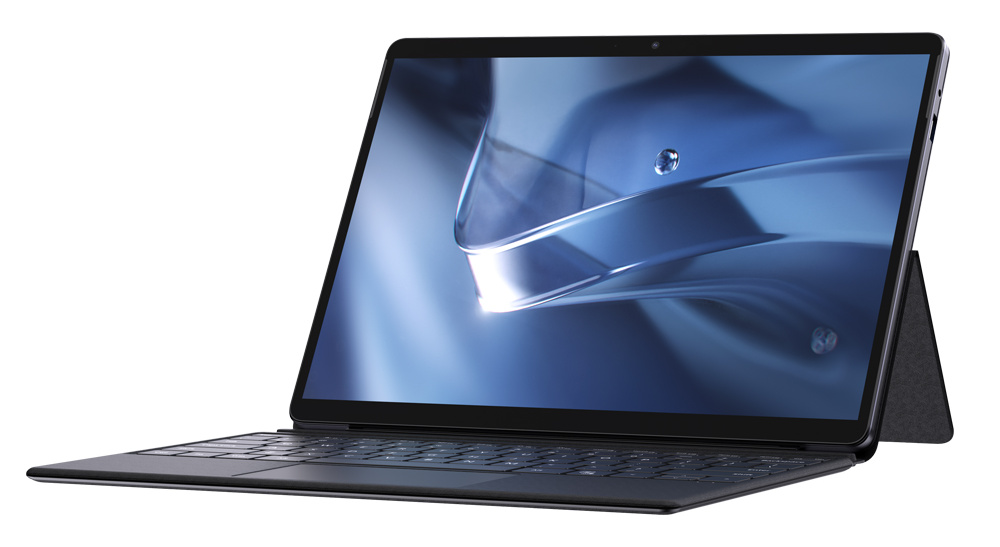
The Chuwi Hi10 Max with its optional magnetic keyboard. Image: Chuwi
Performance
The Chuwi Hi10 Max is powered by the relatively old Intel Core Ultra 5 125U processor, released in 2023 and built on a 7 nm process. It is a fast chip: demanding games, large drawings and video editing run smoothly. Compared with other large tablets:
- The Apple M5 in the Apple iPad Pro 13″ (M5) is about 70 % faster.
- The Chuwi Hi10 Max is about 3 times faster than the Ninkear S13 Neo and its Intel Processor N150.
- The Chuwi Hi10 Max is about 4.5 times faster than the Meswao MES-B3 (Pro) and its MediaTek Helio G99.
Pros
- Sharp 3:2 screen (2880 × 1920, 267 ppi)
- Bright, flicker-free panel (413 nits measured on the N100 version)
- Many ports: 2 × USB-C with video out, USB-A, micro HDMI
- Core Ultra 5 version much faster than the N100 and N150
- Low price for a Windows tablet
Cons
- Short battery life (5 h 14 min measured on the N100 version)
- Thin, hollow speakers
- Stand is a separate magnetic back cover on the N100 version (1,375 g with keyboard)
- Laggy HiPen H7 stylus
- Very reflective glossy screen
- Keyboard and pen cost extra
Sponsored
Teclast T65 Max
12.9″ 16:10 · 1920 × 1200 · MediaTek Helio G99 (MT8781) · 740 g
Teclast T65 Max
12.9″ 16:10 · 1920 × 1200 · MediaTek Helio G99 (MT8781) · 740 g
A low-cost 13-inch Android tablet with 4G, long battery life and a dim Full HD screen
A low-cost 13-inch Android tablet with 4G, GPS, Widevine L1 and nearly 12 hours of battery life, held back by a dim, soft Full HD screen and an entry-level chip.
Teclast T65 Max tech specs: OS: Android 15 / Processor: MediaTek Helio G99 (MT8781) (6 nm, 2022) / RAM: 8 GB / Storage: 256 GB (UFS) / microSD slot: yes (up to 1 TB) / Pen: Teclast T-Pen (USI 2.0) (optional) / Keyboard: no official one / Battery: 10,000 mAh, 15 W charging — 11.9 hours (Notebookcheck) / Connections: 1 × USB-C / HD streaming: yes (Widevine L1) / Released: 2025
Screen specs: IPS LCD (in-cell), glossy, 60 Hz / Size: 12.9 inches / Max brightness: 290 cd/m² (Notebookcheck (2024 version)) / Resolution: 1920 × 1200 pixels, 175 ppi / Aspect ratio: 16:10 (1.60)
Weight: without keyboard: 26.1 ounces – 1.63 pounds – 740 g
Sponsored
The best 12.7 to 12.9-inch tablets
Apple iPad Air 13-inch (M4, 2026)
Much cheaper than the iPad Pro, but still great
Update October 2026: the 13-inch iPad Air got an M4 chip and 12 GB of RAM on March 11, 2026. The 12.9-inch LCD (2732 × 2048, 600 nits) and the 616 g weight barely change (Apple).
The 13-inch iPad Air (M4 chip since March 2026; the M2 and M3 models before it look the same) has, in fact, a 12.9-inch screen.
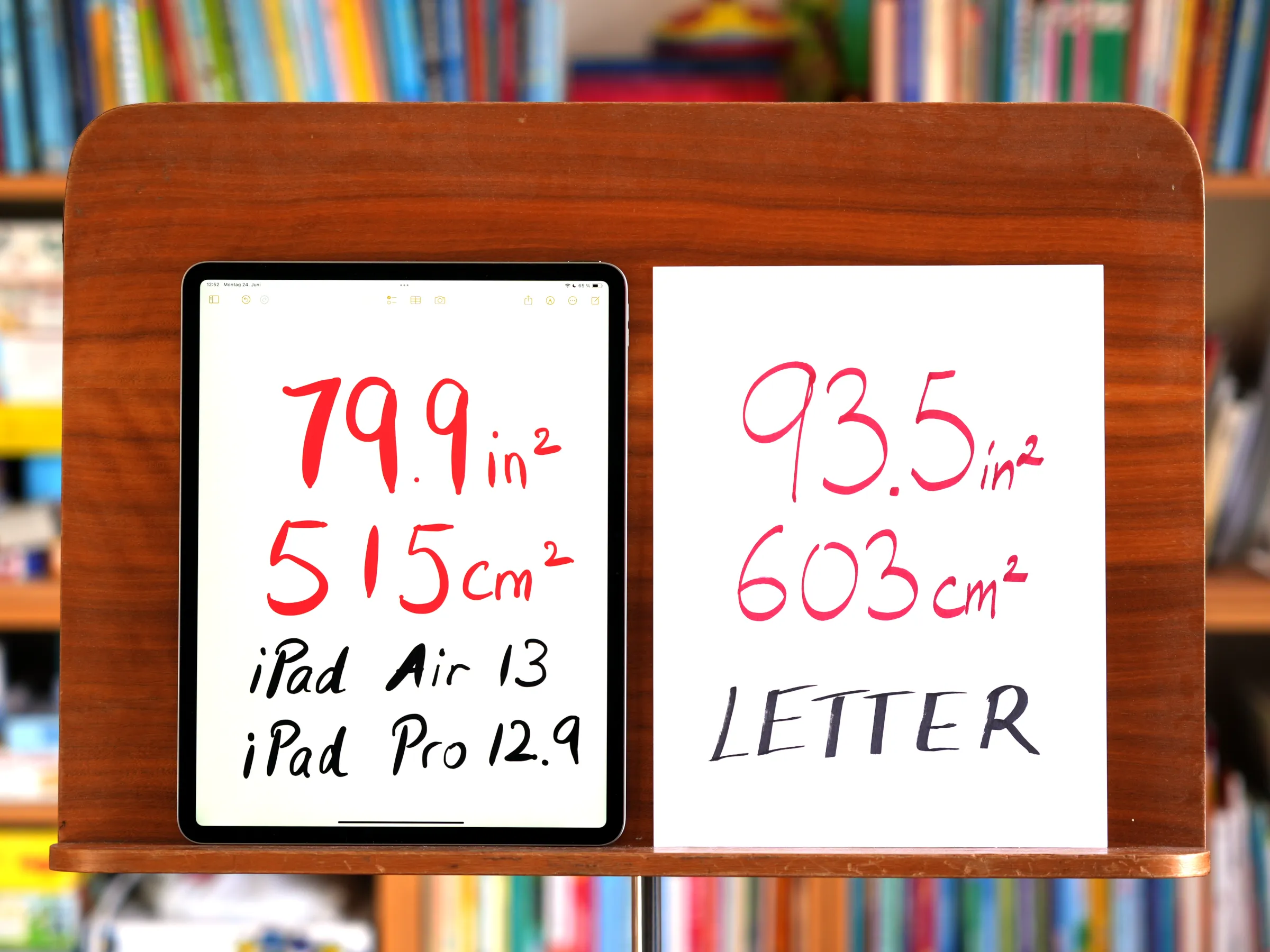
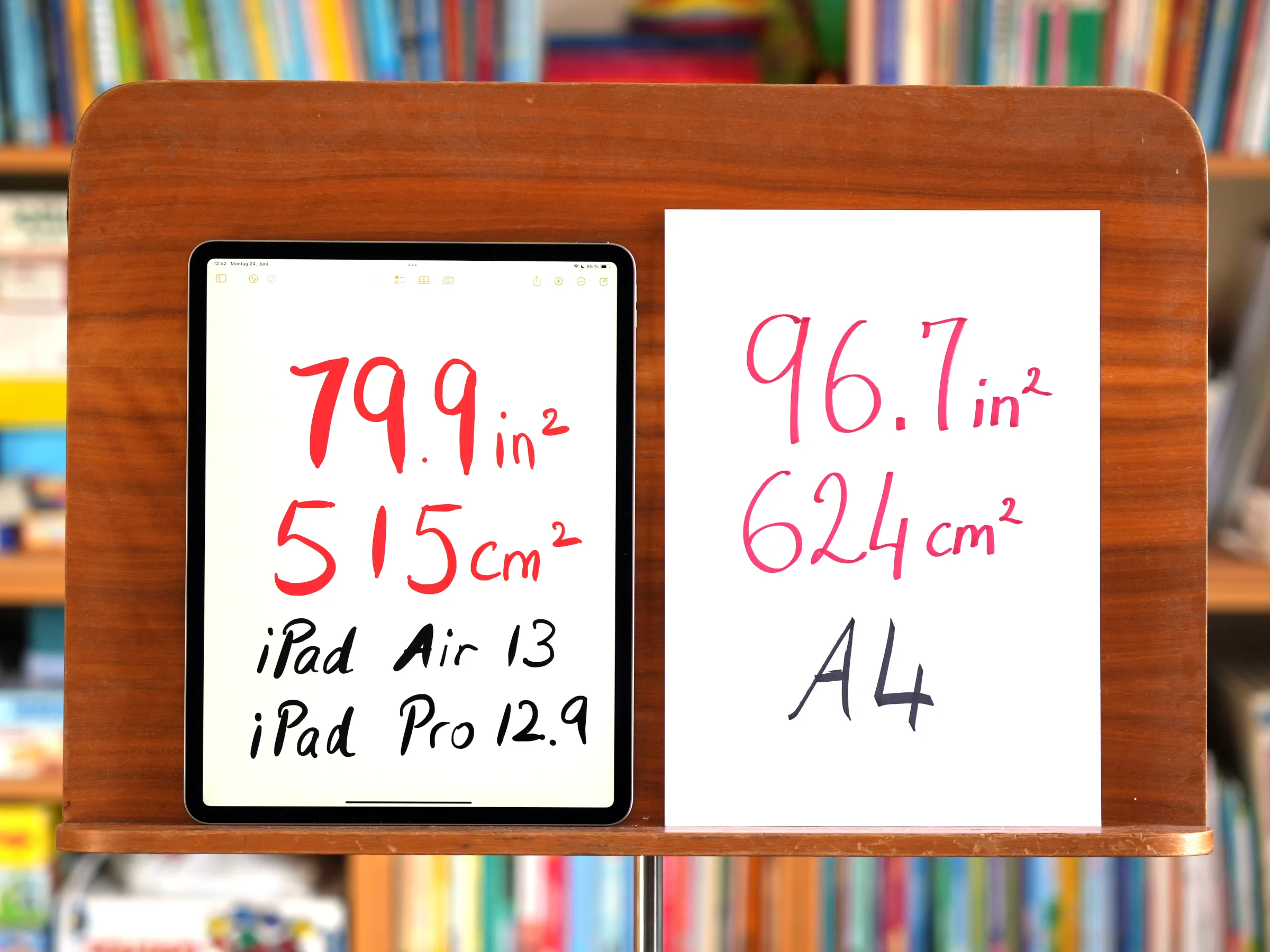
Performance
The Apple iPad Air 13″ (M4) is powered by the Apple M4 (8-core CPU) processor, released in 2026 and built on a 3 nm process. It is one of the fastest chips in any tablet: it handles everything, including heavy video editing, 3D work and the most demanding games. Compared with other large tablets:
- The Apple M5 in the Apple iPad Pro 13″ (M5) is about 20 % faster.
- The Apple iPad Air 13″ (M4) is about 50 % faster than the Samsung Galaxy Tab S11 Ultra and its MediaTek Dimensity 9400+.
- The Apple iPad Air 13″ (M4) is about 3 times faster than the Samsung Galaxy Tab S10 FE+ and its Samsung Exynos 1580.
Pros
- Very fast Apple M4 chip with 12 GB of RAM
- Accurate screen without PWM flicker (625 nits measured)
- Long battery life (13 h 23 min of Wi-Fi browsing measured)
- Apple Pencil Pro and Magic Keyboard support
- Thin, light metal body (6.1 mm, 616 g)
- Long software support
Cons
- 60 Hz LCD screen, no ProMotion or OLED
- Slow charging (20 W, over 2 hours)
- Apple Pencil and Magic Keyboard sold separately
- Only 128 GB in the base model, expensive upgrades
- No Face ID, headphone jack or microSD slot
Sponsored

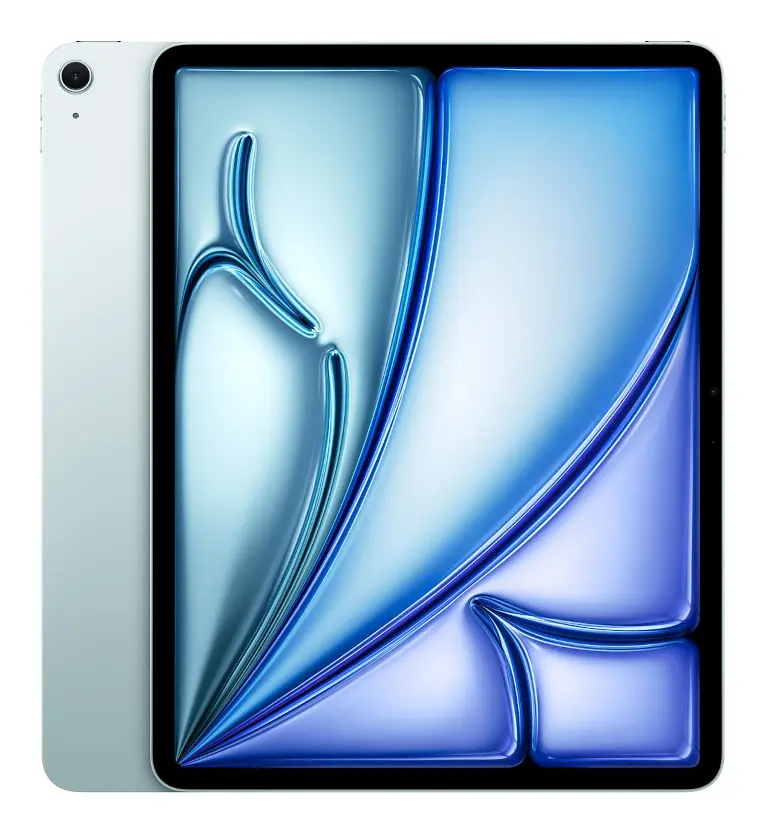
Apple iPad Pro 12.9-inch (2022)
The second-largest iPad: still excellent and fast
iPad Pro 12.9 (2022) tech specs: Display: 12.9″ Liquid Retina XDR display with ProMotion and True Tone / Brightness: up to 600 nits (SDR), up to 1000 nits (XDR max full screen), 1600 nits peak (HDR content only) / Resolution: 2048 × 2732 pixels, 264 ppi / OS: iPadOS / Processor: Apple Silicon M2 / RAM: 8GB or 16GB / Storage: 128GB, 256GB, 512GB, 1TB or 2TB / microSD slot: No / Colors: Silver, space gray / Weight: 1.51 pounds (685 grams) / Connections: USB-C Thunderbolt/USB-4 | Battery life: up to 10 hours (10758 mAh / 40.88 Wh)
Performance
The Apple iPad Pro 12.9″ (2015–2022) is powered by the relatively old Apple M2 processor, released in 2022 and built on a 5 nm process. It is one of the fastest chips in any tablet: it handles everything, including heavy video editing, 3D work and the most demanding games. Compared with other large tablets:
- The Apple M5 in the Apple iPad Pro 13″ (M5) is about 50 % faster.
- The Apple iPad Pro 12.9″ (2015–2022) is about 20 % faster than the Samsung Galaxy Tab S11 Ultra and its MediaTek Dimensity 9400+.
- The Apple iPad Pro 12.9″ (2015–2022) is about 5 times faster than the Meswao MES-B3 (Pro) and its MediaTek Helio G99.
Pros
- Mini-LED screen with deep blacks and strong HDR (1,123 nits measured)
- Large, sharp 4:3 screen (264 ppi, 120 Hz)
- M2 chip still very fast
- Over 10 hours of light use (10 h 39 min web, Tom’s Guide)
- Apple Pencil hover, Magic Keyboard with touchpad, four good speakers
- Still supported by iPadOS 27, with Apple Intelligence
Cons
- No longer sold new; Apple refurbished, close in price to a refurbished 13-inch M4
- Only 5 to 7 hours in heavy use or HDR video
- Heavy with the Magic Keyboard (1.36 kg)
- Front camera on the short side, awkward for video calls
- Slow 20 W charger (about 2.5 hours)
- No headphone jack or microSD; no Apple Pencil Pro support
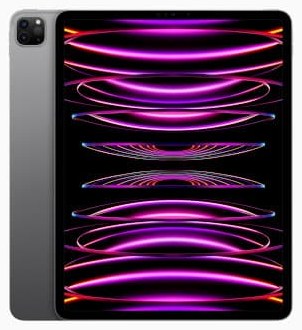

Huion Kamvas Slate 13
12.7″ 4:3 · 2176 × 1600 · MediaTek Helio G99 · 682 g
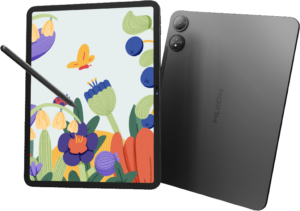
Huion Kamvas Slate 13
12.7″ 4:3 · 2176 × 1600 · MediaTek Helio G99 · 682 g
A 12.7-inch 4:3 Android drawing tablet with matte glass and a pen in the box
A 12.7-inch Android drawing tablet with a 4:3 matte screen, pen and case included; well built, but reviewers find the screen dim and the pen imprecise.
Huion Kamvas Slate 13 tech specs: OS: Android 14 / Processor: MediaTek Helio G99 (6 nm, 2022) / RAM: 8 GB / Storage: 256 GB / microSD slot: yes (up to 1 TB) / Pen: Huion H-Pencil (HS230) (included) / Keyboard: no official one / Battery: 10,000 mAh — 7.5 hours (Parkablogs) / Connections: 1 × USB-C (USB 2.0) / Released: April 2025
Screen specs: IPS LCD, matte (Nano-etched glass), 60 Hz / Size: 12.7 inches / Max brightness: 350 nits (Huion) / Resolution: 2176 × 1600 pixels, 213 ppi / Aspect ratio: 4:3 (1.33)
Weight: without keyboard: 24.1 ounces – 1.50 pounds – 682 g
Sponsored

Teclast ArtPad Pro
12.7″ 4:3 · 2176 × 1600 · MediaTek Helio G99 · 674 g
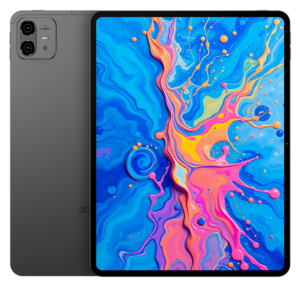
Teclast ArtPad Pro
12.7″ 4:3 · 2176 × 1600 · MediaTek Helio G99 · 674 g
A low-cost 12.7-inch Android tablet with a metal body, a pen and 4G
A low-cost 12.7-inch Android tablet with a metal body, 4G and a pen in European packs, but a dim, glossy 60 Hz screen and an entry-level processor.
Teclast ArtPad Pro tech specs: OS: Android 15 (ArtOS) / Processor: MediaTek Helio G99 (6 nm, 2022) / RAM: 8 GB / Storage: 256 GB (UFS 2.2) / microSD slot: yes (up to 1 TB [hybrid slot: second SIM or microSD]) / Pen: Teclast T-Pen (included) / Keyboard: no official one / Battery: 10,000 mAh, 30 W charging — 10.1 hours (Notebookcheck) / Connections: 1 × USB-C (USB 2.0) / HD streaming: yes (Widevine L1) / Released: August 2025
Screen specs: IPS LCD, glossy, 90 Hz / Size: 12.7 inches / Max brightness: 291 cd/m² (Notebookcheck) / Min brightness: 8.2 cd/m² (Notebookcheck) / Resolution: 2176 × 1600 pixels, 213 ppi / Aspect ratio: 4:3 (1.33)
Weight: without keyboard: 23.8 ounces – 1.49 pounds – 674 g
Sponsored

Lenovo Idea Tab Pro / Tab P12
12.7″ 16:10 · 2944 × 1840 · MediaTek Dimensity 8300 · 620 g
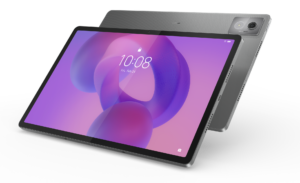
Lenovo Idea Tab Pro / Tab P12
12.7″ 16:10 · 2944 × 1840 · MediaTek Dimensity 8300 · 620 g
A 12.7-inch 144 Hz Android tablet with a pen and loud speakers, but a dim screen
A 12.7-inch 144 Hz Android tablet with a Dimensity 8300, loud speakers and often a pen in the box; the 400-nit screen is dim and updates end early.
Lenovo Idea Tab Pro tech specs: OS: Android 14 (at launch) / Processor: MediaTek Dimensity 8300 (4 nm, 2023) / RAM: 8 GB or 12 GB / Storage: 128 GB or 256 GB (UFS 3.1 [128 GB], UFS 4.0 [256 GB]) / microSD slot: yes (up to 1 TB) / Pen: Lenovo Tab Pen Plus (included) / Keyboard: Lenovo Keyboard Pack for Idea Tab Pro (optional, with touchpad) / Battery: 10,200 mAh, 45 W charging — 13.3 hours (Notebookcheck) / Connections: 1 × USB-C (USB 3.2 Gen 1, 5 Gbps) with charging, DisplayPort out and audio; microSD slot; 3-point pogo connector / HD streaming: yes (Widevine L1) / Updates: 4 years of security updates / Released: February 2025
Screen specs: LTPS IPS LCD, matte version available (Paper-like anti-glare), 144 Hz / Size: 12.7 inches / Max brightness: 400 nits (Lenovo), 409 cd/m² (Notebookcheck) / Min brightness: 1.9 cd/m² (Notebookcheck) / Resolution: 2944 × 1840 pixels, 273 ppi / Aspect ratio: 16:10 (1.60)
Weight: without keyboard: 21.9 ounces – 1.37 pounds – 620 g
Sponsored
Lenovo Yoga Tab Plus
12.7″ 16:10 · 2944 × 1840 · Qualcomm Snapdragon 8 Gen 3 · 640 g
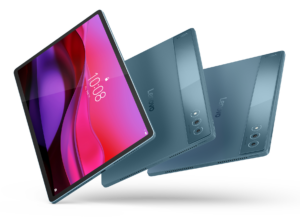
Lenovo Yoga Tab Plus
12.7″ 16:10 · 2944 × 1840 · Qualcomm Snapdragon 8 Gen 3 · 640 g
A 12.7-inch Snapdragon 8 Gen 3 tablet with a 144 Hz screen, six speakers, pen and keyboard
Lenovo’s 2025 12.7-inch Android tablet: fast Snapdragon 8 Gen 3, bright 144 Hz LCD, six loud speakers and usually a pen and keyboard in the box; updates stop at Android 17.
Lenovo Yoga Tab Plus tech specs: OS: Android 14 (at launch) / Processor: Qualcomm Snapdragon 8 Gen 3 (4 nm) / RAM: 16 GB / Storage: 256 GB or 512 GB (UFS 4.0) / microSD slot: no / Pen: Lenovo Tab Pen Pro (included) / Keyboard: Lenovo 2-in-1 Keyboard Pack for Yoga Tab Plus (included, with touchpad) / Battery: 10,200 mAh, 45 W charging — 12.8 hours (Notebookcheck) / Connections: 1 × USB-C (USB 3.2 Gen 1, 5 Gbps) with charging, DisplayPort out and audio; 3-point pogo connector / HD streaming: yes (Widevine L1) / Updates: 4 years of security updates / Released: January 2025
Screen specs: LTPS LCD, anti-reflective, 144 Hz / Size: 12.7 inches / Max brightness: 650 nits (Lenovo), 726 cd/m² (Notebookcheck) / Min brightness: 1.4 cd/m² (Notebookcheck) / Resolution: 2944 × 1840 pixels, 273 ppi / Aspect ratio: 16:10 (1.60)
Weight: without keyboard: 22.6 ounces – 1.41 pounds – 640 g
Sponsored
Largest tablets FAQ
What is the fastest tablet available in 2026?
Well, the fastest tablet is probably not the one you think! The fastest “conventional” tablet is, as expected, the 13-inch iPad Pro, boosted since October 2025 by its Apple M5 chip.
However, the fastest tablet available is not an Apple iPad, but a tablet made by Asus, the ROG Flow Z13 (2025). Asus did not release a regular 2026 model, only special editions such as the ROG Flow Z13-KJP with 128 GB of RAM.
The Asus ROG Flow Z13 is a 2-in-1 PC with a detachable keyboard. It features an AMD Ryzen AI Max+ 395 CPU and, in its most powerful configuration, a Radeon 8060S GPU. This gamer tablet is also, unfortunately, the heaviest you can imagine: it weighs no less than 2.65 pounds (1.20 kg) for the tablet alone!
What is the cheapest large tablet available in 2026?
The cheapest large tablet in 2026 is the Acer Iconia A16: a 16-inch screen at an entry-level price, sold in Europe and North America. Its Full HD screen and entry-level processor make it a tablet for videos, reading and web browsing rather than for work.
Its 12.7-inch rival, the Lenovo Idea Tab Pro (successor of the Tab P12 of 2023), has a smaller but much sharper screen, a faster processor and often a pen in the box: it is the better choice for notes and documents. Budget brands such as Doogee and Teclast also sell 13- and 14-inch Android tablets at low prices (see the table above).
Note that the IdeaPad Duet 5 Chromebook, also by Lenovo, has an even larger 13.3-inch screen and a great “price-to-surface” ratio, but it came out in 2021 and never got a successor. Google is now replacing Chromebooks with Googlebooks, and a detachable Lenovo Googlebook Duet m (13 inches) has already leaked.
What is the cheapest large iPad available in 2026?
If you’re entrenched in the Apple ecosystem, or simply want the biggest possible iPad for the best price, your options are more limited. There simply is no cheap and large iPad available.
The cheapest new large iPad is the 13-inch iPad Air with M4 chip (March 2026); Apple raised its price in June 2026.
If that is too expensive, get a renewed, refurbished or used iPad Pro 12.9. I recommend the 5th generation, released in May 2021. This model is old enough to be largely available at great prices, but still has a fast M1 chip. Apple’s software support for iPad Pro devices has proved to be very long, and you’ll get security updates at least until 2030, probably even longer.
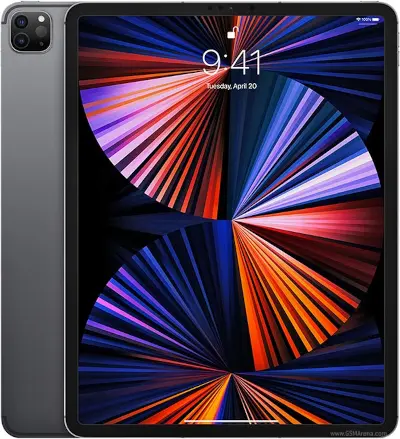
What are Google Mobile Services, and why is it important?
Google Mobile Services (GMS) is a collection of Android apps from Google that are typically pre-installed on Android smartphones and tablets, such as Google Chrome, YouTube, Google Play and Gmail.
When a tablet does not come with GMS, several implications arise:
- Limited App Access: no direct access to the Google Play Store, which significantly limits the availability of apps and games. Users may have to rely on alternative app stores or sideload apps.
- No Google Apps: essential Google apps and services like Gmail, Maps, and YouTube will not be pre-installed. Installing these apps through other means (e.g., via Gbox on Huawei’s tablets) may work, but can’t be considered as reliable enough.
- Security Risks: devices missing GMS may not receive important security updates provided through Google Play Protect. Also, apps using Google for login authentication may not work.
I would NOT recommend purchasing any Android tablet that does not include GMS, such as Huawei tablets or tablets sold only in China (Xiaomi Pad 9 Pro Max, Oppo, vivo, Lenovo Legion…). These tablets are mentioned on this page for exhaustiveness, but the tablets sold only in China are hidden by default in the charts and the table: use the “China / import” filter to show them.
What is a Googlebook?
Googlebook is Google’s new category of premium laptops, presented in May 2026 as the successor of the Chromebook. Googlebooks run Googlebook OS, an Android-based desktop system that runs Android apps natively and keeps the Chrome browser, with 10 years of updates. The first five models (Acer, Asus, Dell, HP and Lenovo) ship from October 4, 2026 — all of them laptops, the Acer model being a 360° convertible.
A detachable Lenovo Googlebook Duet m has leaked in detail in September 2026: a 13-inch tablet with a kickstand, a detachable keyboard that also works over Bluetooth, a pen and, according to supply-chain reports, a MediaTek Kompanio Ultra 910 processor. Lenovo did not present it at its Googlebook event on September 15, 2026, and price and release date are still unknown (Android Authority, Chrome Unboxed). As soon as it is available, it will be added to this list.
Wrap-up: the best large tablets of each category
The largest tablets: 16 inches
Two 16-inch Android tablets share the title: the Acer Iconia A16 (very cheap) and the Meswao B5 (US and Europe, optional keyboard with touchpad).
The largest premium Android tablet
Its successor, the Galaxy Tab S12 Ultra, was announced on September 30, 2026 (on sale from October 7), with the same 14.6-inch screen size.
The largest tablet with a nanotextured display glass
The largest and most powerful gaming tablet
The largest e-book-reader
The largest and best iPad available
Sponsored
The largest Windows tablets
The Asus ProArt PZ14 (14 inches, OLED) is now the largest Windows tablet by a major brand. The 13-inch Microsoft Surface Pro remains the best-known one.
The best large tablet for a small budget
The Acer Iconia A16 offers 16 inches at an entry-level price (see above). For notes and documents, the 12.7-inch Lenovo Idea Tab Pro (successor of the Tab P12) is the better buy: a much sharper screen, a faster processor and often a pen in the box.
6 thoughts on “The largest tablets available in 2026”
Ron
Wow, great website! Thank you for doing all this leg work. Greatly appreciated!!!
I am a seventy year old gigging solo acoustic musician, so a large 3:2 tablet is a must. I purchased a jumper, and I’m very happy with it. But I see, they aren’t available anymore in 3:2.
Since I only use it for Mobilesheets, performance isn’t really an issue.
I’m worried that if something happens to this one I won’t be able to replace it.
P.S. i have tried 16:9, and it drives me crazy.
Eva
Hi, Ron,
yes, the Jumper 15-inch is the largest tablet available with a 3:2 ratio. Although it’s not available on Amazon, it is on Alibaba. I really wonder why it’s not widely available, the sales must not be so high, I suppose! The next biggest model with a 3:2 ratio is the TCL NxtPaper 14, which is finally available on Amazon* (also in the US).
Cheers!
Johannes
Mary Bramwell
Meswao 15.6 tablet seemed fine at first. Then screen started to wobble, then go haywire. Couldn’t log back on until I shut it off and turned back on. No phone # to contact them. One e-mail response requesting me to send video and serial number. No response. I don’t recommend this product or this company. I’m stuck with a defective product.
Eva
Hi Mary, I’m sorry your tablet is broken, and lack of support (or warranty) is a real problem with cheap tablets! Most of these brands are very sensitive to bad Amazon reviews, but I suppose you have already tried this “way”. I will try to write more about brand reliability and support on my website. Thanks for your feedback.
Mamie T
Thank you for this informative review. I need something that would be compatible with a Donner page-turning foot pedal, and am hoping the linked Lenovo Tab P12 will do that for me.
Eva
I am happy to confirm that the Lenovo Tab P12 is compatible with the Donner Bluetooth pedal 🙂
Comments are closed.