


The largest tablets › 14-inch tablets › Xiaomi Pad 7 Ultra
Xiaomi Pad 7 Ultra: specs, size and price
A thin 14-inch OLED tablet with Xiaomi’s own fast chip, sold only in China

Xiaomi Pad 7 Ultra Photo: large-screens.com
Key specifications
- Screen14.0″ OLED, 120 Hz
- Aspect ratio3:2 (1.50)between video and paper formats: good for documents and the web
- Resolution3200 × 2136 pixelsvery sharp (275 ppi)
- Brightness900 nits (1,600 nits peak)bright: fine in the shade outdoors
- Screen area584 cm² · 97 % of a Letter sheet
- SystemAndroid 15
- ProcessorXiaomi XRING O1
- Weight609 g
- Penoptional
- Keyboardoptional
- Statuscurrent model
Overview
The Xiaomi Pad 7 Ultra, launched in China in May 2025, is Xiaomi’s largest tablet: a thin 14-inch OLED model for games, films and work. Because it is sold only in China, few independent reviews exist. Notebookcheck rated it 90% and calls it the best Android tablet, ahead of Samsung; Japan’s TikGadget praises its speed, screen and sound.
The screen is about 12% larger than that of the 13-inch iPad Pro. Its 3:2 format is taller and closer to a sheet of paper, better for documents and sheet music. It has 3200 × 2136 pixels (275 ppi), 120 Hz and very accurate colors. Notebookcheck measured 566 nits and TikGadget 636 nits, far below the 1,600 nits Xiaomi advertises. The standard screen is glossy; the Nano Soft Light Edition (¥600 more) is matte. Notebookcheck measured flicker (PWM) at about 120 Hz, which can bother sensitive eyes.
Xiaomi’s own XRING O1 is a fast 3 nm chip: Notebookcheck found the tablet clearly faster than the Galaxy Tab S10 Ultra, and both reviews say it stays cool. It has 12 or 16 GB of RAM and 256 GB to 1 TB of storage, without a microSD slot. It runs the Chinese HyperOS 2 (Android 15) in Chinese or English; Google Play is not preinstalled but can be added. Xiaomi publishes no update policy. Both reviews confirm Widevine L1 for HD streaming.
The Focus Pen (about €87) and a keyboard with touchpad are sold separately. The 12,000 mAh battery lasts long and charges at 120 W: TikGadget used only 30% in five hours of heavy gaming. It weighs 609 g and is 5.1 mm thin; its eight speakers are loud (88 dB). The USB-C port can drive a monitor; there is no 5G, GPS or IP rating.
Prices started at ¥5,699 in China (ITHome); import shops asked about €860 in June 2025, with their own warranty. The newer Pad 9 Pro Max (September 2026) is smaller (13.3 inches).
Pros
- Large 14-inch OLED panel with a 3:2 aspect ratio
- In-house XRing O1 SOC with excellent performance
- Acceptable 540 nits max brightness
- Stylus support (Xiaomi Focus Pen)
- Exceptional battery life
- Superfast 120 Watt charging
Cons
- Maximum brightness could be better
- No 5G option, no GPS positioning
- No Google Mobile Services (GMS)
- No official security upgrades policy
- Only available via import
Performance
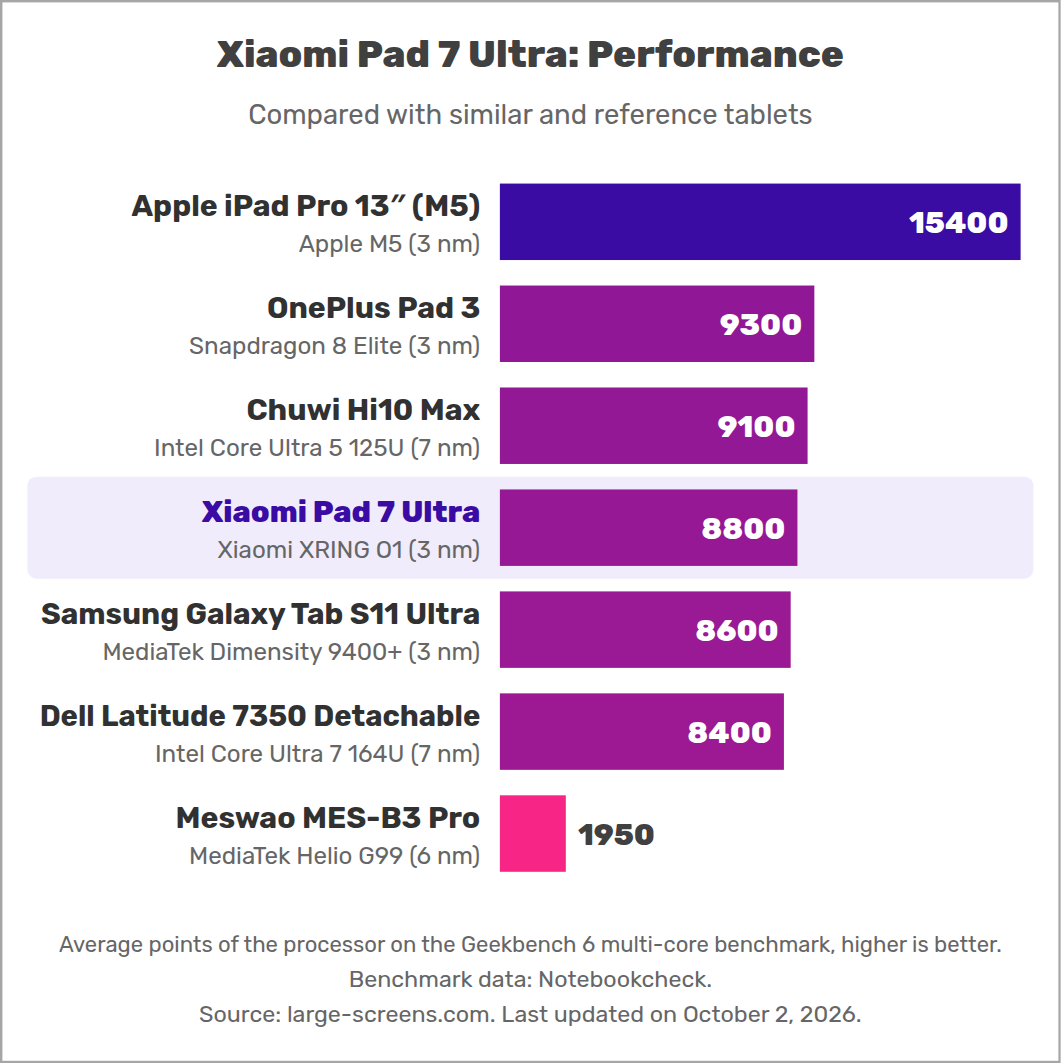
The Xiaomi Pad 7 Ultra is powered by the Xiaomi XRING O1 processor, released in 2025 and built on a 3 nm process. It is a fast chip: demanding games, large drawings and video editing run smoothly. Compared with other large tablets:
- The Apple M5 in the Apple iPad Pro 13″ (M5) is about 80 % faster.
- The Xiaomi Pad 7 Ultra is about 4.5 times faster than the Meswao MES-B3 (Pro) and its MediaTek Helio G99.
Brightness
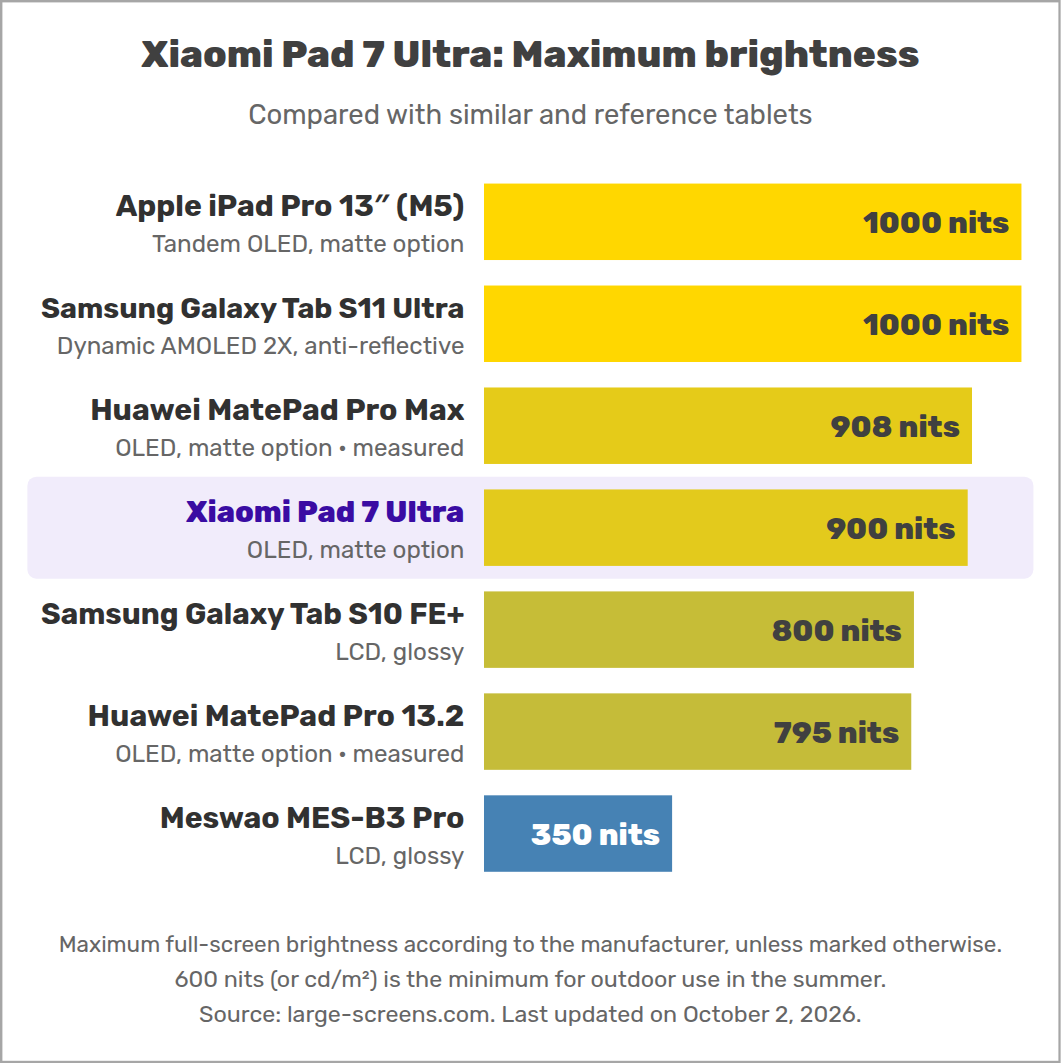
The screen of the Xiaomi Pad 7 Ultra reaches 900 nits according to Xiaomi, which is bright: enough for bright rooms and for outdoor use in the shade, even in the summer. Notebookcheck measured 566 nits.
Size compared with the iPad Pro and a sheet of paper

- Xiaomi Pad 7 Ultra
11.6 × 7.8 in - iPad Pro 13″
10.4 × 7.8 in - Letter sheet
11.0 × 8.5 in
The Xiaomi Pad 7 Ultra drawn to scale with the 13-inch iPad Pro and a Letter sheet.
Full specifications
| Display | |
|---|---|
| Screen size | 14.0 inches |
| Screen area | 90.5 in² · 584 cm² · 97 % of a Letter sheet · 112 % of the 13″ iPad Pro |
| Resolution | 3200 × 2136 |
| Pixel density | 275 ppi |
| Aspect ratio | 3:2 (1.50) |
| Panel | OLED |
| Refresh rate | 120 Hz |
| Max brightness (maker) | 900 nits (1,600 nits HDR) |
| Max brightness (measured) | 566 cd/m² (Notebookcheck) |
| Min brightness (measured) | 1.8 cd/m² (Notebookcheck) |
| Surface | matte version available (Nano Soft Light (纳米柔光版)) |
| Performance and software | |
| Operating system | Android 15 (Xiaomi HyperOS 2) |
| Google services | no |
| Processor | Xiaomi XRING O1 (3 nm) |
| Class | high-end |
| RAM | 12 GB / 16 GB |
| Storage | 256 GB / 512 GB / 1 TB (UFS 4.1) |
| microSD | no |
| HD streaming (Widevine L1) | yes |
| Pen and keyboard | |
| Pen | optional — Xiaomi Focus Pen (焦点触控笔) |
| Keyboard | optional — Xiaomi Pad 7 Ultra floating keyboard |
| Built-in kickstand | no |
| Design and battery | |
| Weight (tablet) | 609 g (1.34 lb) |
| Thickness | 5.1 mm |
| Dimensions | 305.8 × 207.5 × 5.1 mm |
| Battery | 12,000 mAh |
| Charging | 120 W |
| Ports | 1 × USB-C (USB 3.2 Gen 2) |
| Video out (USB-C) | yes |
| Headphone jack | no |
| Speakers | 8 |
| Cameras | 50 MP rear, 32 MP front |
| Connectivity | Wi-Fi 7, Bluetooth 5.4, none |
| Colours | Black, Purple |
| Price and availability | |
| List price (manufacturer) | ¥5,699 |
| Status | current model |
| Released | May 2025 |
| Sold in | China, import only |
Specifications checked on October 2, 2026. Prices are the manufacturers’ list prices (not Amazon prices) and change often.
Similar tablets
- Samsung Galaxy Tab S11 Ultra 14.6″
- Samsung Galaxy Tab S8 / S9 / S10 Ultra 14.6″
- TCL NxtPaper 14 14.3″
- Ugee Trio Pad UT3 14.2″
- Callsky Ctab 14 14.1″
- Doogee Tab E3 Max 14.0″
- Wacom MovinkPad Pro 14 14.0″
- Meswao MES-B2 14.0″