


The largest tablets › 13-inch tablets › Lenovo Duet 5 Chromebook
Lenovo Duet 5 Chromebook: specs, size and price
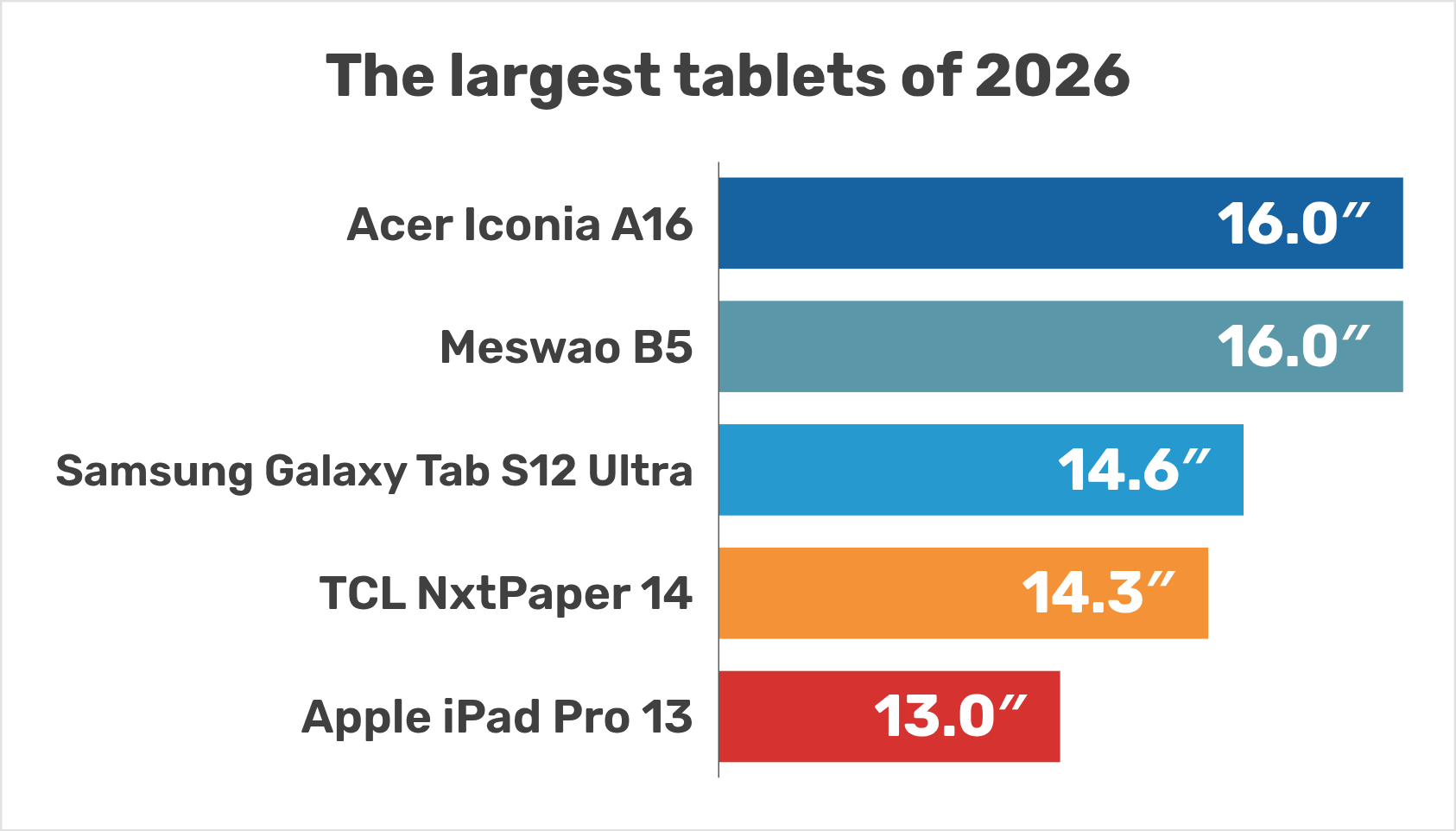
The largest ChromeOS detachable: a 13.3-inch OLED screen and long battery life
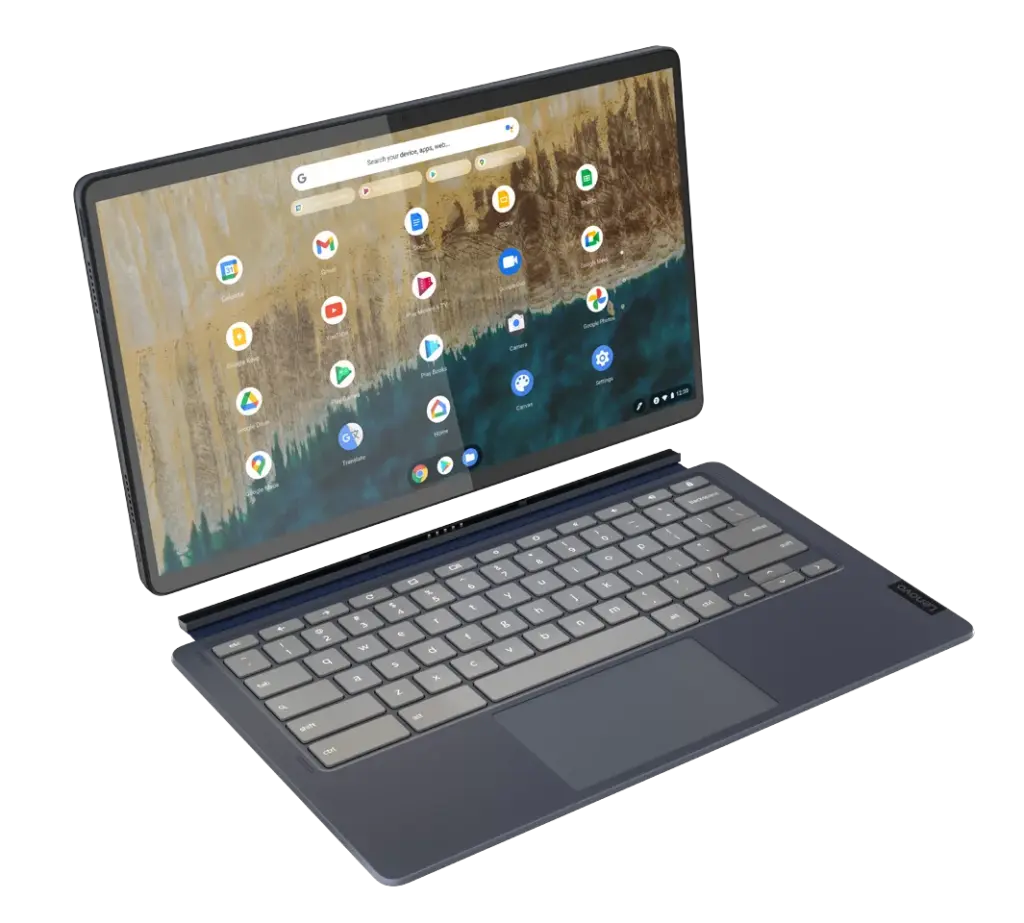
Lenovo Duet 5 Chromebook Photo: large-screens.com
Key specifications
- Screen13.3″ OLED, 60 Hz
- Aspect ratio16:9 (1.78)very wide: made for videos; narrow and tall in portrait
- Resolution1920 × 1080 pixelsfairly sharp (166 ppi): pixels visible up close
- Brightness400 nitsfine indoors, too dim outdoors in summer
- Screen area488 cm² · 81 % of a Letter sheet
- SystemChromeOS
- ProcessorQualcomm Snapdragon 7c Gen 2
- Weight700 g
- Penoptional
- Keyboardincluded
- Statusolder model
Overview
The Lenovo IdeaPad Duet 5 Chromebook (Chromebook Duet 5 in North America) is a 13.3-inch ChromeOS tablet with a detachable keyboard, sold since October 2021 and still the largest of its kind. Reviewers liked it: Laptop Mag gave it an Editor’s Choice award, Notebookcheck rated it 79 %, while PCWorld found the wide screen awkward for a tablet.
The OLED screen is about 7 % smaller than the 13-inch iPad Pro’s. Its 16:9 format is very wide: good for videos, but long and narrow when held upright. At 1920 × 1080 pixels (166 ppi), it is not very sharp. Reviewers praised the deep blacks and rich colors, but measured less than Lenovo’s 400 nits: 369 nits (Notebookcheck), 361 nits (Laptop Mag) and 315 nits (Gizmodo). The glossy screen flickers (PWM) at all brightness levels, according to Notebookcheck.
The Snapdragon 7c Gen 2 is an entry-level chip. It handles browsing and videos, but Laptop Mag, Gizmodo and Android Authority found its performance weak. It has 4 or 8 GB of RAM and 64 to 256 GB of storage, without microSD. ChromeOS runs Chrome and Android apps from Google Play; Google updates it until June 2031.
The keyboard with touchpad and the kickstand cover are included, but reviewers found the keys shallow and unlit and the stand wobbly on the lap. The USI pen is sold separately in most versions. Battery life is long: Notebookcheck measured 11 hours of Wi-Fi browsing, Laptop Mag 13 h 31 min and TechRadar 16 h 20 min of video. The tablet weighs 700 g, about 1.2 kg with cover and keyboard (Notebookcheck). The four speakers are loud but thin. There are two USB-C ports with DisplayPort, but no headphone jack or fingerprint reader (Lenovo PSREF).
It launched at $429.99 in the US and €499 in Germany; today it is mostly found used or refurbished. A 13-inch successor, the Lenovo Googlebook Duet m, has leaked but is not announced yet (Android Authority).
Pros
- Largest Chromebook with a detachable keyboard
- Great OLED display
- Two USB Type-C ports with DisplayPort
- Fanless
- Cheapest large tablet available
Cons
- Outdated hardware, slow performance
- Low display resolution
- Max brightness (400 nits) could be higher
- No cellular option (Wi-Fi only)
- No SD card reader, no fingerprint sensor
Performance
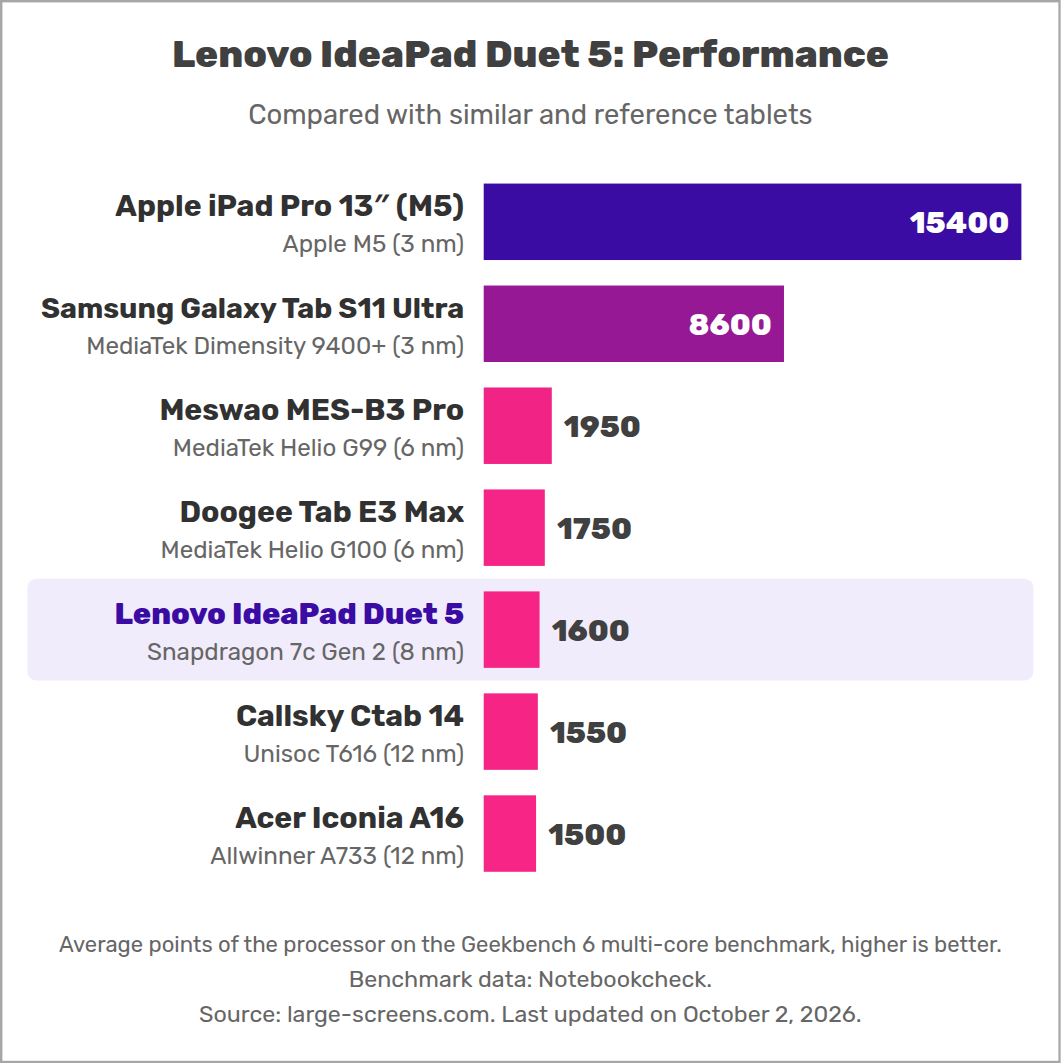
The Lenovo IdeaPad Duet 5 Chromebook is powered by the relatively old Qualcomm Snapdragon 7c Gen 2 processor, released in 2021 and built on a 8 nm process. It is an entry-level chip: fine for videos, web browsing, reading and taking notes, but apps open slowly and games have to run at low settings. Compared with other large tablets:
- The Apple M5 in the Apple iPad Pro 13″ (M5) is about 9.5 times faster.
- The MediaTek Helio G99 in the Meswao MES-B3 (Pro) is about 20 % faster.
Brightness
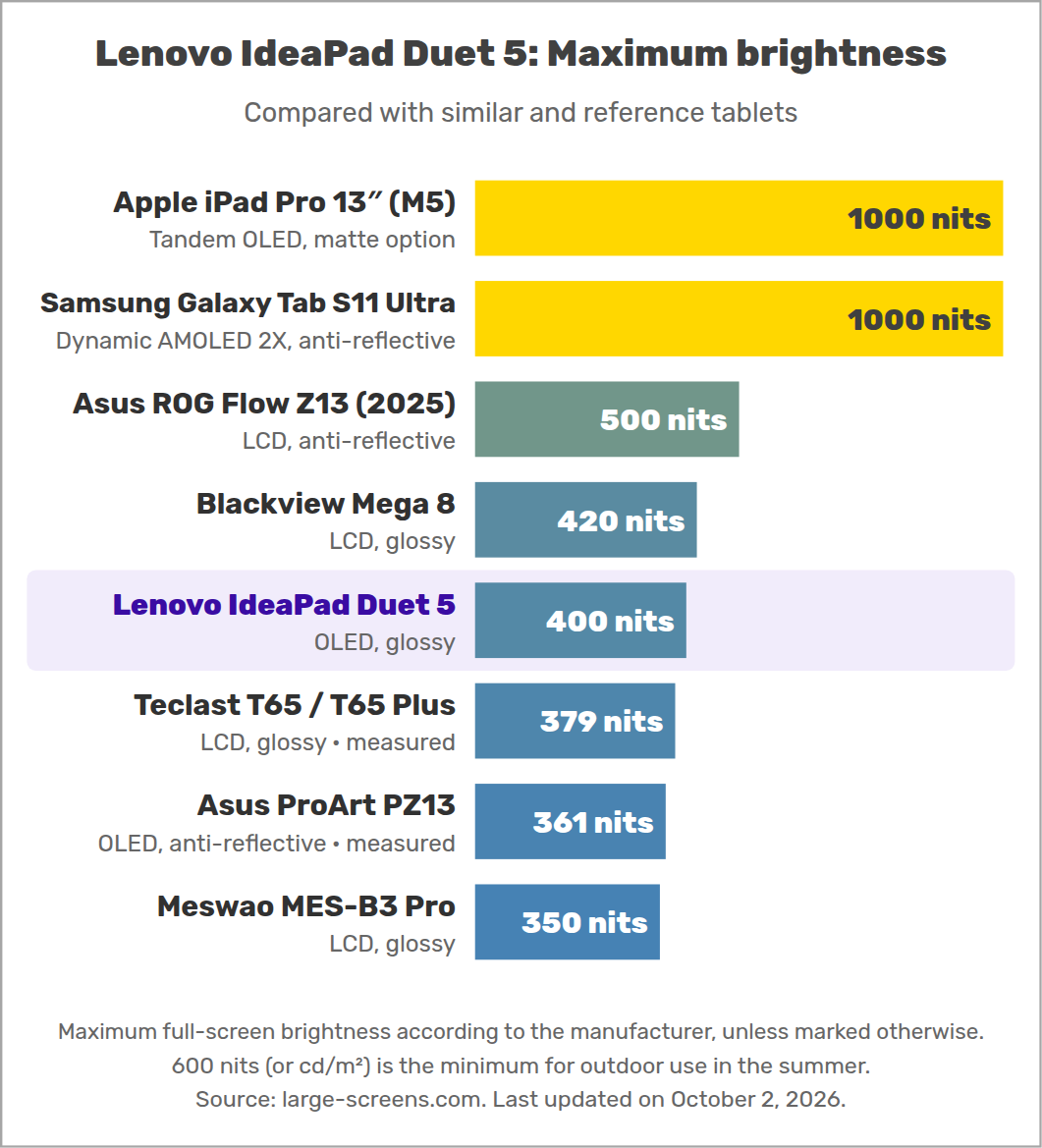
The screen of the Lenovo IdeaPad Duet 5 Chromebook reaches 400 nits according to Lenovo, which is enough indoors, but not for outdoor use in the summer (600 nits is the minimum). Notebookcheck measured 369 nits.
Size compared with the iPad Pro and a sheet of paper

- Lenovo IdeaPad Duet 5 Chromebook
11.6 × 6.5 in - iPad Pro 13″
10.4 × 7.8 in - Letter sheet
11.0 × 8.5 in
The Lenovo Duet 5 Chromebook drawn to scale with the 13-inch iPad Pro and a Letter sheet.
Full specifications
| Display | |
|---|---|
| Screen size | 13.3 inches |
| Screen area | 75.6 in² · 488 cm² · 81 % of a Letter sheet · 93 % of the 13″ iPad Pro |
| Resolution | 1920 × 1080 |
| Pixel density | 166 ppi |
| Aspect ratio | 16:9 (1.78) |
| Panel | OLED |
| Refresh rate | 60 Hz |
| Max brightness (maker) | 400 nits |
| Max brightness (measured) | 369 cd/m² (Notebookcheck (maximum; 366 average, 358 center on battery). Laptop Mag: 361 nits; Gizmodo: 315 nits) |
| Min brightness (measured) | 0.7 cd/m² (Notebookcheck) |
| Surface | glossy |
| Performance and software | |
| Operating system | ChromeOS |
| Updates | 10 years |
| Processor | Qualcomm Snapdragon 7c Gen 2 (8 nm) |
| Class | entry level |
| RAM | 4 GB / 8 GB |
| Storage | 64 GB / 128 GB / 256 GB (eMMC 5.1) |
| microSD | no |
| Pen and keyboard | |
| Pen | optional — Lenovo USI Pen |
| Keyboard | included — Chromebook folio keyboard (detachable, pogo pins) |
| Built-in kickstand | no |
| Design and battery | |
| Weight (tablet) | 700 g (1.54 lb) |
| Weight with keyboard | 1,020 g |
| Thickness | 7.2 mm |
| Dimensions | 305.9 × 186.7 × 7.2 mm |
| Battery | 42 Wh |
| Charging | 45 W |
| Battery life | 11 h (Wi-Fi browsing at 150 nits (Notebookcheck): 11 h 0 min; Laptop Mag: 13 h 31 min of Wi-Fi web surfing at 150 nits; Gizmodo: 12 h 7 min of video at 200 nits; TechRadar / IT Pro: 16 h 20 min video rundown, Notebookcheck) |
| Ports | 2 × USB-C 3.2 Gen 1 (5 Gbps, Power Delivery 3.0, DisplayPort 1.4); 5-point pogo connector |
| Video out (USB-C) | yes |
| Headphone jack | no |
| Speakers | 4 |
| Cameras | 8 MP AF rear, 5 MP front |
| Connectivity | Wi-Fi 5, Bluetooth 5.1, none |
| Colours | Abyss Blue, Storm Grey |
| Price and availability | |
| List price (manufacturer) | $429.99 · €499 · £500 |
| Status | older model |
| Released | October 2021 |
| Sold in | USA, Europe |
Specifications checked on October 2, 2026. Prices are the manufacturers’ list prices (not Amazon prices) and change often.
Similar tablets
- Asus ROG Flow Z13 (2025) 13.4″
- Asus ProArt PZ13 13.3″
- Honor MagicPad3 / MagicPad3 Pro 13.3″
- Boox Tab X C / Note Max 13.3″
- Oppo Pad 4 Pro 13.2″
- OnePlus Pad 3 13.2″
- Huawei MatePad Pro 13.2 (2025) 13.2″
- Samsung Galaxy Tab S10 FE+ 13.1″
Sources
- Lenovo PSREF (April 2022)
- Lenovo (press release, September 2021)
- Google (Auto Update policy)
- Notebookcheck (review)
- Notebookcheck DE (review)
- Laptop Mag (review)
- Gizmodo (review)
- TechRadar (review)
- IT Pro (review)
- Android Authority (review)
- PCWorld (review)
- XDA Developers (review)
- Chrome Unboxed (review)
- Reviewed (review, 2023)
- netzwelt (launch)
- 9to5Google (launch)
- AboutChromebooks (launch)
- Android Authority (Googlebook Duet m leak, 2026)