



Asus ProArt PZ13: specs, size and price
A 13.3-inch OLED Windows tablet with keyboard in the box and long battery life
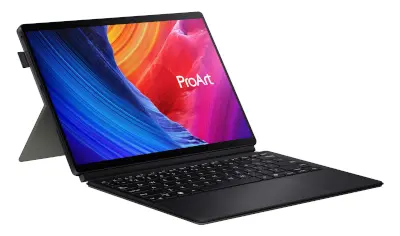
Asus ProArt PZ13 Photo: large-screens.com
Key specifications
- Screen13.3″ OLED, 60 Hz
- Aspect ratio16:10 (1.60)wide: good for videos and split screen
- Resolution2880 × 1800 pixelsvery sharp (255 ppi)
- Brightness361 nits measuredfine indoors, too dim outdoors in summer
- Screen area513 cm² · 85 % of a Letter sheet
- SystemWindows 11 Home or Pro (Arm)
- ProcessorQualcomm Snapdragon X Plus X1P-42-100
- Weight850 g (1.87 lb)
- Penoptional
- Keyboardincluded
- Statusprevious generation
I am registered with the Amazon Associates Program. This website contains Amazon affiliate links (marked with a star). If you click on one of these links and make a purchase, I may receive a commission from Amazon.
Clicking on an affiliate link does not change the price you pay. As an Amazon Associate I earn from qualifying purchases.
 I am a classical musician (violist) with 20 years of professional experience in orchestra and chamber music. For many years, I have been advising colleagues, students, and fellow musicians in the choice of their tablet.
Along with the many positives of using tablets, I’ve also seen the negatives: tablets crashing just before going on stage, batteries that don’t hold up during long rehearsal days, and missing page turner pedals in concert.
Asus ProArt PZ13: strengths and weaknesses
Verdict: keyboard included, a good Surface Pro rival
The Asus ProArt PZ13 is a 13.3-inch Windows 11 tablet for photographers and designers, launched in September 2024. Its keyboard and stand cover come in the box. Tom’s Guide (4/5) and XDA (8/10) found it a better buy than Microsoft’s Surface Pro 11 in the US; Spanish reviewers found it expensive for its chip.
Screen: color-accurate OLED, but 60 Hz and reflective
The screen is about 2 % smaller than that of the 13-inch iPad Pro, in 16:10, a wide format made for videos. The 3K OLED panel (2880 × 1800, 255 ppi) is sharp and very color-accurate (Tom’s Guide measured a Delta E of 0.2). It runs at only 60 Hz, and brightness is moderate: Tom’s Guide measured 361 nits, Profesional Review 393 nits. Despite an anti-glare coating, reviewers found the glass glossy and reflective.
Speed: fine for office work, weak for video editing
The chip is the slowest Snapdragon X Plus (8 cores), with 16 GB of RAM and a 1 TB SSD. Everyday work feels fast, but XDA found multi-core performance weak, and Geeknetic found the graphics too slow for video editing. On Windows on Arm, most common apps work, natively or in emulation, but some do not, such as DaVinci Resolve Studio (Geeknetic). Windows updates come from Microsoft.
Battery: 15 to 18 hours of video; pen included in Europe
The backlit keyboard attaches magnetically and types well; the stand cover works in landscape only. The Asus Pen 2.0 is included in Europe but sold separately in the US. Battery life is long: Tom’s Guide measured 15 hours 5 minutes, Muy Computer 18 hours 40 minutes of video. It weighs 850 g, about 1.5 kg with keyboard and cover; Pocket-lint found it thick and heavy as a tablet. It is IP52 dust- and splash-resistant. Ports: two USB4 (40 Gbps, display output, charging), a full-size SD Express card reader, but no headphone jack (Asus).
Keyboard included at launch; replaced by the PZ14
At launch, the keyboard was included in the price, and in Europe the pen too (ComputerBase). In 2026, Asus replaced it with the 14-inch ProArt PZ14, with a 144 Hz screen.
Pros
- Color-accurate 3K OLED screen (Delta E 0.2 measured)
- Long battery life (15 h measured, 18 h of video)
- Keyboard and stand cover included (pen too in Europe)
- Full-size SD Express card reader and two USB4 ports
- Rugged: IP52 and MIL-STD 810H
- Good value for an OLED tablet with a keyboard
Cons
- Only 60 Hz
- Moderate brightness (361 nits measured), reflective glass
- Slowest Snapdragon X Plus: weak graphics for video editing
- Windows on Arm: some creative apps do not run
- No headphone jack, only two USB-C ports
- About 1.5 kg with keyboard and stand cover
Performance
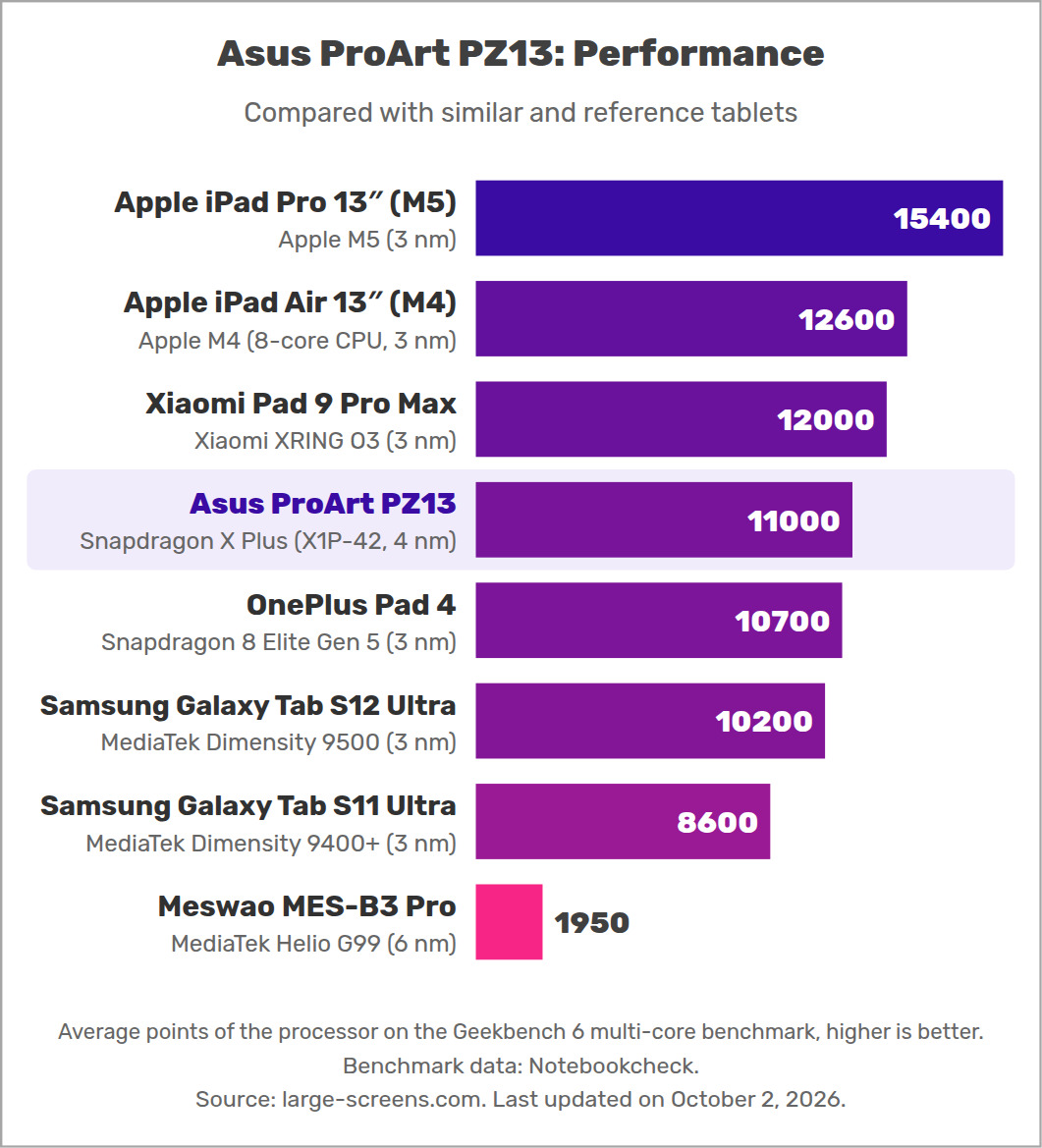
The Asus ProArt PZ13 is powered by the Qualcomm Snapdragon X Plus X1P-42-100 processor, released in 2024 and built on a 4 nm process. It is one of the fastest chips in any tablet: it handles everything, including heavy video editing, 3D work and the most demanding games. Compared with other large tablets:
- The Qualcomm Snapdragon X2 Elite X2E-88-100 in the Asus ProArt PZ14 is about 60 % faster.
- The Qualcomm Snapdragon X2 Plus X2P-64-100 in the Microsoft Surface Pro 13-inch, 12th Edition is about 20 % faster.
- The Asus ProArt PZ13 is about 30 % faster than the Samsung Galaxy Tab S11 Ultra and its MediaTek Dimensity 9400+.
Brightness
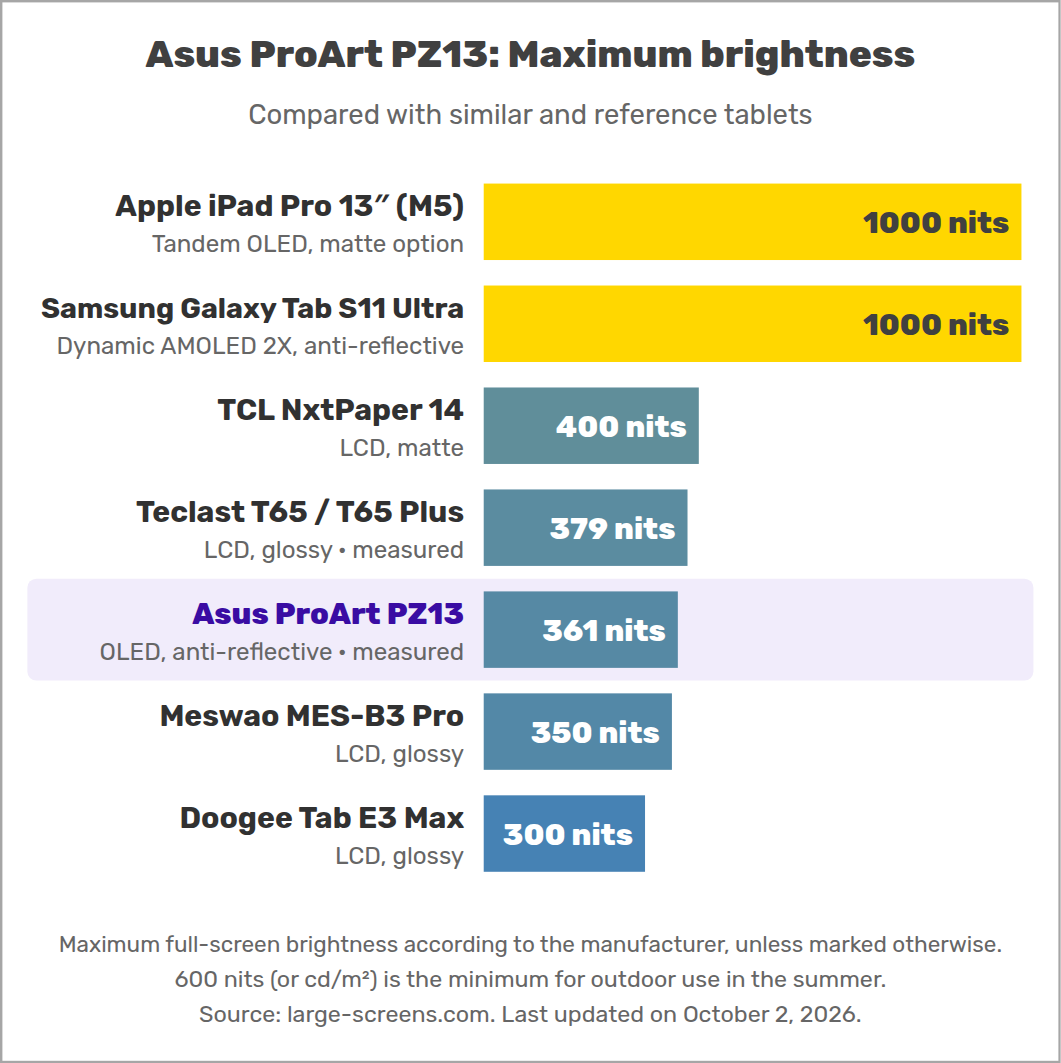
The screen of the Asus ProArt PZ13 reaches 361 nits measured by Tom's Guide, which is enough indoors, but not for outdoor use in the summer (600 nits is the minimum).
Size compared with the iPad Pro and a sheet of paper

- Asus ProArt PZ13
11.3 × 7.0 in - iPad Pro 13″
10.4 × 7.8 in - Letter sheet
11.0 × 8.5 in
The Asus ProArt PZ13 drawn to scale with the 13-inch iPad Pro and a Letter sheet.
Full specifications
| Display | |
|---|---|
| Screen size | 13.3 inches |
| Screen area | 79.5 in² · 513 cm² · 85 % of a Letter sheet · 98 % of the 13″ iPad Pro |
| Resolution | 2880 × 1800 |
| Pixel density | 255 ppi |
| Aspect ratio | 16:10 (1.60) |
| Panel | OLED |
| Refresh rate | 60 Hz |
| Max brightness (measured) | 361 cd/m² (Tom's Guide) |
| Surface | anti-reflective coating |
| Performance and software | |
| Operating system | Windows 11 Home or Pro (Arm) |
| Processor | Qualcomm Snapdragon X Plus X1P-42-100 |
| Class | upper mid-range |
| RAM | 16 GB |
| Storage | 1 TB (PCIe 4.0 NVMe M.2 SSD) |
| microSD | yes (Full-size SD Express 7.0 card reader [microSD adapter in the box]) |
| Pen and keyboard | |
| Pen | optional — Asus Pen 2.0 (SA203H, MPP 2.0, 4,096 pressure levels) |
| Keyboard | included — Asus ProArt PZ13 detachable keyboard (backlit, 1.4 mm key travel, mechanical touchpad, Copilot key) |
| Built-in kickstand | no |
| Design and battery | |
| Weight (tablet) | 850 g (1.87 lb) |
| Weight with keyboard | 1,515 g (3.34 lb) |
| Thickness | 9 mm |
| Dimensions | 297.5 × 202.9 × 9 mm |
| Battery | 70 Wh |
| Charging | 65 W |
| Battery life | 15.1 h (Tom's Guide battery test (15 h 05 min), Tom's Guide) |
| Ports | 2 × USB4 Type-C (40 Gbps, DisplayPort, power delivery), SD card reader behind a protective side cover |
| Video out (USB-C) | yes |
| Headphone jack | no |
| Speakers | 2 |
| Cameras | 13 MP rear, 5 MP front (1440p) |
| Connectivity | Wi-Fi 7, Bluetooth 5.4, no cellular |
| Colours | Nano Black |
| Price and availability | |
| Launch price (manufacturer) | $1,099 · €1,299.99 (September 2024) |
| Status | previous generation |
| Released | September 2024 |
| Sold in | USA, Europe |
Specifications checked on October 2, 2026. Prices are those set by the manufacturer, at launch or on its own store at the date shown (in Europe including VAT; US prices before sales tax). Shop and Amazon prices differ.
Similar tablets
- Microsoft Surface Pro 13-inch 13.0″ · direct rival
- Asus ProArt PZ14 14.0″ · direct rival
- Dell Latitude 7350 Detachable 13.0″
- Chuwi Hi10 Max 13.0″
- Huawei MatePad Pro Max 13.2″
- Huawei MatePad Pro 13.2 (2025) 13.2″
- Ninkear S13 Neo 13.0″
- Juno Tab 4 13.0″ · announced